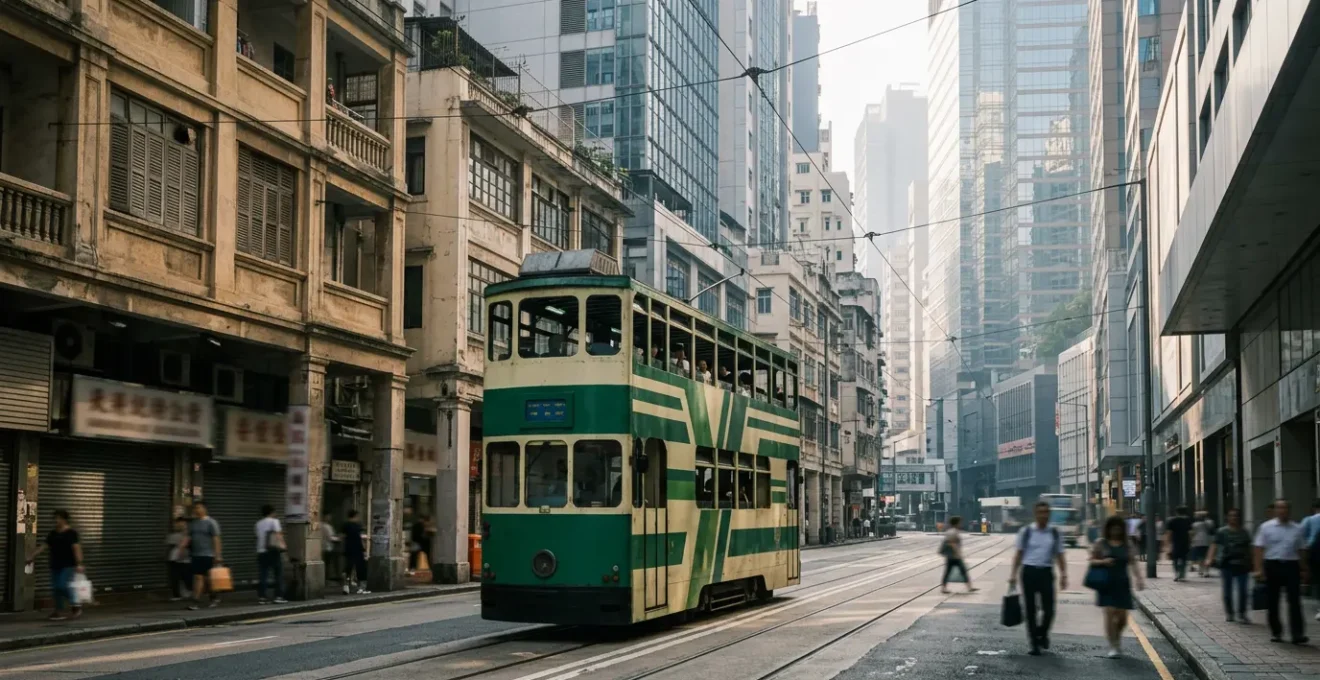
The Hong Kong tram is more than just cheap transport; it’s a strategic tool for an authentic, historical tour if you know its secrets.
- Mastering the « Terminus Strategy » guarantees the best upper-deck seats for unparalleled views.
- Understanding the pay-on-exit system and luggage limitations reveals the tram’s history and operational logic.
Recommendation: Use the eastbound route from Kennedy Town to ride through the historic Sheung Wan district and the Chun Yeung Street market for a complete sensory experience.
The iconic double-clang of the bell—the « ding ding »—is one of the most evocative sounds of Hong Kong. For over a century, these narrow, double-decker trams have been the lifeblood of Hong Kong Island, a rolling, rattling testament to the city’s history. While most tourists see them as a novelty or simply a cheap way to get from A to B, they are missing the point. The real value of the tram isn’t just its astonishingly low fare; it’s a key that unlocks a different kind of travel, one that is slower, more observant, and deeply connected to the city’s pulse.
Many guides will tell you to « get a seat on the top deck » or « buy an Octopus card. » This is basic advice. It treats the tram as a simple utility. But what if the tram itself is the destination? What if its unique quirks—the strange payment system, the specific routes, the way it carves through a bustling market—are not inconveniences but clues to a richer experience? This guide reframes the tram from a mere vehicle into a flowing museum. We will go beyond the platitudes and transform you from a simple passenger into a savvy observer, decoding the tram’s soul to craft an unforgettable city tour for less than the price of a newspaper.
This article will guide you through mastering the tram system. We’ll cover everything from securing the best seats to understanding its unique operational logic, ensuring you can navigate the city like a seasoned local.
Summary: How to Use the Hong Kong Tram for a £0.30 City Tour
- Why Do You Pay When Getting Off the Tram, Not When Getting On?
- How to Snag the Front Seat on the Upper Deck for the Best Views?
- Which Tram Route Covers the Most Historic Buildings in Sheung Wan?
- Why Is It a Bad Idea to Take Large Suitcases on the ‘Ding Ding’?
- Why Are Hong Kong Trams Still Double-Deckers Unlike Elsewhere in Asia?
- How to Spend Less Than £100 per Day During a Hong Kong Layover?
- Upper Deck or Lower Deck: Which Star Ferry Seat Offers the Better Breeze?
- How to Ride the Tram Through the Chun Yeung Street Wet Market?
Why Do You Pay When Getting Off the Tram, Not When Getting On?
The pay-on-exit system is one of the tram’s most distinctive system quirks, born from practicality and historical efficiency. Unlike most public transport systems, you board at the rear of a Hong Kong tram without paying and only settle your flat fare at the front when you disembark. This method was introduced in the 1970s as a cost-cutting measure, streamlining the boarding process and reducing the need for conductors to check tickets at every stop. It allows passengers to board quickly, which is essential on the city’s congested streets.
For the modern traveler, this system is a gift of simplicity. The fare is a flat HK$3.30 for adults, regardless of the distance you travel. You can ride from one end of the island to the other for the same price as a two-stop journey. To pay, you simply move towards the driver’s cabin when you’re ready to get off. You can either tap your Octopus card on the reader or deposit the exact change into the coin box—no change is given, a classic feature of old-school transport systems. This simple, honour-based system is a charming relic that contributes to the tram’s unique character and efficiency.
How to Snag the Front Seat on the Upper Deck for the Best Views?
Securing the coveted front-row seat on the upper deck is the key to unlocking the tram’s potential for « vertical sightseeing. » This vantage point transforms the ride from simple transit into a cinematic experience, offering an unobstructed, panoramic view of the urban canyon. From here, you can watch the intricate urban choreography of pedestrians, traffic, and neon signs unfold below. But getting this prime spot isn’t just about luck; it requires a « Terminus Strategy. »
The secret is to board a tram when it is empty, and the only guaranteed way to do that is by starting your journey at a terminus station. These are the points where a tram line begins or ends its route, so carriages are often cleared of passengers and waiting for new ones. Instead of hopping on at a busy mid-route stop in Central or Causeway Bay, make your way to one of these strategic starting points.
Once you board an empty tram at a terminus, head directly up the steep, narrow wooden staircase. The front-row seats will be yours for the taking. From there, the entire journey becomes your personal viewing gallery. The best terminus points to start your journey include:
- Kennedy Town Terminus: As the westernmost point, it’s the perfect start for eastbound journeys towards all major destinations.
- Shau Kei Wan Terminus: The easternmost terminus, ideal for westbound journeys back through the heart of the city.
- Happy Valley Terminus: A great starting point for rides through the bustling shopping district of Causeway Bay and the vibrant nightlife area of Wan Chai.
- North Point Terminus: Board here for westbound trams that will take you through the famous market street and into the central business district.
Which Tram Route Covers the Most Historic Buildings in Sheung Wan?
For a journey back in time, any eastbound tram route passing through Sheung Wan offers a front-row seat to Hong Kong’s rich history. This district, one of the city’s oldest, is a living museum of colonial architecture and traditional Chinese commerce. The tram tracks here are part of the official Central and Western Heritage Trail, which was designed by the Antiquities and Monuments Office to highlight 35 historic sites. As your tram sways through Des Voeux Road Central and Morrison Street, you are literally riding through history.
The star of the show is the Western Market, an elegant Edwardian-style building from 1906. Its red-brick facade and granite arches stand in stark contrast to the modern skyscrapers nearby. A little further along, the tram glides past the famous « dried seafood streets, » where traditional shops sell everything from ginseng to bird’s nest, their fragrant aromas wafting up to the tram’s open windows. This is not a curated tourist experience; it is the real, functioning heart of old Hong Kong. The tram provides the perfect elevated platform to observe this fascinating trade without intrusion.
Your Action Plan for Crafting a Custom Tram Tour
- Points of contact: List all the terminus and major interchange stops (e.g., Kennedy Town, Western Market, North Point).
- Collecte: Inventory the key sights you want to see along the main route (e.g., Western Market, Chun Yeung Street, Causeway Bay shopping).
- Cohérence: Match your list of sights to the tram route map. Does one continuous eastbound or westbound journey cover most of them?
- Mémorabilité/émotion: Identify the most unique experiences (riding through a market vs. seeing skyscrapers). Prioritize these for your hop-on/hop-off stops.
- Plan d’intégration: Create a simple itinerary: Start at a terminus, ride through a few zones, hop off to explore on foot, then hop back on to continue.
Why Is It a Bad Idea to Take Large Suitcases on the ‘Ding Ding’?
Attempting to bring large luggage onto a Hong Kong tram is not just inconvenient; it’s physically impossible and goes against the unwritten rules of this unique transport system. The tram’s design is a product of its time, prioritizing passenger capacity over baggage space. There are several formidable physical barriers that make it a non-starter for travelers with anything more than a small backpack. The most immediate obstacle is the narrow rotating turnstile at the rear entrance, specifically installed to manage passenger flow and prevent fare evasion. A standard suitcase simply will not fit through it.
Even if you could get your bag past the entrance, there is nowhere to put it. The tram has a complete absence of luggage racks. The lower deck is designed for standing passengers and quick turnover, while the upper deck is accessible only via a steep, winding staircase with tight turns, making it impossible to haul a suitcase up. During peak hours, when a single tram can carry up to 115 people, a large bag would cause a serious obstruction and safety hazard for daily commuters. The tram is part of the city’s functional fabric, not a dedicated airport shuttle.
Case Study: Smart Airport-to-Hotel Transport
For travelers with luggage heading to a hotel along the tram line, there are far better options. A traveler arriving at Hong Kong International Airport can take the Airport Express train directly to Hong Kong Station in just 24 minutes, which offers dedicated luggage storage. From there, a taxi to a hotel in Sheung Wan or Central costs around HK$40 and takes 10 minutes. Alternatively, as detailed by a travel guide on getting around Hong Kong, one can walk from the station to a nearby hotel, saving the tram for luggage-free sightseeing later.
Why Are Hong Kong Trams Still Double-Deckers Unlike Elsewhere in Asia?
The persistence of the double-decker tram in Hong Kong is a fascinating story of geography, history, and engineering creating a « perfect storm » of conditions. While other Asian cities abandoned their tall trams, Hong Kong doubled down, creating the world’s only exclusively double-decker tram fleet. This distinction is so unique that, as officially recognized by Guinness World Records in 2021, Hong Kong Tramways holds the title for the largest double-decker tram fleet in service, with 165 cars.
The primary reason is geographical constraint. The tram line services an extremely narrow and densely populated corridor along the northern shore of Hong Kong Island. With stops averaging only 250 meters apart, moving a huge volume of people efficiently requires building up, not out. A double-decker tram maximizes vertical capacity on a small footprint. This was a solution adopted as early as 1912. Secondly, the route’s topography is perfectly suited for it. The east-west line is almost entirely flat, which is ideal for the stability of tall, narrow vehicles running at a gentle pace of 25-30 km/h. Finally, there’s historical inertia; the system has worked so well for so long that there has never been a compelling reason to change it.
These factors combine to make the double-decker not just a nostalgic icon, but the most logical and efficient engineering solution for its specific environment. It’s a living piece of urban problem-solving.
How to Spend Less Than £100 per Day During a Hong Kong Layover?
A layover in Hong Kong doesn’t have to drain your wallet, especially if you leverage the city’s incredibly efficient and affordable public transport. The tram, in particular, is the budget traveler’s best friend. For the price of a single ride (£0.30), you get a 1.5-hour sightseeing tour that rivals expensive bus tours. The money saved on a single tour bus ticket is enough to fund several delicious local meals.
The key is to combine the tram with other low-cost transport and activities. An Octopus card is your passport to this budget-friendly exploration, allowing you to seamlessly hop between the tram, the MTR, and the iconic Star Ferry. Instead of paying for expensive tourist attractions, you can enjoy free alternatives like walking up the Morning Trail for stunning views of Victoria Peak Garden, or immersing yourself in the atmosphere of the Temple Street Night Market.
This comparative analysis from a dedicated Hong Kong travel site clearly shows the financial advantage of choosing the tram over commercial tours.
| Experience | Cost (Approx.) | Duration | Flexibility | Savings Potential |
|---|---|---|---|---|
| Hong Kong Tram (End-to-End) | £0.30 (HK$3.3) | 1.5 hours | Hop-on/hop-off at 120+ stops | Use £39.70 saved for 5-6 local meals |
| Big Bus Sightseeing Tour | ~£40 (HK$400+) | 1-2 hours (set route) | Fixed route, limited stops | – |
| TramOramic Heritage Tour | £14 (HK$150) + 2-day pass | 1 hour guided + 2 days unlimited | Narrated introduction then explore freely | Best value for first-timers wanting structure |
By following a smart itinerary, you can have a full, exciting day in Hong Kong for a fraction of the typical tourist cost. Consider this sample plan:
- Transport from Airport: Airport Express to Hong Kong Station (£11).
- Local Transport: Purchase an Octopus card (£12.45) for all your rides.
- Main Activity: An end-to-end tram tour from Kennedy Town (£0.30).
- Food: Enjoy lunch at a local cha chaan teng café (£5-7) and a street food dinner (£8-10).
- Iconic Experience: Cross Victoria Harbour on the Star Ferry (£0.40).
Upper Deck or Lower Deck: Which Star Ferry Seat Offers the Better Breeze?
While the tram rules the land, the Star Ferry is the undisputed king of Victoria Harbour, and choosing the right seat is crucial for comfort, especially on a humid day. For the best breeze, the upper deck is unequivocally superior. This isn’t just a matter of opinion; it’s based on the vessel’s design and simple physics. The upper deck features an open-sided construction that allows for natural cross-ventilation, catching the harbour’s prevailing winds from every direction.
Being elevated approximately three meters above the water, the upper deck enjoys an unobstructed airflow that is noticeably cooler and fresher. In contrast, the lower deck is more enclosed and sits much closer to the waterline and the engine compartment. This results in warmer, heavier air with significantly reduced circulation. Furthermore, the proximity to the diesel engines can create a distinct petroleum smell that many find unpleasant. Scientific observation confirms that during a typical summer crossing, the temperature on the upper deck can be 2-3°C cooler than on the lower deck. For the small price difference, the upper deck provides a vastly more pleasant and refreshing 10-minute journey.
Key Takeaways
- The tram’s pay-on-exit system and double-decker design are historical solutions to urban density and cost-efficiency.
- Master the « Terminus Strategy » by boarding at stations like Kennedy Town or Shau Kei Wan to secure the best upper-deck seats.
- The tram is the ultimate tool for a budget layover, offering a full city tour for just £0.30 and freeing up funds for local food and experiences.
How to Ride the Tram Through the Chun Yeung Street Wet Market?
Riding the tram through the Chun Yeung Street wet market in North Point is one of Hong Kong’s most surreal and captivating urban experiences. This is the only place in the city where a public market is set up directly on and around the tram tracks. As the tram approaches, a fascinating piece of urban choreography unfolds: vendors casually pull back their awnings, shoppers step aside, and produce carts are rolled back just enough for the tram to slowly cleave a path through the throng. The driver’s constant « ding-ding » is not an angry warning, but a rhythmic part of the market’s daily soundtrack.
To experience this, board any eastbound tram displaying « North Point » as its destination. For the best view, head to the upper deck, but remember you are a guest in a functioning workplace. Be discreet with your camera and avoid leaning out of the windows. The journey through the market section is a sensory feast—the smells of fresh seafood, tropical fruits, and baked goods from nearby stalls mix in the air. This short 5-minute passage is a powerful reminder of how life in this dense city has adapted to coexist with its historic transport.
For a complete experience, ride through the market once on the tram, then disembark at the North Point Terminus and walk back through Chun Yeung Street on foot. This allows you to appreciate the vibrant energy, colourful produce, and friendly chaos from a different perspective. Weekday mornings between 7 and 10 AM are the most active and authentic times to visit.
Now that you are equipped with the secrets of the « Ding Ding, » your adventure awaits. Step aboard, find your seat, and watch the incredible, living history of Hong Kong glide by your window.