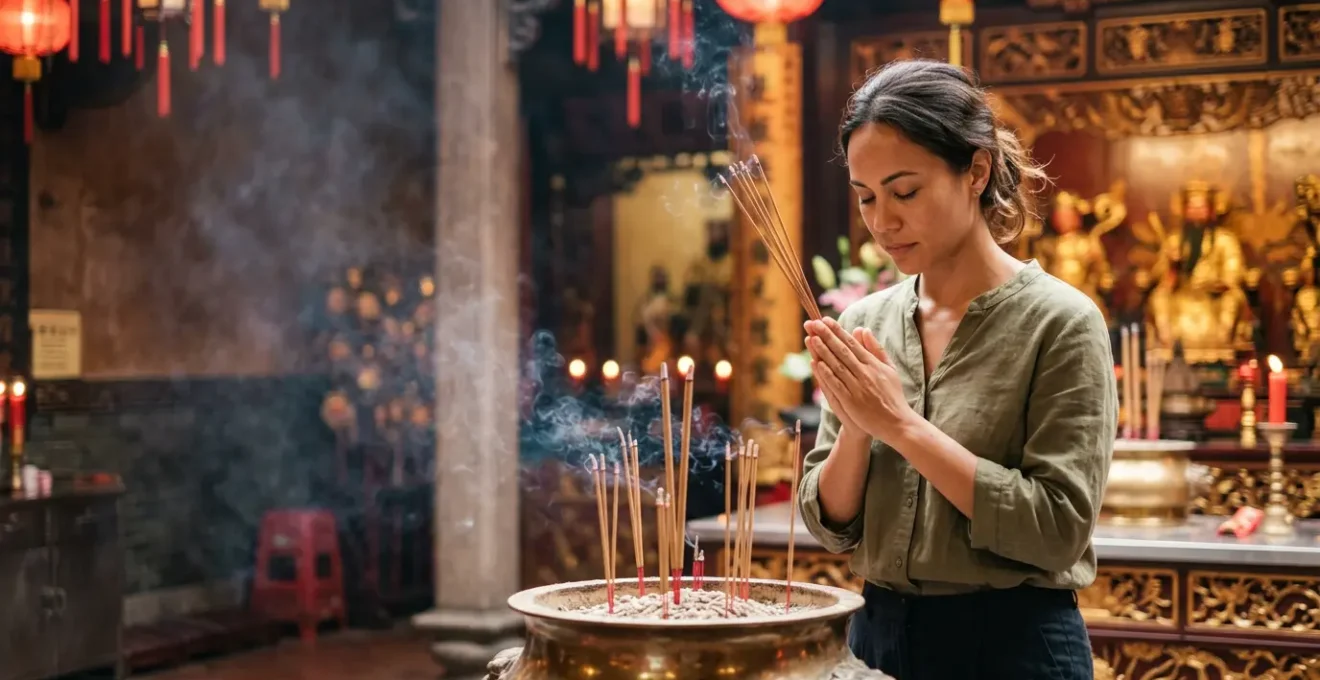
The fear of committing a cultural faux pas in a Hong Kong temple stems from not understanding the ‘why’ behind the rituals, not just a lack of rules.
- Most temples function as either ‘transactional’ spaces for earthly needs (like Man Mo) or ‘transcendental’ places for spiritual cultivation (like monasteries), which dictates the etiquette.
- Respectful behaviour, especially in photography and ritual participation, comes from recognising these sites as active spiritual hubs, not just historical monuments.
Recommendation: Instead of memorising rules, learn to read the temple’s ‘spiritual grammar’—its purpose, atmosphere, and the function of its rituals—to navigate your visit with genuine, informed respect.
The moment you step across the threshold of a Hong Kong temple, the world outside dissolves. Your senses are immediately engaged: the sweet, heavy scent of sandalwood and burning incense, the murmur of hushed prayers, the visual symphony of red and gold, and the almost tangible weight of centuries of devotion. For a respectful visitor from the UK, this experience is a mix of profound awe and a slight, gnawing anxiety. You want to soak it all in, but more importantly, you want to do so without causing offence. The common advice—dress modestly, be quiet—feels woefully inadequate for such a spiritually charged environment.
As a British cultural anthropologist who has spent years living amidst these vibrant traditions in Hong Kong, I can assure you the key to a truly respectful visit isn’t found in a simple checklist of do’s and don’ts. The fear of a faux pas often comes from viewing these spaces as museums, where the rules are about preservation. But these temples are living, breathing entities. True respect lies not in timidly avoiding interaction, but in understanding the underlying ‘spiritual grammar’ of the space. It’s about learning to read the language of the rituals, the architecture, and the worshippers themselves.
This guide moves beyond the superficial. We won’t just tell you *what* to do; we will explain *why* it’s done. By understanding the purpose behind a gesture, you transform a potentially awkward tourist action into a meaningful act of cultural appreciation. We will explore the different functions of temples, decode the technology of ritual, and learn the subtle art of the respectful gaze. By the end, you will not only know how to avoid offence, but how to engage with these sacred spaces in a way that enriches your own experience and honours the living heritage they represent.
This article provides a comprehensive look into the spiritual and cultural nuances that govern behaviour inside Hong Kong’s most sacred spaces. To help you navigate these concepts, the following summary outlines the key areas we will explore.
Summary: Decoding the Spiritual Grammar of Hong Kong’s Temples
- Why Do Students Flock to Man Mo Temple Before Exams?
- Why Should You Touch the Golden Pens for Academic Success?
- What Is the Difference Between a Man Mo Temple and a Pure Land Monastery?
- Why Should You Never Photograph the Deities Directly in Some Temples?
- How to Use Fortune Sticks Correctly to Ask a Question About Your Future?
- Why Do Incense Coils Hang From the Ceiling for Weeks at a Time?
- Why Is Sandalwood Incense Used Specifically for Ancestral Worship?
- When Is the Best Time to Visit Tin Hau Temples to See the Lion Dances?
Why Do Students Flock to Man Mo Temple Before Exams?
Walking into Man Mo Temple, especially in the months leading up to major academic exams, you’ll notice a distinct demographic: students, often accompanied by anxious parents. This phenomenon is not coincidental; it’s a prime example of a temple’s specialized, transactional function. The temple is dedicated to two primary deities: Man Cheong, the God of Literature, and Mo Tai (or Kwan Tai), the God of War. For centuries, Man Cheong has been the patron deity of scholars, civil servants, and anyone seeking success in literary or bureaucratic pursuits.
Students and their families come here to pray for good grades, a clear mind during examinations, and a favourable path into a good university. They are engaging in a direct spiritual transaction: offerings and devotion in exchange for a divine blessing on their academic efforts. This practice is deeply embedded in the local culture, blending folk religion, Taoism, and a pragmatic approach to life’s challenges. As one local observer noted on a popular travel forum, this belief is a powerful and living tradition.
People here believe that Man Cheung is responsible for those learning, and examination and other literature issues. Every year, before the school term or examination, many parents will bring their kids to Man Mo Temple.
– Local Hong Kong Forum Contributor, TripAdvisor Hong Kong Temple Etiquette Forum
Understanding this context is crucial for a respectful visitor. You are witnessing a moment of deep personal and familial hope, an active ritual aimed at securing a better future in a highly competitive society. Observing this with quiet empathy, rather than as a mere spectacle, is the first step in learning the temple’s spiritual grammar.
Why Should You Touch the Golden Pens for Academic Success?
Following the prayers to Man Cheong, you may see worshippers, particularly students, making their way to a specific altar to perform another important ritual: touching the ‘golden pens’. These large, golden-coloured calligraphy brushes are not merely decorative. They are a form of ritual technology, a physical conduit for the blessings of the God of Literature. The act of touching the pen is a symbolic and tangible way of receiving Man Cheong’s wisdom, clarity, and literary prowess.
This gesture is a perfect illustration of how abstract faith is translated into concrete action within a transactional temple. The prayer is the request, but the physical touch seals the deal, making the blessing feel more direct and personal. For a student facing a daunting exam, this act provides not only spiritual hope but also a psychological boost. They walk away feeling they have actively done something to absorb the deity’s scholarly energy.
As a visitor, if you see these pens, understand that they are a key part of the spiritual toolkit offered by the temple. It is generally acceptable for anyone to touch them, and doing so respectfully can be seen as an appreciation of the local culture. However, always be mindful of worshippers who are there for a specific, urgent purpose. Allowing a student about to take their public exams priority is an act of unspoken, but deeply appreciated, respect.
What Is the Difference Between a Man Mo Temple and a Pure Land Monastery?
A common mistake for first-time visitors is to assume all temples are alike. In Hong Kong, this couldn’t be further from the truth. The key to understanding etiquette is first identifying the temple’s purpose. Broadly, they fall into two categories: the earthly, ‘transactional’ Taoist or folk temples like Man Mo, and the otherworldly, ‘transcendental’ Buddhist monasteries, such as the Chi Lin Nunnery or Po Lin Monastery.
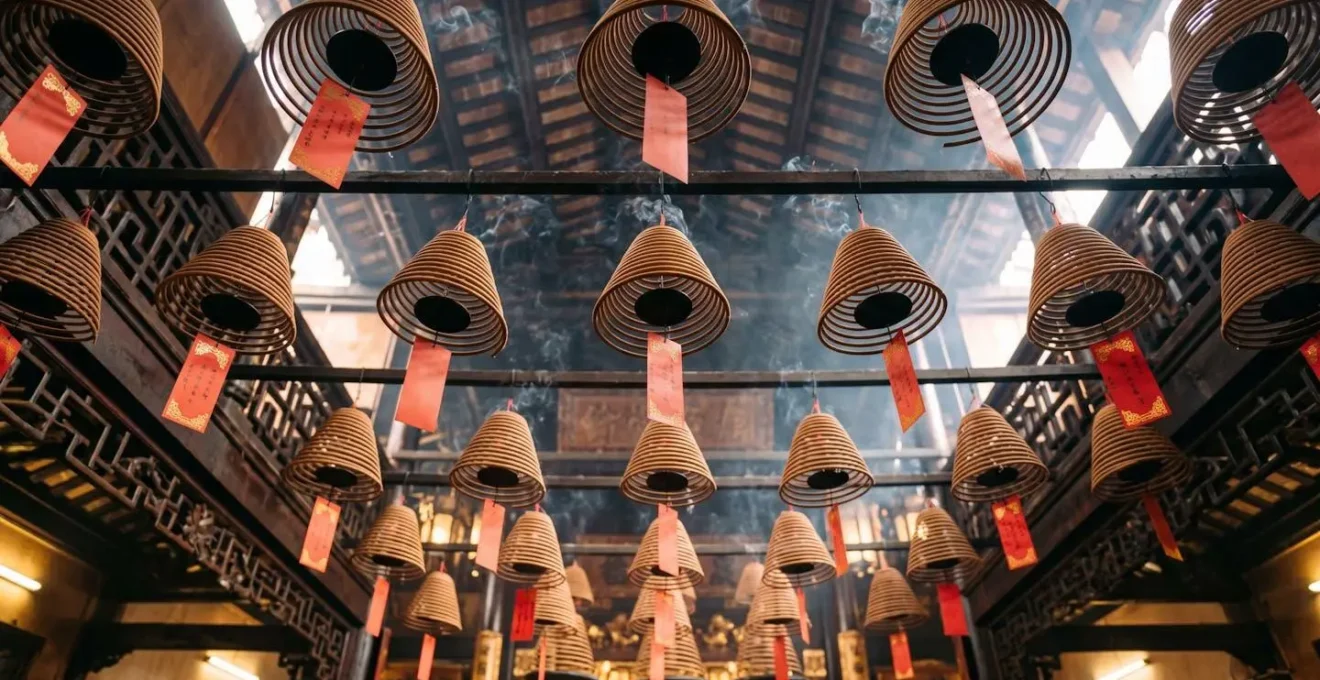
Man Mo Temple is a bustling, smoky, and vibrant space. It’s a spiritual marketplace where people come to solve earthly problems: seeking justice, success in business, or good exam results. The air is thick with the smoke from giant incense coils, each representing a long-term prayer from a hopeful devotee. The atmosphere is pragmatic and goal-oriented. This is a place of action.
In stark contrast, a Pure Land Buddhist monastery is a haven of serenity. Its purpose is not to solve immediate worldly problems but to facilitate the spiritual cultivation of the self, aiming for enlightenment and release from the cycle of rebirth. The architecture is often minimalist, the gardens are for contemplation, and the atmosphere is quiet and serene. Here, the focus is internal. As a visitor, your role is to merge with this tranquillity, not to disrupt it.
These fundamental differences in function dictate very different codes of conduct. The vibrant energy of Man Mo allows for more activity, while the quietude of a monastery demands stillness and introspection. This comparative table, drawing on information from official tourism resources like the one provided by Discover Hong Kong, breaks down the core distinctions.
| Characteristic | Man Mo Temple (Taoist/Folk) | Pure Land Monastery (Buddhist) |
|---|---|---|
| Primary Function | Transactional space for earthly concerns (justice, success, wealth, exams) | Transcendental space for spiritual cultivation and enlightenment |
| Religious Foundation | Taoism and Chinese folk religion | Buddhism (Pure Land tradition) |
| Atmosphere | Vibrant, smoky, often noisy with worshippers and fortune-telling activity | Serene, quiet, minimalist aesthetic emphasizing contemplation |
| Deities Worshipped | Man Cheong (God of Literature) and Mo Tai/Kwan Tai (God of War); syncretic pantheon of historical figures | Buddhas and Bodhisattvas (Sakyamuni, Guanyin) for universal compassion |
| Architecture | Red pillars, golden decorations, hanging incense coils, ornate carvings | Tang dynasty wooden architecture, often without nails, minimalist gardens |
| Typical Visitors | Students before exams, business people seeking success, those needing practical guidance | Those seeking meditation practice, spiritual peace, Buddhist teachings |
Why Should You Never Photograph the Deities Directly in Some Temples?
In our visually-driven culture, the first impulse when faced with the stunning artistry of a temple’s main altar is to raise a camera. While many temples are tolerant, the most respectful approach—and a strict rule in many Buddhist monasteries—is to refrain from photographing the main deity statues directly. This rule isn’t about copyright; it’s rooted in deep-seated spiritual beliefs. The primary reason is one of respect: the statues are not considered mere art objects but are consecrated vessels housing the spirit or energy of the deity. To photograph them is akin to pointing a camera at someone in deep prayer or meditation—it is intrusive and objectifying.
There’s also a belief that photography can ‘capture’ or diminish the spiritual energy of the effigy. The focus should be on personal, internal connection with the deity, not on creating an external replica. This is a core tenet of the ‘transcendental’ space, where the goal is introspection, not documentation. As writer Donny Kimball notes in his exploration of the topic, there’s a historical basis for keeping these images sacred and localized.
In days of yore, pilgrims would travel far and wide to kneel before these Buddhist effigies. As such, temples tried to keep their likeness from being reproduced.
– Donny Kimball, Why Buddhist Temples Forbid Photography
Instead of seeking to capture the image, practice the art of the respectful gaze. Observe the details, the posture, the offerings at the deity’s feet. Let the image imprint on your memory rather than your memory card. Feel the atmosphere of the space. You can often photograph the general architecture, the incense burners in the courtyard, or the decorative roof details. By focusing your lens away from the deities and worshippers, you demonstrate a profound understanding of the temple’s sacred function.
How to Use Fortune Sticks Correctly to Ask a Question About Your Future?
One of the most fascinating rituals you can participate in is the *kau cim* (求籤), or the asking for a fortune stick. This is not a game, but a serious form of spiritual consultation, another powerful ‘ritual technology’ for seeking guidance. To do it correctly and respectfully, you must approach it with sincerity. The process involves a combination of focus, humility, and physical action. It is a powerful example of how deeply these practices are woven into the fabric of society, from personal troubles to matters of state.
Case Study: The Hong Kong Government’s Annual Kau Chim Tradition
To understand the cultural weight of this ritual, look no further than the government itself. Every year on the second day of the Lunar New Year, a designated Hong Kong Government official travels to Che Kung Temple. They perform the *kau chim* divination ritual on behalf of the entire city, drawing a single stick that is believed to foretell Hong Kong’s fortune for the year ahead. As confirmed by the public record of this annual government kau chim tradition, the poetic message on the stick is then interpreted by a feng shui master, an event closely watched by the media and the public. This demonstrates that *kau cim* is not mere superstition, but a respected institution.
For your own consultation, follow the established process to ensure you are showing the proper respect for this tradition. The sincerity of your approach is believed to directly impact the accuracy of the guidance you receive.
Action Plan: Performing the Kau Chim Ritual
- Purify and Focus: Before you begin, wash your hands if possible. Kneel on one of the provided cushions before the main altar. Close your eyes and clear your mind of all thoughts except your one, specific question.
- Formulate Your Question: The key to a good reading is a good question. It must be a single, clear question about one area of your life (e.g., « What will my career prospects be this year? » not « Should I change careers and also will I find love? »). State your name, date of birth, and your question silently to the deity.
- Shake the Canister: Hold the canister of bamboo fortune sticks between your palms and tilt it at a roughly 45-degree angle. Gently shake it with a steady, rhythmic motion until a single stick works its way out and falls to the ground. If multiple sticks fall out, they are considered invalid and you must start again.
- Confirm with Moon Blocks: Pick up the stick and note its number. To confirm the deity has answered, you must use the *jiaobei* or ‘moon blocks’—two crescent-shaped wooden blocks. Hold them and ask if this stick is your answer, then drop them. A « yes » is indicated by one flat side and one rounded side facing up. If you get two flat sides (no) or two rounded sides (the deity is laughing/unclear), you must redraw a stick.
- Receive Your Fortune: Once confirmed, take your stick to the temple’s interpretation counter. Give the attendant your stick’s number, and they will give you a corresponding slip of paper with your fortune, which they can help you interpret for a small fee.
Why Do Incense Coils Hang From the Ceiling for Weeks at a Time?
The vast, spiralling cones of incense hanging from the ceilings of temples like Man Mo are one of Hong Kong’s most iconic spiritual images. These are not standard incense sticks for a quick prayer; they are giant coils designed to burn slowly, sometimes for several weeks. Their purpose is rooted in the desire for a long-lasting and persistent prayer. A standard stick of incense represents a fleeting thought or request, but these massive coils symbolize a continuous petition to the gods.
Worshippers purchase these coils to petition for significant, long-term goals: the health of a family member, the success of a new business, or the academic achievement of a child. The constant, fragrant smoke that spirals upwards from the coil is believed to carry this persistent prayer up to the heavens, keeping the request at the forefront of the deity’s attention. It’s a beautiful and powerful physical metaphor for endurance in faith.
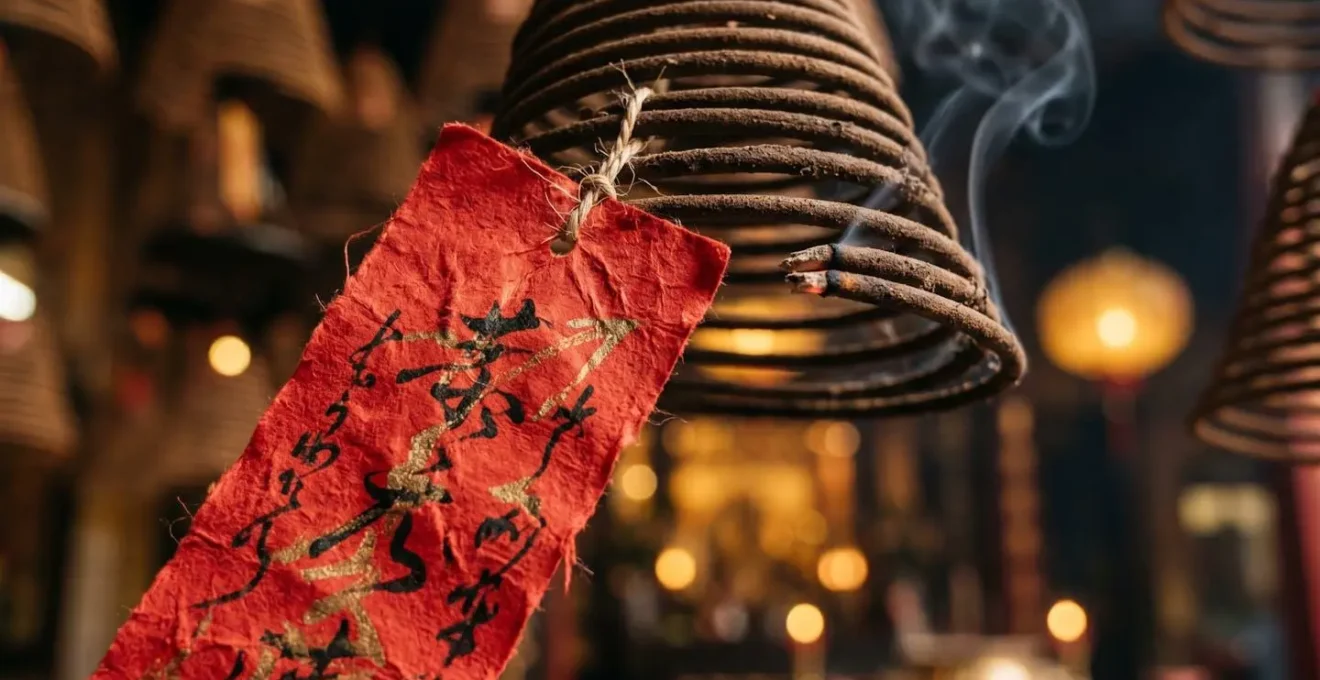
Attached to the bottom of many of these coils, you will see a small, red paper tag. This is not just a decoration. This tag contains the name of the petitioner and the specific wish they are making. It personalizes the prayer, ensuring the gods know who is asking for what. For a visitor, understanding this transforms the smoky, hazy atmosphere from a mere aesthetic into a deeply moving collective experience. You are literally walking through the accumulated hopes, dreams, and persistent prayers of hundreds of individuals.
Why Is Sandalwood Incense Used Specifically for Ancestral Worship?
While you will encounter many types of incense, you may notice that for particularly important rituals, especially those involving ancestral worship, sandalwood is often the preferred choice. This is not arbitrary; it’s based on a cultural hierarchy of scents and materials. In Chinese culture, sandalwood holds a special place. Its fragrance is considered purer, more refined, and more spiritually potent than that of common incense. It is also significantly more expensive, making it a more valuable and respectful offering.
When honouring ancestors, the goal is to show the utmost respect and filial piety. Offering a lower-quality incense would be seen as neglectful or disrespectful. Using sandalwood is a way of offering the very best to the spirits of the departed, ensuring they are appeased and continue to watch over the family from the afterlife. The fragrant smoke is believed to nourish the spirits and serves as a communication channel, carrying the prayers and respects of the living to the realm of the ancestors.
Furthermore, the scent of sandalwood has a calming and meditative effect, helping to create a sacred and solemn atmosphere appropriate for communing with family predecessors. When you smell that distinctive, sweet, and woody aroma in a temple, particularly near the ancestral tablets, you are smelling a scent chosen specifically for its ability to bridge the worlds of the living and the dead with the highest form of olfactory respect.
Key Takeaways
- Distinguish ‘Transactional’ temples (for earthly needs) from ‘Transcendental’ ones (for spiritual peace) to understand the expected atmosphere and etiquette.
- Photography rules are not about restriction but about spiritual respect; avoid photographing deities and worshippers to honour the temple as a living sacred space, not a museum.
- Rituals like using fortune sticks are a serious form of spiritual consultation; approaching them with sincerity and following the correct steps is a sign of profound respect.
When Is the Best Time to Visit Tin Hau Temples to See the Lion Dances?
While Man Mo temple serves the scholars, Hong Kong’s identity as a port city is embodied in its devotion to Tin Hau, the Goddess of the Sea. As the patron deity of fishermen and anyone whose life is tied to the water, her temples are found all across the territory, often facing the sea. While these temples are active year-round, to witness them at their most vibrant, you must time your visit to coincide with the Tin Hau Festival.
The festival takes place on the 23rd day of the third lunar month, which typically falls in April or May. This is, without question, the best time to see the electrifying lion dances and cultural processions. During this period, communities come alive to honour their protector. The festivities often include colourful parades where fishing boats, adorned with flags and banners, sail in procession, and energetic lion and dragon dance troupes perform to the deafening beat of drums and gongs to scare away evil spirits and bring good fortune.
Visiting a Tin Hau temple, such as the famous one in Joss House Bay, during her festival is to see Hong Kong’s living heritage in its most spectacular form. It is loud, crowded, and chaotic, but it is a joyous chaos. As a respectful visitor, your role here is to embrace the energy. Make way for the performers, enjoy the spectacle, and appreciate that you are witnessing a tradition that has protected and guided the people of this coastal metropolis for centuries. It’s a powerful reminder that the spiritual grammar of Hong Kong is not just written in quiet contemplation, but also in explosive, communal celebration.
Now that you can read the spiritual grammar of these sacred spaces, your visit can transform from a sightseeing trip into a genuine cultural immersion. You have the tools not just to avoid offence, but to actively participate with understanding and appreciation, creating a far more memorable and meaningful experience.