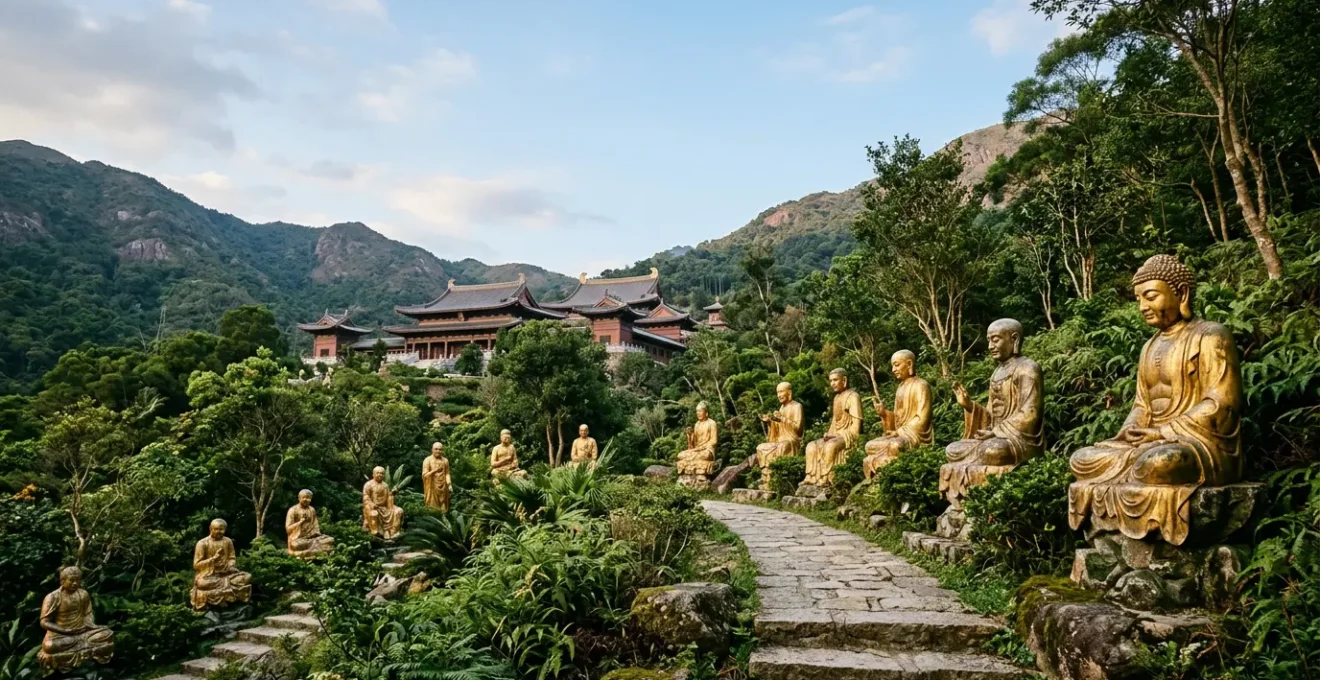
The most profound experiences with Hong Kong’s religious statues are found not in the shadow of the biggest, but in understanding the stories of the many.
- The Ten Thousand Buddhas Monastery is a unique, layman-built complex, not a traditional monastery, offering a glimpse into a different kind of devotion.
- The visual differences between temples (gold leaf vs. bronze, cluttered vs. serene) reveal deep philosophical distinctions between Taoist and Buddhist practices.
Recommendation: Approach your visit not as a tourist ticking a box, but as a conscious pilgrim, and you will uncover a layer of Hong Kong that most visitors miss.
So you’ve seen the photos, perhaps you’ve even made the pilgrimage: the majestic Tian Tan Buddha on Lantau Island, serene and monumental, drawing thousands of visitors daily. It’s an icon, a must-see on countless itineraries. But for the repeat visitor, or the traveller seeking a more intimate connection with Hong Kong’s spiritual landscape, the very popularity of the « Big Buddha » can be its drawback. The crowds, the queues, the commercialised village at its base—it can all dilute the sense of peace one hopes to find.
Most guides will point you to the next famous spot, treating it as just another photo opportunity. They’ll tell you what to see, but not how to see it. They might mention the golden statues or the winding steps, but rarely delve into the rich tapestry of belief, history, and symbolism woven into these sites. The common advice is to simply show up, but this approach misses the profound cultural context that makes these places truly special.
But what if the key to a deeper experience wasn’t about finding another, smaller version of the Big Buddha, but about understanding why these sites are so different? This guide adopts a different philosophy. We’ll move beyond the checklist to explore the stories behind the statues, the meaning behind the architecture, and the practical strategies to turn a simple outing into a memorable cultural immersion. We will explore the demanding but rewarding climb to the Ten Thousand Buddhas Monastery, decode the symbolism of its golden army, and even learn how to peacefully coexist with its wild simian residents.
This journey is about transforming your perspective. By understanding the distinct purposes of a Taoist temple versus a Buddhist monastery, or the deep meaning embedded in the Wisdom Path’s columns, you’ll gain a richer appreciation for Hong Kong’s diverse spiritual fabric. Let’s explore the sites that offer not just impressive statues, but compelling narratives, far from the beaten path.
Summary: A Deeper Look at Hong Kong’s Spiritual Statues
- Why Is the Ten Thousand Buddhas Monastery Not Actually a Monastery?
- How Fit Do You Need to Be to Climb the Steps to the Ten Thousand Buddhas?
- Why Are the Statues at Ten Thousand Buddhas Painted Gold Unlike Tian Tan?
- How to protect your snacks from wild macaques on the path to the statues?
- Can You Visit the Heritage Museum and the Buddha Statues in One Afternoon?
- What Is the Difference Between a Man Mo Temple and a Pure Land Monastery?
- What Do the Wooden Columns of the Wisdom Path Actually Signify?
- How to Beat the Crowds to the Big Buddha by Arriving Before 10 AM?
Why Is the Ten Thousand Buddhas Monastery Not Actually a Monastery?
The name itself—Ten Thousand Buddhas Monastery—conjures images of robed monks in silent contemplation, chanting in unison within a formal religious institution. However, the first and most crucial thing to understand about this unique Sha Tin landmark is that its name is a fascinating misnomer. In reality, no monks reside here, and it doesn’t operate as a formal monastery. This distinction is the key to unlocking its singular history and character.
The Layman’s Legacy: Reverend Yuet Kai’s Vision
The story of the Ten Thousand Buddhas Monastery is the story of one man’s incredible devotion. It was founded in 1949 not by a monastic order, but by a layman, Reverend Yuet Kai. He and his followers painstakingly constructed the entire complex by hand, a monumental effort that spanned eight years. This origin is precisely why it isn’t a true monastery; it was built by the people, for the people, and has been maintained by laypeople ever since. After Yuet Kai’s death in 1965, his body was preserved through embalming, covered in gold leaf, and is now displayed in the main hall—a testament to his central role. The site’s governance passed to his family, cementing a lay-led, family-maintained model rather than a traditional ordained community. It’s a place of worship born from grassroots passion, not institutional structure, and contains nearly 13,000 statues in total, far exceeding its name.
Understanding this distinction changes your entire visit. You are not stepping into an ancient, formal religious bastion, but rather a sprawling, eccentric, and deeply personal monument to Buddhist faith. It feels more like a sacred art installation winding up a hillside, a project of passion whose quirky and individualistic nature is its greatest charm. Every golden statue feels less like a distant deity and more like a character in one man’s epic story of devotion.
How Fit Do You Need to Be to Climb the Steps to the Ten Thousand Buddhas?
Let’s be direct: the path to the Ten Thousand Buddhas Monastery is not a gentle stroll. It’s a proper workout, a vertical pilgrimage that demands a moderate level of fitness. The main challenge isn’t distance, but the relentless, steep ascent of over 400 steps on a concrete path. You will feel the burn in your calves, and in Hong Kong’s notorious humidity, you will sweat. However, the journey is designed to be as much a part of the experience as the destination.
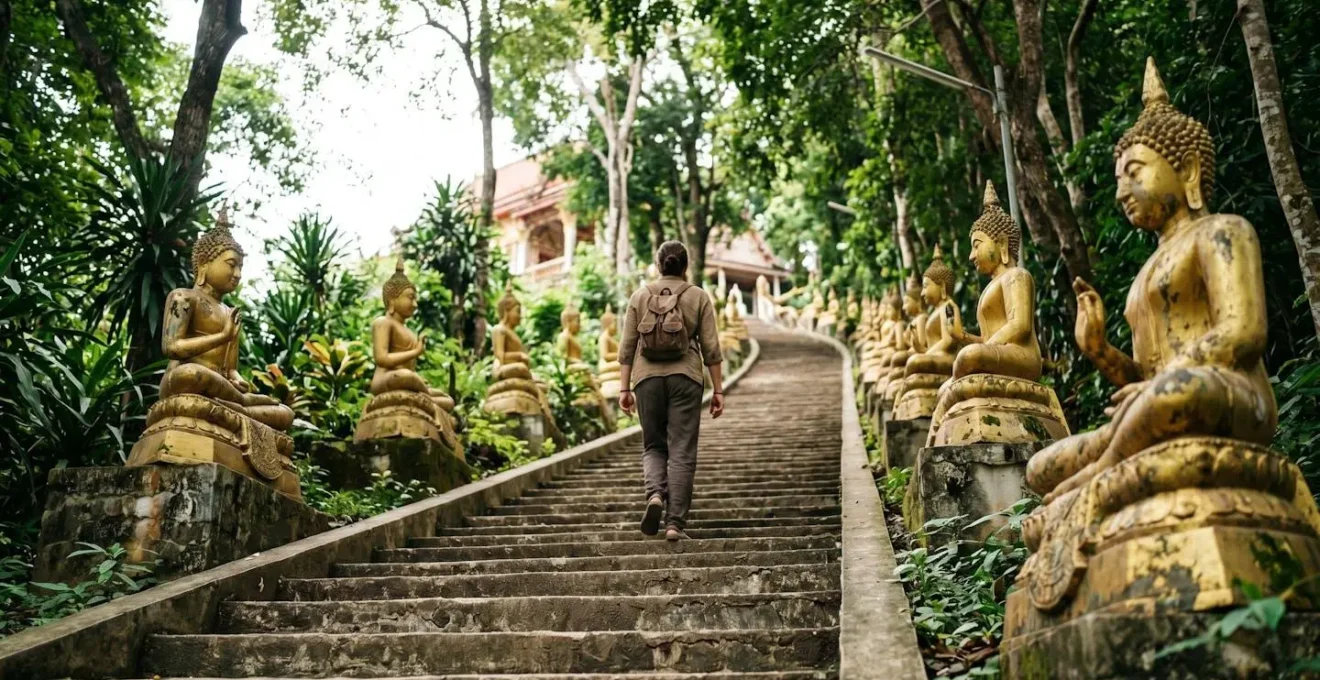
As you can see, the path is flanked by hundreds of life-sized, golden arhats (Buddhist saints), each with a unique expression and pose. They are not just decoration; they are your companions on the climb, turning the physical exertion into a meditative and visually stunning experience. They serve as perfect, guilt-free excuses to pause, catch your breath, and admire the craftsmanship. The climb is a physical test, but it rewards you every step of the way.
Action Plan: Preparing for the Climb
- Assess Baseline Fitness: Can you comfortably walk up 25 flights of stairs or maintain a brisk 30-minute walk? If so, you are ready. The main path involves approximately 430 steps on a steep incline.
- Pace for the Initial Ascent: The first section is the most intense. Use the golden statues as natural rest points to manage your energy and take in the details. Don’t rush.
- Recognize the Mid-Point: You’ll reach a mid-level plaza. Many mistake this for the end, but it’s a planned resting area. Take a moment here before continuing the final, less intense push to the main terrace.
- Explore the Summit: The main terrace is just the beginning. The climb to the upper levels and the iconic pagoda is less strenuous but adds to the total effort.
- Pack Smart for Humidity: Water is non-negotiable. Given Hong Kong’s climate, a small towel or a personal fan is also highly recommended, especially if you’re visiting during the sweltering summer months.
Why Are the Statues at Ten Thousand Buddhas Painted Gold Unlike Tian Tan?
One of the most striking visual contrasts for any visitor is the material and finish of the statues. The Tian Tan Buddha on Lantau is a colossal figure of solemn bronze. In contrast, the path to the Ten Thousand Buddhas Monastery is a riot of shimmering, brilliant gold. This is not an arbitrary aesthetic choice; it reflects profound differences in symbolism, purpose, and artistic tradition within Buddhism.
The Tian Tan Buddha’s use of bronze speaks to permanence, gravitas, and monumental importance. It was built to endure for centuries, a stoic and unadorned representation of the historical Buddha. As noted by its creators, the Tian Tan Buddha stands at 34 metres tall, a scale designed to inspire awe through sheer size and sober presence. The choice of bronze, a material of antiquity and strength, reinforces its role as a timeless, unshakable icon.
The 34 m tall image weighs over 250 metric tons, and was constructed from 202 bronze pieces.
– Wikipedia contributors, The Big Buddha (Hong Kong) – Wikipedia
The golden statues at the Ten Thousand Buddhas Monastery, on the other hand, tap into a different stream of symbolism. In Buddhism, gold represents purity, enlightenment, and the celestial. A golden hue signifies a being that has achieved a higher state of existence, reflecting the « light » of wisdom. By painting the hundreds of arhats in gold, the creators are not just making them eye-catching; they are visually stating that these figures have attained enlightenment. This creates an immersive experience where the pilgrim walks among a heavenly host, a far more vibrant and personal vision of the Buddhist pantheon compared to the singular, monumental focus of the Tian Tan Buddha.
How to protect your snacks from wild macaques on the path to the statues?
The path to the Ten Thousand Buddhas Monastery offers more than just spiritual encounters; you are almost guaranteed a meeting with its other famous residents: wild rhesus macaques. While fascinating to observe, these monkeys are intelligent, opportunistic, and have learned to associate humans with food. Protecting your snacks is not just about keeping your lunch; it’s about responsible wildlife interaction. Hong Kong is home to a total population of about 2,000 to 2,100 monkeys, and this area is a well-known habitat.
The key is prevention and understanding their behaviour. The crinkling sound of a plastic bag is like a dinner bell to them. Flaunting a water bottle or eating openly on the main path is an open invitation. The official advice is not just « don’t feed them »—it’s to make yourself as uninteresting as possible from a food perspective. This requires a proactive strategy before you even start your climb.
Remember, these are wild animals. Do not make eye contact, which they can interpret as a threat, and never show your teeth by smiling. If a monkey approaches, stay calm, secure any food, and walk away slowly. Most importantly, feeding the monkeys is illegal in Hong Kong and carries heavy penalties, as it disrupts their natural behaviour and creates dependency. Your goal is peaceful coexistence, not confrontation.
- Prevention Strategy 1: Sensory Deprivation. Store all food in an opaque, hard-sided container (like Tupperware) inside your backpack. Monkeys associate the sound and sight of plastic bags and wrappers with food.
- Prevention Strategy 2: Secure Liquids. Keep water bottles inside your bag when not in use.
- Prevention Strategy 3: Designated Eating Zones. Only consume food in designated areas away from the main monkey-trafficked paths.
- If Approached Protocol: Remain calm, avoid eye contact, hide any food, and slowly walk away without sudden movements.
- Legal Reminder: Feeding monkeys is illegal under Hong Kong law, with significant fines and potential jail time.
Can You Visit the Heritage Museum and the Buddha Statues in One Afternoon?
Yes, it is absolutely possible to combine a visit to the excellent Hong Kong Heritage Museum with the Ten Thousand Buddhas Monastery in a single, culturally packed afternoon. Their close proximity in the Sha Tin district makes them a perfect pairing for an efficient traveller. However, this is an ambitious itinerary that requires good timing and a steady pace, especially on a hot day.
The Hong Kong Heritage Museum, a short 10-minute walk from the monastery’s base, provides fantastic context for the region. Its exhibits on New Territories heritage and the dedicated Cantonese Opera Heritage Hall are world-class. A focused visit of 90 minutes is sufficient to see the highlights. The museum is open 10am-6pm on weekdays and until 7pm on weekends, providing a flexible window. The ideal strategy is to visit the museum first, enjoying its air-conditioned halls during the hottest part of the afternoon, and then tackle the monastery climb as the sun begins to lose its intensity.
This « Museum & Monastery » itinerary creates a powerful narrative for your day. You begin with the curated history and culture of the region, and then you step out to experience its living, breathing spiritual side on the climb. An alternative but equally compelling pairing is to swap the museum for the nearby Tsang Tai Uk, a beautifully preserved Hakka walled village, for a « Spiritual Hills & Historic Walls » tour that is deeply rooted in Sha Tin’s unique history.
Your Half-Day Sha Tin Itinerary
- 2:00 PM – 3:30 PM: Explore the Hong Kong Heritage Museum. Focus on the Cantonese Opera and New Territories exhibits. It’s just a 5-minute walk from Che Kung Temple MTR station.
- 3:30 PM: Begin the 10-minute walk from the museum to the base of the Ten Thousand Buddhas Monastery path.
- 3:40 PM – 5:00 PM: Allocate 20 minutes for the ascent, 40 minutes to explore the main pavilions and pagoda at the top, and 20 minutes for the descent.
- 5:15 PM: You should be back near the Sha Tin MTR station, having completed a rich cultural afternoon.
- Energy Management: This plan is demanding in summer. To truly appreciate both sites without feeling rushed, especially in the heat, consider splitting them across two different, more leisurely days.
What Is the Difference Between a Man Mo Temple and a Pure Land Monastery?
To the casual visitor, a temple is a temple. But in Hong Kong, stepping from a Man Mo Temple into a Pure Land Buddhist monastery like Chi Lin Nunnery or the Ten Thousand Buddhas complex is like entering two different spiritual universes. Understanding their differences is key to appreciating the city’s religious diversity. At its core, the distinction lies in their primary purpose: worldly transaction versus spiritual cultivation.
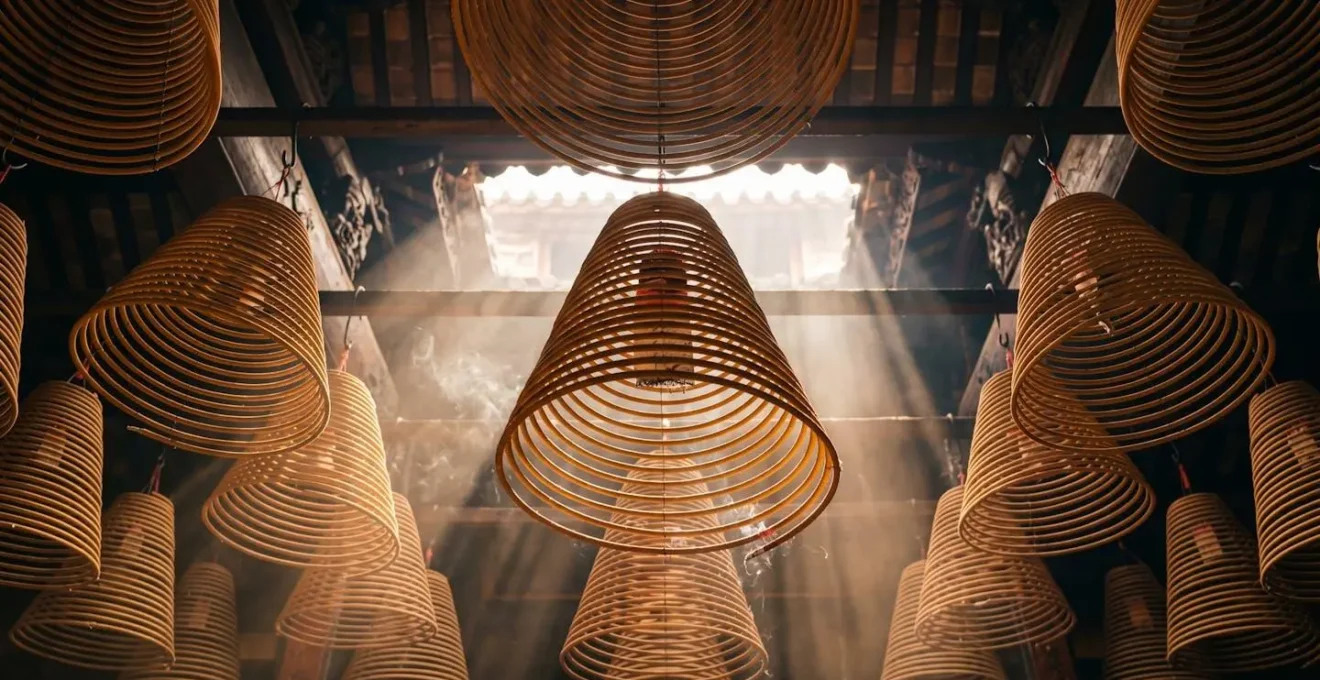
A Man Mo Temple, which is primarily Taoist, is a bustling, pragmatic place. It’s dedicated to Man, the God of Literature, and Mo, the God of War. Worshippers come here with specific, worldly requests: success in exams, favourable outcomes in legal disputes, or prosperity in business. The atmosphere is thick with the smoke of giant, hanging incense coils, each one representing a sustained prayer or offering. The visual language is one of transaction and appeal to a pantheon of deities who can intervene in earthly affairs.
A Pure Land Buddhist monastery, by contrast, is an oasis of calm and contemplation. The focus is not on immediate worldly gain, but on cultivating merit for a favourable rebirth in the Western Pure Land of Amitābha Buddha. The architectural style is often serene and minimalist, the atmosphere quiet and introspective. The goal is not to ask for a promotion, but to work towards enlightenment. The following table breaks down these fundamental differences.
| Characteristic | Man Mo Temple (Taoist) | Pure Land Monastery (Buddhist) |
|---|---|---|
| Primary Purpose | Transactional spiritual site for worldly affairs | Spiritual cultivation for next life and enlightenment |
| Main Deities | Man (God of Literature) and Mo (God of War) | Amitābha Buddha |
| Worshippers’ Goals | Academic success, dispute resolution, promotion, good fortune | Rebirth in Western Pure Land, achieving enlightenment |
| Visual Cues | Giant hanging incense coils, elaborate altars with many figures, paper tributes | Serene halls with central prominent Buddha statue, quiet meditation courtyards, uniform aesthetic |
| Atmosphere | Active, transactional, multiple deities (60+ guardian gods) | Contemplative, peaceful, focused on single Buddha figure |
| Architectural Style | Elaborate, cluttered with offerings, polytheistic displays | Minimalist, serene, less cluttered design |
What Do the Wooden Columns of the Wisdom Path Actually Signify?
While this guide focuses on alternatives to Lantau Island, no discussion of Hong Kong’s spiritual landscape is complete without mentioning the Wisdom Path. Located a short walk from the Big Buddha, it offers a profoundly different and often quieter experience. The « path » is an awe-inspiring outdoor installation of 38 enormous wooden columns, each standing between 8 and 10 metres tall. Their significance is not merely aesthetic; they are a monumental, physical transcription of one of Buddhism’s most important texts.
The characters carved into these timber beams make up the entirety of the Heart Sutra (Xinjing), a short but incredibly dense and profound prayer revered by Buddhists, Taoists, and Confucians alike. The Sutra’s core message is the concept of emptiness (śūnyatā)—the idea that all phenomena are devoid of intrinsic, independent existence. Walking amongst these towering columns is to be physically enveloped by this ancient wisdom.
In the Wisdom Path nearby, content of Heart Sutra (or Xinjing, a treasure which is worshiped by Confucianism, Buddhism and Taoism) is carved on stakes and displayed as large-scale outdoor wood carvings.
– VisitOurChina, Tiantan Buddha Statue Hong Kong, Big Buddha Statue
The arrangement of the columns is also deeply symbolic. The 38 wooden columns are arranged in an ∞ pattern, representing the mathematical symbol for infinity. This layout further reinforces the Sutra’s themes of eternity and formlessness. One column is left deliberately blank, a powerful symbol of the « emptiness » that the Sutra describes. The Wisdom Path is therefore not just a collection of columns; it’s a large-scale, walkable representation of a core philosophical concept, designed to be experienced meditatively in the heart of nature.
Key Takeaways
- Beyond the name, the Ten Thousand Buddhas Monastery’s true identity is a massive, passion-driven art project built by a layman, not a formal religious institution.
- The visual language of Hong Kong’s temples is rich with meaning; gold leaf often signifies enlightenment and divinity, while the solemnity of bronze can represent permanence and historical gravity.
- A successful visit to popular and semi-wild sites requires a strategic mindset, whether it’s outsmarting crowds with counter-intuitive timing or outsmarting monkeys with proactive food management.
How to Beat the Crowds to the Big Buddha by Arriving Before 10 AM?
Even for the traveller determined to seek out alternatives, the pull of the iconic Tian Tan Buddha can be strong. And it should be—it’s a magnificent monument. The challenge is not the site itself, but the experience when shared with thousands of others. The secret to enjoying the Big Buddha is not to avoid it, but to out-think the crowds. While this guide champions other sites, it also recognizes the value of smart tourism. The most common advice is to « arrive early, » but a truly strategic approach involves more than just setting an alarm.
The peak crowds typically descend between 11 AM and 2 PM. Beating them means arriving before the Ngong Ping 360 cable car, the primary tourist artery, begins disgorging its first packed cabins at 10 AM. This can be achieved by taking the first MTR to Tung Chung to be at the front of the cable car queue, or by using the more scenic, and often faster, route of the first ferry from Central to Mui Wo, followed by Bus #2 to Ngong Ping. These strategies buy you a precious window of relative solitude.
However, the most powerful strategy is often counter-intuitive. Consider the Sunset Strategy: arriving after 3:30 PM. By this time, the large tour groups are departing, the cable car queue has vanished, and the entire plateau is bathed in a beautiful golden light. The 268 steps to the statue are far less daunting without a human traffic jam, and you have the space to truly appreciate the monument’s scale and the panoramic views in a much more peaceful atmosphere. This turns a frantic tourist rush into a serene evening experience.
Your Strategic Timing Playbook for the Big Buddha
- The Ferry First Blueprint: Take the first ferry from Central to Mui Wo, then connect with bus #2. This combination often gets you to Ngong Ping before the first wave of tour groups.
- The Cable Car Gambit: Be at the Tung Chung MTR station early to be among the first in line for the 10 AM opening of the Ngong Ping 360 cable car, securing a spot before the main rush.
- The Explorer’s Alternative: If even an early start sounds like a crowd, commit to a truly off-piste experience. Sites like the Tsz Shan Monastery (which requires booking) offer guaranteed serenity from the start.
- The Counter-Intuitive Sunset Strategy: Plan your visit for after 3:30 PM. You will miss the crowds, enjoy the golden hour light, and experience the 268-step climb in relative peace.
- Key Advantage of Late Arrival: The late afternoon offers a completely different, more contemplative atmosphere, allowing for a more personal connection with the site than the morning rush.
Ultimately, exploring Hong Kong’s religious statues is a personal journey. Armed with the stories behind the sites and the strategies to experience them authentically, you are now equipped to go beyond the surface. The next step is to choose your own path and begin your conscious pilgrimage.