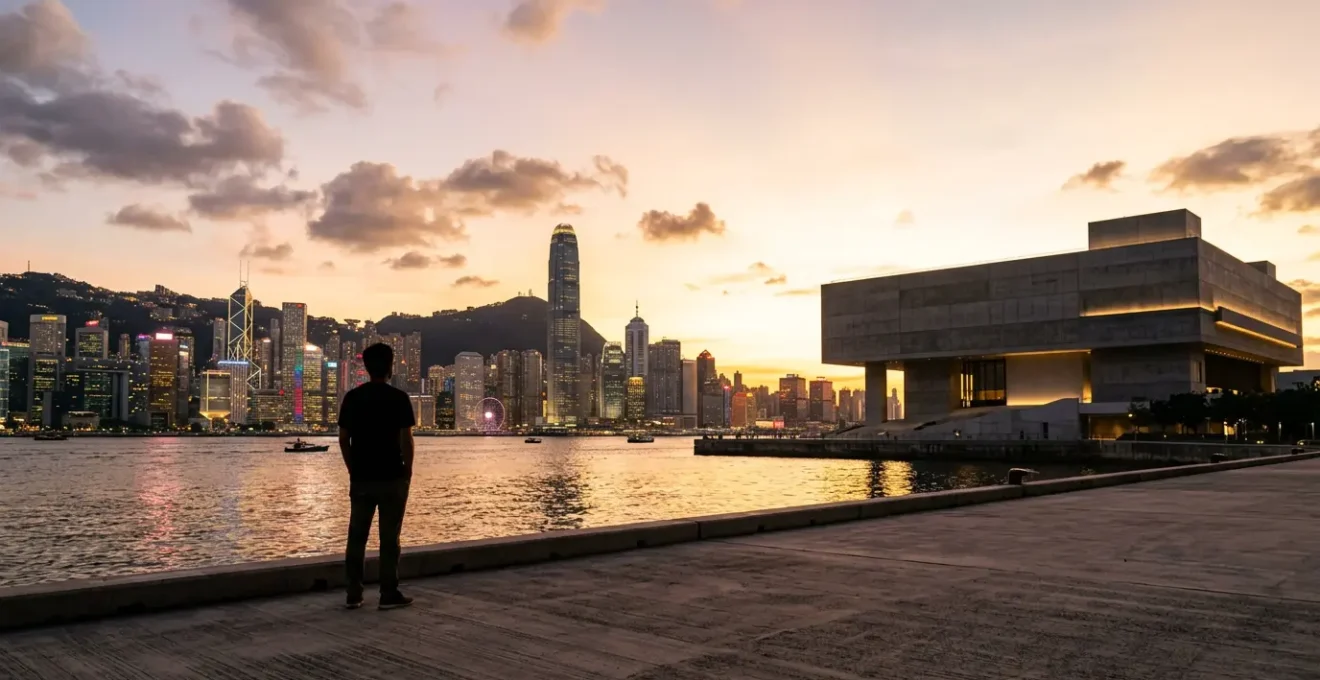
Art Basel isn’t just a fair to visit; it’s the annual catalyst that unlocks Hong Kong’s entire, dynamic art ecosystem for those who know where to look.
- The city’s true value for an art lover lies in its incredible diversity, from the monumental M+ Museum to ephemeral street art in Soho.
- Hong Kong’s status as a tax-free port creates a uniquely accessible market for both observing and acquiring world-class contemporary art.
Recommendation: Use the fair’s schedule as a framework, but dedicate the majority of your time to strategically exploring the galleries, auctions, and cultural sites that thrive in its orbit.
The arrival of Art Basel in Hong Kong sends a palpable current of energy through the city. For a week, the global art world converges, and the narrative is often dominated by multi-million-dollar sales and exclusive VIP previews. For the art lover without a high-level invitation, the experience can feel like looking through a window at a private party. Most guides will offer the standard advice: buy your tickets early, check the exhibitor list, and wear comfortable shoes. This is sound, but it misses the fundamental point about what makes this week so special.
The real opportunity isn’t just to see the art inside the convention center. The true secret, known to market insiders, is to treat the fair not as the destination, but as the powerful catalyst that brings the city’s entire art ecosystem to its peak. What if the key wasn’t getting into the VIP lounge, but leveraging the city-wide momentum to gain unparalleled access to everything from blue-chip auction houses to the grassroots street art scene? This is where the strategic visitor thrives.
This guide is designed to give you that insider’s edge. We will move beyond the fair itself to construct a curated journey through the real Hong Kong art world. We will assess the institutional heavyweights like M+, map out a tactical gallery hop, decode the rules of art acquisition in a free port, and even explore the cultural and architectural dialogues that shape the city’s creative identity. It’s time to stop being a mere spectator and start engaging with Hong Kong’s art scene on your own terms.
To navigate this vibrant landscape, this article breaks down the essential experiences and insider knowledge you’ll need. The following sections will guide you through curating a visit that goes far beyond the main event, transforming your trip into a deep and rewarding cultural immersion.
Summary: A Strategic Guide to Experiencing Hong Kong’s Art Ecosystem
- Is the M+ Museum of Visual Culture Worth the Entry Fee?
- How to Map a Gallery Hopping Tour in Sheung Wan?
- Where to Find the Famous « HK Walls » Murals in Soho?
- What are the Export Rules for Buying Contemporary Art in HK?
- Can Tourists Attend Christie’s or Sotheby’s Auctions in HK?
- Ozone or Sevva: Which Rooftop Bar Justifies the £20 Cocktail Price?
- How Did I.M. Pei’s Design Challenge Traditional Feng Shui Beliefs?
- How to Plan a Picnic Sunset at the West Kowloon Art Park?
Is the M+ Museum of Visual Culture Worth the Entry Fee?
In a word: absolutely. To frame M+ as just another museum is to fundamentally misunderstand its scale and ambition. It was conceived from the ground up to be Asia’s definitive global museum of contemporary visual culture, a direct rival to institutions like MoMA and the Tate Modern. The entry fee isn’t just for access to artworks; it’s an investment in experiencing a piece of cultural history in the making. The collection is vast, with official data confirming more than 9,100 cross-boundary visual culture pieces that span everything from design and architecture to moving images and Hong Kong’s unique visual identity.
Beyond the collection, the building itself, designed by Herzog & de Meuron, is a destination. Its cathedral-like concrete spaces, the iconic Grand Stair, and the deliberate framing of the Victoria Harbour skyline are all part of the curated experience. It’s a space designed for contemplation, not just consumption. While photography is generally permitted for personal use without flash, the true value lies in immersing yourself in the environment. Allot at least half a day here; to rush M+ is to miss the point entirely.
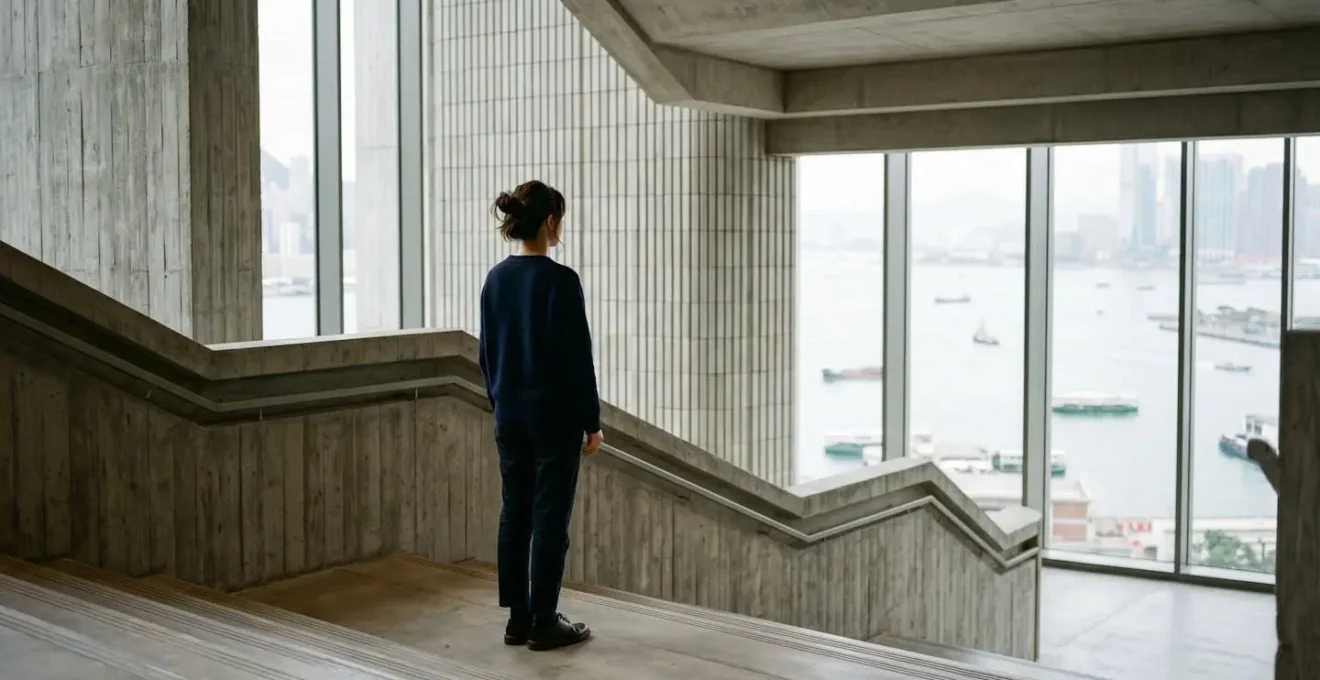
As you can see, the architecture invites you to pause and connect with the art and the city simultaneously. The fee grants you access to this entire ecosystem. It’s not just about what hangs on the walls, but about the dialogue between the art, the architecture, and the urban landscape of Hong Kong. For any serious art lover, it’s a non-negotiable part of the itinerary and provides crucial context for the commercial art you’ll see elsewhere.
How to Map a Gallery Hopping Tour in Sheung Wan?
While Central hosts the glossy international mega-galleries, the adjacent district of Sheung Wan offers a more granular, discovery-oriented experience. This is where you engage with the city’s creative pulse. A successful gallery hop here is not about seeing everything, but about strategic curation. The area, particularly the PoHo neighbourhood around Tai Ping Shan Street, is a dense network of independent galleries, design studios, and antique shops. Mapping a route is essential to avoid aimless wandering.
A logical approach starts at the Sheung Wan MTR station and works its way uphill. Begin on Des Voeux and Queen’s Road Central to visit established names like Pearl Lam Galleries, known for championing Asian contemporary artists. From there, ascend towards Hollywood Road. This is the historic heart of the city’s art and antiques trade. Here you’ll find institutions like Opera Gallery and the pioneering 10 Chancery Lane Gallery, which has been a force in Asian contemporary art for decades.
The final, and perhaps most rewarding, part of your tour should be an unstructured exploration of the smaller streets branching off Hollywood Road, such as Upper Lascar Row (Cat Street). This is where you’ll find emerging artist spaces next to traditional curio shops. The goal is to experience the contrast—the dialogue between Hong Kong’s hyper-modern art scene and its deep-rooted history. Conclude your tour at the historic Man Mo Temple, a moment of spiritual reflection that grounds your contemporary art journey in a rich cultural context.
Where to Find the Famous « HK Walls » Murals in Soho?
Finding Hong Kong’s best street art is a treasure hunt where the map is constantly changing. The most famous pieces are concentrated in Central and Sheung Wan (Soho), but unlike gallery art, they are often ephemeral. The organization HKwalls holds a street art festival each year, and many works are painted over annually. This makes blogs and social media your most valuable tool, but some landmarks are perennial favourites.
The undisputed epicentre of street art photography is the colourful mural of old Hong Kong townhouses on Graham Street. Created in 2012 by Alex Croft, it is recognized by Hong Kong street art documentation as the definitive Instagram spot in the territory. Be prepared to queue for a photo. However, to see more current and diverse works, you must look further. The nearby alleyways and staircases between Hollywood Road and Caine Road are a living gallery. Look for works on Peel Street, Elgin Street, and Staunton Street.
Case Study: The HKwalls Festival’s Evolving Urban Canvas
The partnership between the Hong Kong Tourism Board and the HKwalls Street Art Festival in 2024-2025 exemplifies the city’s embrace of street art. The initiative commissioned significant murals across Central and Sheung Wan. Notable pieces included Miguel Emerico’s ‘Hong Kong Encoded’ at 26 Tai Ping Shan Street, which ingeniously incorporated traditional bamboo scaffolding into its creation. Others, like Shaw Daan’s ‘Mother’, explored a fusion of Chinese painting styles with graffiti techniques. The festival’s core principle is the ephemeral nature of the art, creating a dynamic and ever-changing urban gallery that requires active discovery from visitors.
The key to a successful street art tour is to embrace this transient nature. While you should seek out famous works like the Graham Street mural, the real joy comes from the unexpected discoveries. Wander the slopes of Soho with an open mind and your camera ready, and you’ll find a side of Hong Kong’s art scene that is vibrant, raw, and completely free.
What are the Export Rules for Buying Contemporary Art in HK?
For any art lover, the thought of buying a piece during Art Basel week is tantalizing. In Hong Kong, it’s also remarkably straightforward from a regulatory perspective. The city’s greatest advantage, and a primary reason for its art market dominance, is its status as a free port. This is the most critical piece of information for any potential buyer. According to Acclime Hong Kong trade guidance, Hong Kong is a free port with no customs fees, VAT or GST on art imports or exports. This applies to both buying from a gallery and winning a lot at auction.
This tax-free environment dramatically simplifies the « exit » part of your purchase. The gallery or auction house will be highly experienced in arranging international shipping and insurance. They will handle the professional packing and export documentation from the Hong Kong side. However, your responsibility doesn’t end there. The crucial step is understanding the import regulations and potential duties or taxes in your home country. A 0% export tax from Hong Kong does not guarantee a 0% import tax upon arrival.
Your Pre-Purchase Audit for Exporting Art
- Points of contact: Confirm who is managing the process—the gallery, a dedicated art shipper, and your potential customs broker at home.
- Collecte: Inventory all necessary documents before payment: the certificate of authenticity, the full sales invoice, and a condition report.
- Cohérence: Confront the artwork with your collection goals. Does it fill a gap, start a new direction, or is it an impulse buy?
- Mémorabilité/émotion: Step back and assess the artwork’s personal resonance. The best acquisitions carry emotional weight beyond their financial value.
- Plan d’intégration: Finalize the plan for international shipping, comprehensive insurance during transit, and any required framing or installation upon arrival.
Ultimately, buying art in Hong Kong is an accessible dream. The system is designed to be efficient for international collectors. By doing your due diligence on your home country’s rules and working with the reputable seller, you can confidently acquire a piece of the vibrant Hong Kong art scene and make it part of your own collection.
Can Tourists Attend Christie’s or Sotheby’s Auctions in HK?
Yes, and you absolutely should. This is one of the most underutilized opportunities for art lovers visiting during peak season. The major auction houses like Christie’s and Sotheby’s hold their flagship spring and autumn sales to coincide with Art Basel. While the environment is geared towards high-net-worth individuals, the public previews are completely open and free to attend. This is your chance to see museum-quality masterpieces, from classical Chinese antiques to works by Warhol and Basquiat, up close and outside of a glass case.
The public viewings are typically held in the week leading up to the auctions at the Hong Kong Convention and Exhibition Centre (the same venue as Art Basel) or in their own gallery spaces. Check their respective websites for the « Exhibitions & Events » schedule. Attending the actual auction is also possible. While you need to register to bid, anyone can register to simply attend as a spectator. It’s a fascinating piece of theatre, offering a direct glimpse into the mechanics and psychology of the global art market. You get to feel the tension in the room and witness the moments when art history, and market history, are made.
This accessibility is a core part of Hong Kong’s strategy as a global art hub. As noted by industry experts, the city’s role is central to the market’s infrastructure. In a report on the city’s art market, Monx Hong Kong highlights this global significance:
Hong Kong has increasingly become a premier location for art auctions, rivalling the likes of New York and London
– Monx Hong Kong, Hong Kong: A Thriving Hub for Art and Tax Benefits
Do not be intimidated. Dress smartly, walk in confidently, and experience this thrilling side of the art world. It costs you nothing but time and provides an education that no museum visit can replicate.
Ozone or Sevva: Which Rooftop Bar Justifies the £20 Cocktail Price?
After a day immersed in art, a sky-high cocktail is a classic Hong Kong ritual. But with prices often exceeding £20, the choice of venue becomes a question of « cultural arbitrage »—which experience delivers the most value? The two dominant contenders are Ozone and Sevva, and they offer entirely different returns on your investment.
Ozone, located atop the ICC in Kowloon, holds the title of the world’s highest bar. Its value proposition is pure, unadulterated spectacle. The view is a god’s-eye perspective of Hong Kong Island, a dizzying carpet of lights from an almost surreal altitude. You go to Ozone for the sheer wow-factor and the feeling of being on top of the world. The interior is futuristic and abstract. The experience is less about intimacy and more about the scale of the city. It’s the perfect choice after visiting M+ or the West Kowloon Art Park, keeping you on the Kowloon side with a dramatic, wide-angle view of the island you might explore the next day.
Sevva, on Hong Kong Island, offers a different kind of value. Located atop the Prince’s Building in Central, its terrace provides a much closer, more intimate, and arguably more iconic view. You are eye-level with the architectural masterpieces of Norman Foster (HSBC Main Building) and I.M. Pei (Bank of China Tower). You aren’t looking down on the city; you are in the thick of it. The vibe is classic, old-money Hong Kong—sophisticated, elegant, and a prime spot for people-watching. You go to Sevva to feel the heartbeat of the financial district. It’s the ideal choice after a day of gallery hopping in Central and Sheung Wan.
So, which justifies the price? If you want a once-in-a-lifetime, vertigo-inducing spectacle, choose Ozone. If you want a chic, quintessentially Hong Kong experience embedded in the city’s architectural power-play, choose Sevva. Both are worth it, but for very different reasons.
How Did I.M. Pei’s Design Challenge Traditional Feng Shui Beliefs?
The Hong Kong skyline is not just a collection of buildings; it’s a battleground of architectural egos and ancient spiritual beliefs. No story illustrates this better than the construction of the Bank of China Tower, designed by the legendary I.M. Pei. To understand its impact, one must understand a core concept of Feng Shui: the avoidance of sharp angles or « sha qi » (killing energy).
Pei’s 1990 design was a masterpiece of structural engineering, a crystalline sculpture of triangles reaching for the sky. However, from a traditional Feng Shui perspective, it was an act of architectural aggression. Its sharp, knife-like edges were seen as projecting negative energy directly at its rivals. The most prominent target was the headquarters of the Hongkong and Shanghai Banking Corporation (HSBC), designed by Norman Foster. The HSBC building, itself a Feng Shui-conscious design, suddenly found itself in the direct path of the Bank of China’s ‘blades’.
The response from HSBC was a now-famous piece of architectural lore. To counteract the « sha qi » from Pei’s tower, HSBC installed two large, cannon-like structures on its roof, disguised as maintenance equipment. These ‘cannons’ are aimed directly back at the Bank of China Tower, a symbolic act of deflecting the negative energy. This silent, high-altitude dialogue is invisible to the casual tourist but is a fundamental part of the city’s DNA. It shows that in Hong Kong, business, architecture, and mysticism are inextricably linked. When you look up at the skyline, you’re not just seeing steel and glass; you’re seeing a story.
Key Takeaways
- Art Basel is the starting pistol, not the finish line. Use its energy to explore the entire city’s art offerings.
- Hong Kong’s institutional and commercial art scenes are remarkably accessible, from the M+ Museum to public auction previews.
- The city’s tax-free status as a free port simplifies the process of acquiring and exporting art, but diligence on your home country’s import rules is essential.
How to Plan a Picnic Sunset at the West Kowloon Art Park?
After days of navigating the intense, commercially charged atmosphere of galleries and auction houses, there is no better way to decompress and synthesize your experience than with a sunset picnic at the West Kowloon Art Park. This sprawling green space offers an unparalleled, ground-level panorama of the entire Hong Kong Island skyline. It’s the perfect bookend to your art journey.
Planning is simple. The high-end supermarket in the basement of the adjacent Elements Mall is the perfect place to procure supplies, from charcuterie and cheese to a chilled bottle of wine. While there are cafés within the park, creating your own picnic offers more freedom. Find a spot on the main lawn or one of the smaller, more secluded grassy areas near the water’s edge. The key is to arrive at least an hour before sunset. This gives you time to relax and watch as the city transitions from day to night, a spectacle known as the « golden hour » when the setting sun bathes the skyscrapers in a warm, magical light.
This is more than just a meal; it’s a moment for reflection. From this vantage point, you can see the architectural landmarks you’ve learned about—the ICC housing Ozone behind you, and across the water, the Bank of China and HSBC buildings continuing their silent Feng Shui battle. It’s a chance to look back at the city not as a series of individual venues, but as a single, interconnected cultural landscape. As the city lights begin to twinkle and the nightly « Symphony of Lights » show begins at 8 p.m., you’ll have a new appreciation for the vibrant, complex, and utterly captivating art ecosystem you’ve just explored.
Your visit to Hong Kong during Art Basel week can be so much more than a conventional trip. By adopting the strategic mindset of an insider, you can curate a journey that is uniquely your own. Now it’s time to take these insights and begin planning your own immersive exploration of one of the world’s most dynamic art capitals.