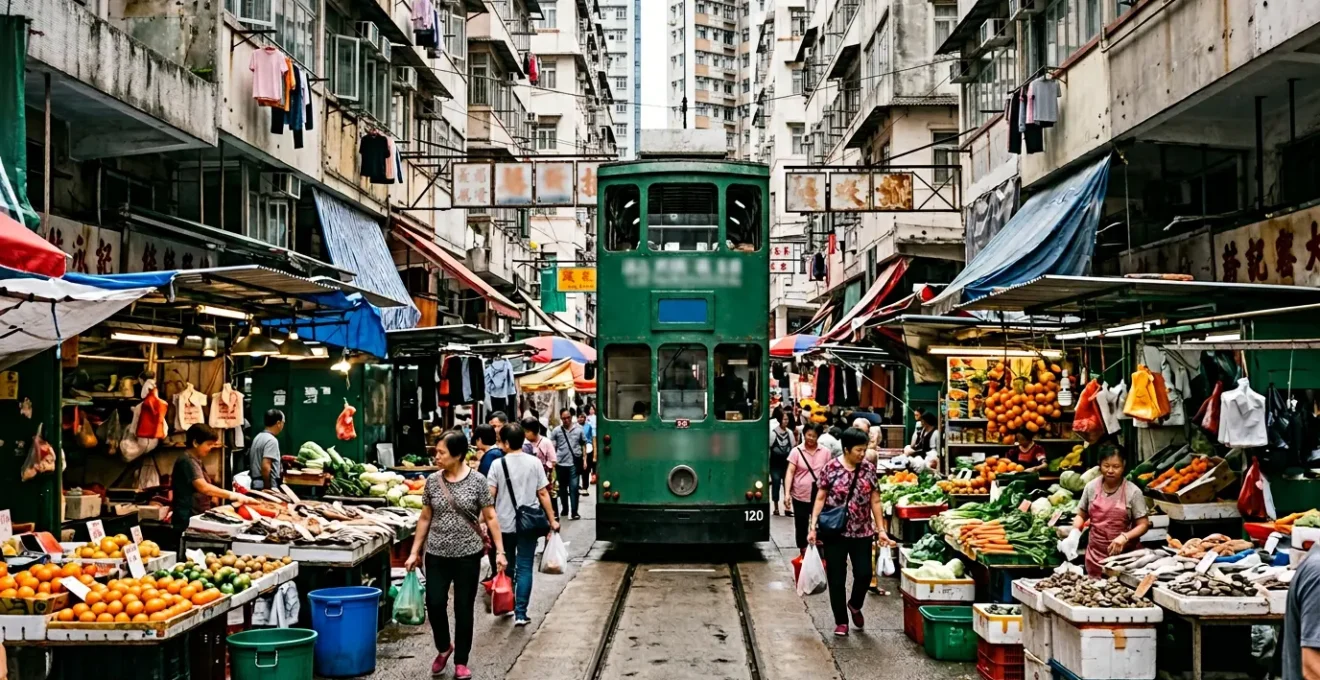
Trying to capture the iconic photo of a Hong Kong tram parting the crowds of Chun Yeung Street Market often feels like a game of chance. The real secret isn’t a fast shutter speed, but understanding the hidden system behind the chaos. This guide decodes the operational rhythms of the tram and the market, transforming you from a reactive tourist into a patient observer who can anticipate and compose the perfect, story-rich shot.
For any photographer exploring Hong Kong, it’s the holy grail shot: the slender, double-decker tram, affectionately known as the « Ding Ding, » gliding miraculously through the throngs of shoppers and vibrant stalls of a wet market. This unique urban choreography happens daily on Chun Yeung Street in North Point. Most visitors arrive, feel overwhelmed by the beautiful chaos, and snap frantically, hoping to get lucky. They see a spectacle, but miss the story.
The common advice is simply to « be quick » or « find a high vantage point. » But this approach treats the scene as a static postcard. What if the key wasn’t speed, but slowness? What if the secret to a truly compelling photograph lies not in reacting to the scene, but in understanding it? The truth is, this seemingly chaotic interaction is a highly organized system, a dance with unwritten rules and predictable rhythms. To get the shot that stands apart, you must first become an urban explorer and learn to read the city’s unique language.
This guide will deconstruct that system for you. We’ll move beyond the surface-level tips and delve into the operational logic of the tram, the character of its destinations, and the sensory experience of the journey itself. By the end, you won’t just know how to take a picture; you’ll know how to see the picture before it even happens.
Summary: A Photographer’s Guide to the Chun Yeung Street Tram
- Why Must You Enter at the Back and Pay at the Front?
- Is the Front Window Seat on the Upper Deck Hot in Summer?
- How to Identify the Terminus Destination on Vintage Tram Signs?
- How to Book a Private Antique Tram for a Rolling Party?
- Is the Tram Slower Than Walking During Rush Hour in Central?
- When Is the Best Time to Ride the Star Ferry for Sunset Photos?
- Is It Safe to Shop in Mong Kok Markets Alone After 10 PM?
- How to Use the Hong Kong Tram for a £0.30 City Tour?
Why Must You Enter at the Back and Pay at the Front?
Your first interaction with the tram’s internal logic begins before you even move. The rule is simple: board at the rear, exit and pay at the front. This isn’t just a quaint tradition; it’s a masterpiece of crowd-flow engineering designed to efficiently move a significant portion of its ridership. The system is built around a flat fare, paid upon exit by tapping an Octopus card or dropping exact change next to the driver. This front-end payment bottleneck is deliberately managed by having passengers board and find their space from the rear, allowing the tram to load and unload with surprising speed.
Understanding this reveals the first piece of the puzzle for a photographer: the tram is not just a tourist ride, it’s a vital, high-volume artery of the city. With an average of 138,000 passengers daily, according to Hong Kong Transport Department data, the system’s efficiency is paramount. The payment ritual is the heartbeat of this operational rhythm. As an observer, you can use the flow of people entering the back and queuing at the front to anticipate stops and starts, capturing moments of daily life that tell a deeper story than the vehicle alone.
By seeing it not as an inconvenience but as a design choice, you shift your perspective from that of a passenger to that of an analyst, a crucial step for any explorer.
Is the Front Window Seat on the Upper Deck Hot in Summer?
In a word: yes. And for the photographer seeking an authentic experience, that’s a very good thing. Most of the tram fleet is not air-conditioned, and the coveted front-row seat on the upper deck becomes a glass-fronted greenhouse during Hong Kong’s humid summers. But this « discomfort » is your gateway to a deeper sensory immersion. The heat connects you to the city’s climate, and your only relief is the breeze from the sliding windows—the tram’s mechanical lungs. This forces you to engage with the environment, not just observe it from a climate-controlled bubble.
The experience is tactile. You feel the sticky air, hear the unfiltered sounds of the street, and see the city through a frame of worn wood and metal. This is the raw material of great photography. While a fleet of newer, air-conditioned trams now offers a cooler ride, they trade this raw, sensory input for sterile comfort. For the urban explorer, the choice is clear: embrace the heat of the vintage trams. It’s in that slight discomfort that the most authentic moments are found, where the barrier between you and the city dissolves.
This direct connection to the city’s pulse is precisely what allows you to capture its true character, not just its skyline.
How to Identify the Terminus Destination on Vintage Tram Signs?
The destination displayed on the front of the tram is more than just a place name; it’s a clue to the character of the journey ahead. For a photographer, « decoding the signs » is essential. It allows you to predict the photographic « palette » you’re about to enter. The tram line is a cross-section of Hong Kong Island, with the western and eastern termini representing two different worlds. A tram bound for « Kennedy Town » (堅尼地城) is heading toward a trendy, gentrified neighbourhood of waterfront cafes and modern high-rises. In contrast, a tram marked for « Shau Kei Wan » (筲箕灣) is journeying east into a realm of traditional markets, older housing estates, and a grittier, more historic atmosphere.
Knowing this allows you to choose your route intentionally. Do you want to capture the contrast of old and new in Wan Chai, or the relentless commercial energy of Causeway Bay? Or do you want to head straight for the main event in North Point? This is where you transform from a passive passenger to an active director of your photographic expedition. Understanding the destination gives you narrative control.
Action Plan: Decoding Tram Destinations
- Kennedy Town: The westernmost point. Your target for sleek, modern cityscapes and a relaxed, almost European waterfront vibe.
- Western Market: A key central point. Alight here to capture the beautiful Edwardian-style building and the heart of the older colonial district.
- Happy Valley: A loop off the main line. This is your route for a unique view of the iconic racecourse and surrounding affluent residential areas.
- Causeway Bay: The epicentre of retail. Choose this destination if you want to capture shots of extreme urban density, crowds, and neon lights.
- North Point: The gateway to our primary objective. This sign means you are approaching the Chun Yeung Street Market experience.
Each sign is a promise of a different story, and the savvy explorer knows which story they want to tell before they even board.
How to Book a Private Antique Tram for a Rolling Party?
For the average tourist, the tram is public transport. For the urban explorer, it’s a mobile observation deck. But for the truly committed photographer, it can become a private, rolling studio. Chartering a private antique tram offers the ultimate control over your photographic environment. Imagine a « rolling party » where the guests are your camera angles and the music is the ding-ding of the tram bell, unencumbered by other passengers blocking your shot. This isn’t just a fantasy; it’s a surprisingly accessible option for a group or a dedicated project.
The process involves booking directly through Hong Kong Tramways, with options ranging from standard-issue trams to beautifully maintained open-top antique models. While it may sound extravagant, when you compare the cost to other private venue rentals in Hong Kong, it reveals itself as a unique and high-value proposition. According to recent pricing data, standard charter rates can range from HK$1,400 to HK$3,500 per hour, depending on the tram type and time. This gives you an exclusive platform to execute your vision perfectly.
| Venue Type | Capacity | Cost per Hour | Duration | Total Cost (3 hours) | Per Person Cost |
|---|---|---|---|---|---|
| Antique Tram (Private) | 25 people | HK$900 | 3 hours min | HK$2,700 | HK$108 |
| Standard Party Tram | 35 people | HK$2,000 | 2.5-3 hours | HK$6,000 | HK$171 |
| Central Bar Buyout | 30-40 people | HK$3,000-5,000 | 3-4 hours | HK$12,000 | HK$300-400 |
| Party Room Rental | 30 people | Variable | 3-4 hours | HK$4,000-8,000 | HK$133-267 |
It repositions the tram in your mind: not just as a vehicle, but as a potential, exclusive platform for creativity.
Is the Tram Slower Than Walking During Rush Hour in Central?
Yes, frequently. And for the photographer, this is its single greatest advantage. During peak hours in the dense canyons of Central or Wan Chai, the tram often gets caught in the same gridlock as the buses and cars. From the upper deck, you might watch pedestrians overtake you with ease. A tourist might get frustrated. An explorer understands this is a gift. This slowness transforms the tram from a mode of transport into a mobile, elevated viewing platform moving at the perfect speed for observation.
This is where you become the « patient observer. » The slow crawl allows you to witness the city’s intricate « urban choreography » in detail. You have time to see the interactions on the street, to notice the architecture, to compose shots in your mind long before you raise the camera. You’re not rushing from A to B; you are gliding through the very fabric of the city. The journey becomes the destination. The slowness is a feature, not a bug, allowing you to absorb the atmosphere and anticipate moments—a luxury speed would never afford.
Instead of chasing the shot, you let the shot come to you, carried along by the slow, rhythmic pulse of the city’s oldest transport.
When Is the Best Time to Ride the Star Ferry for Sunset Photos?
For the completist urban explorer, capturing Hong Kong’s transport icons doesn’t stop at the tram tracks. The principles of patience and timing are equally critical when framing another classic shot: the sunset over Victoria Harbour from the deck of the Star Ferry. While our main mission is on land, this brief detour across the water is a worthy side quest. The key is to board a ferry from Central or Wan Chai to Tsim Sha Tsui approximately 30-45 minutes before the official sunset time. This gives you one crossing during the golden hour as the sun dips below the western horizon, and a return journey during the « blue hour » as the city’s lights begin to sparkle.
This two-part journey provides two distinct photographic opportunities for a remarkably low cost. According to current Hong Kong government transport data, an adult single journey fare ranges from just HK$4.0 to HK$6.5. For an even more spectacular backdrop, time your return journey to coincide with the city’s nightly light show. As the Hong Kong Tourism Board highlights, a major harbour event creates a dazzling spectacle. The « Symphony of Lights » show is a key feature to capture, as it creates a spectacular light display across Victoria Harbour with synchronized music and laser effects from buildings on both sides.
Now, with the harbour’s grandeur captured, let’s return our focus to the intimate, chaotic beauty of the city’s markets.
Is It Safe to Shop in Mong Kok Markets Alone After 10 PM?
The question of safety in Hong Kong’s bustling night markets, like those in Mong Kok, is a common one for solo travellers. Generally, Hong Kong is an exceptionally safe city. Mong Kok after 10 PM is less about danger and more about an intense, overwhelming energy of crowds, noise, and commerce. Basic situational awareness—keeping an eye on your belongings and being mindful of your surroundings—is all that’s typically required. However, the energy there is one of fast-paced consumerism, which is a very different atmosphere from the market experience at the heart of our photographic mission.
To truly understand the « systemic chaos » that a photographer craves, we pivot from the tourist-heavy Mong Kok to the authentic, lived-in environment of Chun Yeung Street. Here, the question of safety is answered by the atmosphere itself. It’s crowded, yes, but with locals doing their daily grocery shopping, not just tourists seeking bargains. This creates an environment that is busy but inherently communal and secure. It’s a functional, working market, not a performance. As one visitor noted in a review, this authenticity is its main draw.
The place was absolutely buzzing with locals and tourists alike. It was crowded with locals buying their fresh meat, fish and veg straight from the stalls. Whilst tourists wouldn’t be here to find a bargain, it is worth visiting for the atmosphere alone. The highlight, waiting for the trams to run through the middle of the market which was reminiscent of the Maeklong Railway market in Thailand.
– Visitor review on TripAdvisor
In Chun Yeung Street, you are a guest in a community’s living room, not a customer in a shopping mall, and that difference is palpable and reassuring.
Key Takeaways
- The « Enter Back, Pay Front » rule isn’t a quirk; it’s a high-efficiency system for managing massive passenger flow, revealing the tram’s role as vital transport.
- For a photographer, the tram’s slowness in traffic is a major advantage, transforming it into a mobile observation deck for capturing street life.
- Decoding the terminus signs (e.g., Kennedy Town vs. Shau Kei Wan) is key to predicting the character and photographic opportunities of a route.
How to Use the Hong Kong Tram for a £0.30 City Tour?
Now, let’s put all this theory into a concrete, actionable plan. Armed with an understanding of the tram’s rhythms and a new perspective on its « flaws, » you can embark on one of the world’s greatest and cheapest city tours. The title isn’t hyperbole; it’s a fact. The flat fare system is the key that unlocks the entire 30km network for your exploration. As official Hong Kong Tramways data confirms, a single adult fare is just HK$3.30, which is roughly £0.33. For this minuscule price, the entire island’s northern shore is your studio.
Your mission begins at the Western Market terminus in Sheung Wan. Board any eastbound tram and head for an upper-deck front seat. This is not a race; it is a photographic survey. Your first leg takes you through the financial heart of Central, a canyon of steel and glass juxtaposed with colonial-era buildings. As you glide into Wan Chai, the city’s texture changes, revealing older neighbourhoods and traditional markets. Continue through the retail vortex of Causeway Bay before alighting at North Point to immerse yourself in the Chun Yeung Street market. Spend time on foot, feel the rhythm, and capture the tram’s dance with the vendors. Once you have your shot, board the next eastbound tram to the end of the line at Shau Kei Wan to soak in the traditional atmosphere. The return journey, heading west, offers a completely different perspective as the light changes, revealing new angles and shadows.
Now, with this knowledge, your task is simple: grab your camera, an Octopus card, and go explore the living, breathing theatre of Hong Kong’s streets from its most iconic stage.