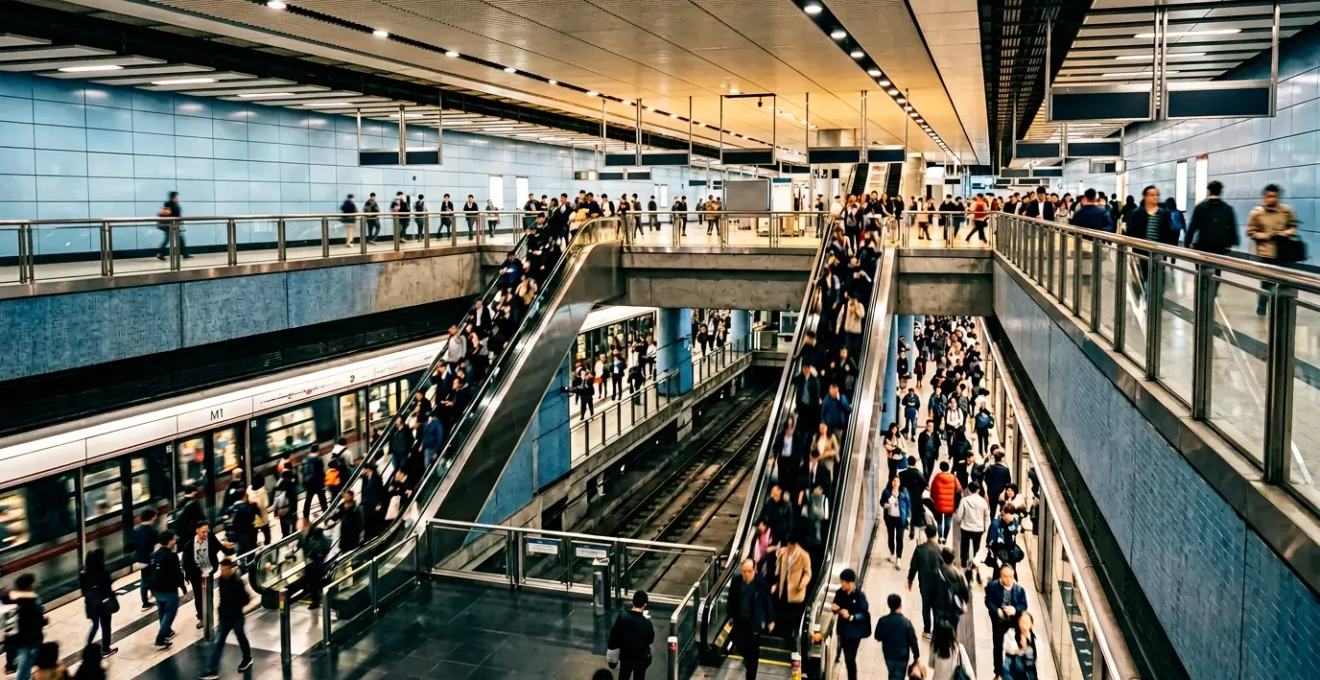
The secret to surviving Hong Kong’s MTR rush hour isn’t avoiding the crowds, but psychologically reframing the system from a source of chaos into a predictable, logical environment.
- Systemic features like frequent announcements and color-coded walls are not random; they are psychological tools designed to reduce your cognitive load and guide you subconsciously.
- Mastering the MTR’s « language »—from its exit letters to its interchange layouts—gives you a sense of predictive control, the most powerful antidote to anxiety and claustrophobia.
Recommendation: Stop seeing the MTR as an obstacle to fight. Instead, learn to read its underlying logic. This shift in perspective is your key to transforming panic into a feeling of calm mastery.
The visceral feeling of the crowd pressing in at Admiralty station during peak hour is a unique form of urban dread. For a traveler, especially one prone to claustrophobia, it can feel like being caught in an unstoppable human river. The noise, the density, the sheer scale of it all triggers a primal fight-or-flight response. Most travel guides offer the same platitudes: « avoid peak times » or « just follow the signs. » But what if you can’t avoid it? What if the signs themselves are part of an overwhelming sensory input?
This guide takes a different approach. As a psychologist of urban stress, I argue that panic doesn’t stem from the crowd itself, but from a perceived loss of control and predictability. The solution, therefore, is not to find a magic empty train car, but to regain that sense of control by understanding the hidden logic of the MTR system. It’s a marvel of engineering, but more importantly, it’s a masterclass in environmental psychology. Its features are designed to manage the flow of millions, and by decoding them, you can navigate the system not with panic, but with purpose.
We will move beyond basic tips and delve into the ‘why’ behind the system’s design. You will learn to see the MTR not as a chaotic force, but as a complex yet solvable puzzle. By understanding the psychological function of its announcements, colors, and layouts, you can transform your journey from a stressful ordeal into an exercise in mindful navigation. This knowledge is your most powerful tool for turning anxiety into a quiet confidence, even in the heart of the world’s most efficient metro system.
This article provides a psychological roadmap to navigating the Hong Kong MTR. By understanding the intent behind each element of the system, you can reduce anxiety and move through its busiest hubs with a newfound sense of calm and control. The following sections break down these hidden logics, from auditory cues to the very structure of the stations themselves.
Summary: A Psychological Guide to Conquering the MTR Crowds
- Why Are the « Please Mind the Gap » Announcements So Frequent?
- Why Are MTR Station Walls Colored in Bright Mosaic Tiles?
- Is the First Class Carriage on the East Rail Line Worth the Extra Cost?
- Where to Find the Lifts for Strollers in Older MTR Stations?
- Why Is Choosing the Right Exit Letter Critical in Hong Kong?
- What Are the Pickpocket Tactics Used in Crowded Markets Like Mong Kok?
- Why Are the Walks Between MTR Lines in Central Station So Long?
- How to Use the Citymapper App to Navigate Hong Kong Like a Local?
Why Are the « Please Mind the Gap » Announcements So Frequent?
The relentless « Please mind the gap » announcements can feel like an assault on the senses, contributing to the feeling of being overwhelmed. However, from a psychological standpoint, this repetition serves a critical function: it creates a cognitive anchor in a chaotic environment. In a system where over 5.5 million trips are made daily, standardized, predictable auditory cues are essential for mass safety and reducing individual cognitive load. You don’t have to actively think about the danger; the system does it for you, freeing up mental resources to focus on your route.
This isn’t just a generic warning. At certain stations, it’s a direct response to specific architectural challenges. Understanding this transforms the announcement from an annoyance into a logical piece of information, which is key to reducing anxiety.
Case Study: The Admiralty Station Platform Curve
Admiralty Station is a prime example. It features distinctly curved platforms, a result of early engineering constraints. This trapezoidal design means the gap between the train and the platform edge is significantly and variably larger than in standard stations. The frequent audio warnings and the unique, large « Mind the gap » stickers on the floor are not a system-wide standard but a targeted safety measure for this specific location. Knowing this, the repetition becomes a helpful, localized reminder rather than a system-wide irritation, reinforcing a sense of predictable control.
By reframing this repetitive sound as a purposeful safety feature tailored to the immediate environment, you can filter it out as background information rather than letting it contribute to sensory overload. It’s a sign that the system is working to protect you, a fact that can be profoundly reassuring in a dense crowd.
Why Are MTR Station Walls Colored in Bright Mosaic Tiles?
The vibrant, often single-color mosaic walls of MTR stations are not merely a design choice from the 1970s; they are a brilliant application of environmental psychology. Each station on the original lines was assigned a unique color (e.g., Central is red, Admiralty is blue, Tsim Sha Tsui is yellow) to act as a powerful tool for subconscious navigation. This system of « cognitive wayfinding » allows passengers to identify stations instantly without needing to read signs.
This visual language is incredibly effective at reducing the stress of navigation, especially in a fast-moving crowd. Your brain recognizes the color pattern long before it processes text, giving you a few extra seconds to prepare to alight. This was a deliberate design strategy rooted in the city’s history. When the MTR was being built, Hong Kong had only launched free compulsory education in 1971, meaning a segment of the population had lower literacy levels. The color-coding was a universal, language-free navigation system accessible to everyone, from children to the elderly and non-literate individuals.

As you can see, the bold, simple color fields function as massive, unmistakable beacons. For a claustrophobic traveler, this system provides a powerful sense of predictability. Even if you are squashed in the middle of a carriage, a flash of « Admiralty blue » through the window is an immediate, calming confirmation that you are in the right place. It’s one less thing to worry about, a small but significant reduction in your mental workload.
Instead of just seeing tiles, recognize these walls as a city-scale communication system designed to help you. Learning a few key station colors (like your hotel’s station and major interchanges) can dramatically increase your feeling of mastery over the environment.
Is the First Class Carriage on the East Rail Line Worth the Extra Cost?
For a traveler battling claustrophobia, the First Class carriage on the East Rail Line (the line connecting to the mainland border) isn’t a luxury; it’s a strategic tool for environmental control. The key benefit is not the softer seats, but the guaranteed reduction in human density. By paying a premium, you are essentially buying personal space and a quieter, less stimulating environment. This can be an invaluable investment in your mental well-being on longer journeys or during peak times.
The cost is straightforward: the First Class Premium is equivalent to the normal Standard Class Fare for the same journey, effectively doubling the price. For a short trip of one or two stops, this may seem excessive. But for a 45-minute ride from Admiralty to the border, the cost-benefit analysis changes, especially if it means avoiding the onset of a panic attack. The decision to upgrade should be a conscious, psychological one based on your personal stress levels and the context of your journey.
The decision framework below is not just about logistics; it’s about proactively managing your anxiety. It gives you a structured way to assess whether the extra cost is a justifiable expense for maintaining your sense of calm.
- Assess your luggage situation: First Class offers guaranteed seating, which is crucial if you have suitcases. Wrestling with bags in a packed standard-class car is a significant stress multiplier.
- Validate at the platform processor BEFORE boarding: This is a critical step. You must tap your Octopus card at a yellow First Class validation machine on the platform before entering. Failure to do so results in a hefty penalty, which would certainly not help your stress levels.
- Calculate walking time to the First Class car: The compartment is in the middle of the train. If your destination exit is at the far end of the platform, the extra walk might negate the time saved, a factor to consider in your planning.
- Consider journey length and time: The upgrade is most valuable for longer trips during morning (9-10 am) or evening (6-7 pm) peak hours when standard cars are at their most crowded.
- Evaluate the intangibles: You are paying for reduced noise, less physical contact with other passengers, and more comfortable seating. For someone with claustrophobia, these « intangibles » are the primary product.
Think of First Class as a « safe zone » you can opt into. Knowing this option exists, even if you don’t always use it, can itself be a comfort. It’s an escape hatch, a tool in your arsenal for managing the MTR experience on your own terms.
Where to Find the Lifts for Strollers in Older MTR Stations?
Navigating an unfamiliar subway system with a stroller or heavy luggage can trigger a specific kind of panic: the fear of being trapped by an endless series of escalators and stairs. The good news is that the MTR network is now fully accessible; the MTR Corporation reports that all stations are equipped with lifts and ramps after an extensive retrofitting program. The challenge, especially in older stations, is that these lifts are often not in obvious locations.
This is where knowledge once again becomes power. Understanding the « logic » of where retrofitted lifts are placed can turn a frantic search into a calm, methodical process. Because they were added long after the original construction, these lifts are frequently located on the station’s perimeter, sometimes even outside the main ticket barriers or tucked away at the very ends of platforms. They are rarely centrally located. Looking for these patterns transforms the station from a maze into a solvable puzzle.
To systematically eliminate the anxiety of finding an accessible route, you can turn the process into a clear, pre-planned strategy. This checklist helps you use available tools to build a predictable path before you even arrive at the station.
Your Action Plan: Finding the Barrier-Free Route
- Pre-Trip Planning with MTR Mobile: Before traveling, use the ‘Barrier-Free Route Planner’ feature in the official MTR Mobile app. It will show you the exact location of lifts at your origin, destination, and any interchange stations.
- Identify Retrofit Patterns on Site: Upon arrival, if a lift isn’t immediately visible, consciously look for signs with the universal wheelchair symbol pointing towards the station’s edges or non-obvious corners.
- Use Concourse-Level Station Maps: The large station layout diagrams in the main concourse are your best friend. Look for the elevator icons (a box with up/down arrows); they will reveal the lift shaft’s precise location relative to platforms and exits.
- Utilize the ‘Staff Assist’ Button: If all else fails, do not hesitate to press the ‘Staff Assist’ intercom button located near escalators. Station staff can guide you directly to the nearest lift, removing all guesswork.
- Strategic Timing for Less Crowding: If possible, avoid traveling during peak hours (9-10 am, 6-7 pm on weekdays). The lifts are used by everyone, and they become bottlenecks during rush hour, adding another layer of stress.
By treating lift-finding as a planned mission rather than a desperate search, you maintain a sense of agency. You have a plan and backup options, which is the psychological opposite of feeling trapped and helpless.
Why Is Choosing the Right Exit Letter Critical in Hong Kong?
In most subway systems, an exit is simply a way to get to the street. In Hong Kong, an MTR exit is a high-precision navigation tool. Choosing the right letter is the difference between a seamless, climate-controlled journey and emerging into a chaotic street, disoriented and exposed to the elements. This is because MTR exits are deeply integrated into the city’s vertical, multi-layered infrastructure, connecting directly to specific buildings, shopping mall basements, and elevated walkway systems.
From a psychological perspective, mastering the exits is the ultimate act of taking control of your environment. It allows you to bypass the sensory overload of the street level—the traffic, the heat, the humidity, the crowds—and instead navigate through a network of calm, predictable, air-conditioned corridors. This isn’t just about comfort; it’s about minimizing unpredictable variables, which is a core strategy for managing anxiety.
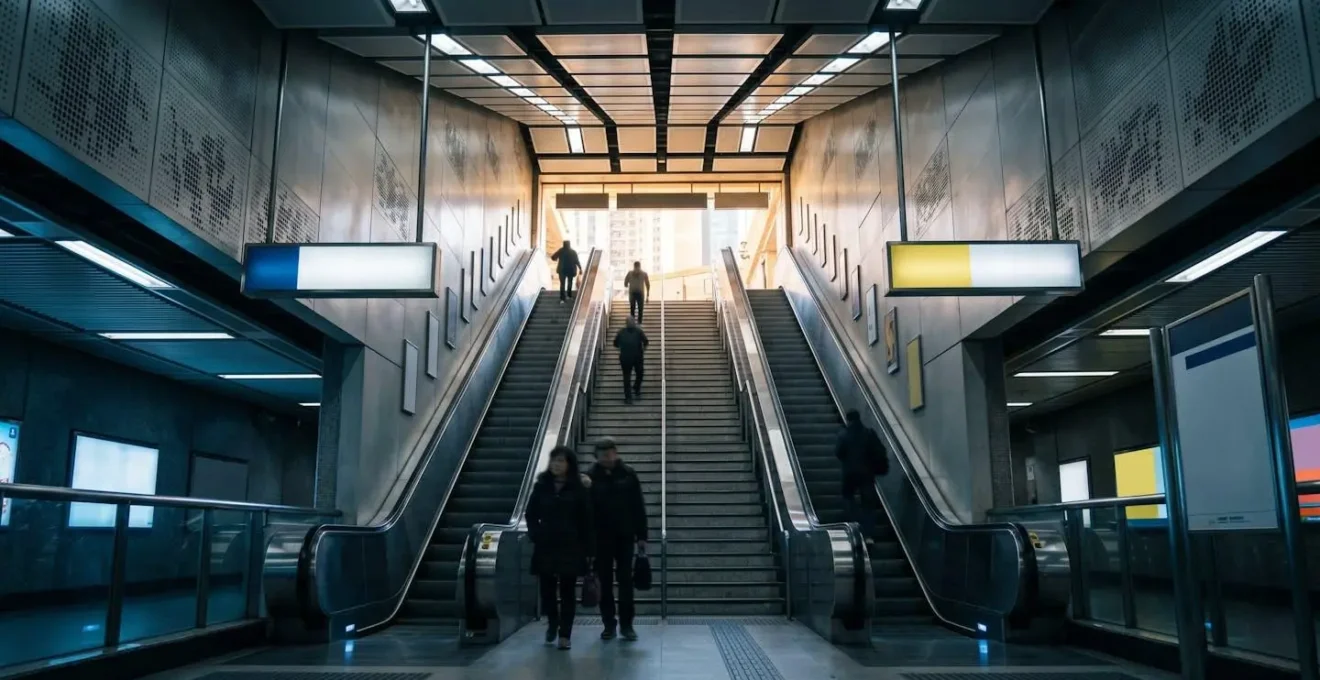
The image above captures the essence of this « hidden » city. These corridors are your sanctuary from the chaos. Learning to use them effectively is a skill that distinguishes a stressed tourist from a confident navigator.
Case Study: The Admiralty to Pacific Place Connection
Admiralty Station provides a perfect illustration. If your destination is the Pacific Place shopping centre, taking Exit F leads you into a direct, covered pedestrian walkway that takes you straight into the mall. You are never exposed to weather or traffic. In contrast, taking another nearby exit would deposit you at street level, forcing you to navigate busy roads and find the building’s entrance from the outside. This single choice dictates the entire character of the last five minutes of your journey—one is calm and controlled, the other is stressful and chaotic.
Before you arrive at your destination station, use a navigation app like Citymapper or Google Maps to determine not just the station, but the exact exit letter you need. This tiny piece of information is your key to unlocking a calmer, more efficient way of moving through the city, turning a moment of potential panic into a seamless transition.
What Are the Pickpocket Tactics Used in Crowded Markets Like Mong Kok?
While the title mentions Mong Kok, the tactics discussed are most relevant where crowds are densest and most transient: the MTR during rush hour. In environments like Admiralty station, where travel guides warn that passengers sometimes have to wait for three or four trains, the extreme crowding creates a perfect hunting ground for pickpockets. For an anxious traveler, the fear of being a victim adds another layer of stress. The psychological antidote to this fear is not paranoia, but empowerment through knowledge.
Pickpockets rely on distraction, confusion, and the anonymity of the crowd. By understanding their methods, you can make yourself a « hard target. » You shift from a state of passive worry to one of active, calm situational awareness. You are no longer just a potential victim; you are an observer who can spot the patterns of predatory behavior. This sense of competence is a powerful anxiety reducer.
Becoming aware of these common tactics is your first line of defense. It allows your brain to flag suspicious behavior, giving you time to react calmly and secure your belongings. The following checklist outlines the key threats and the corresponding defensive mindset.
Your Action Plan: Anti-Pickpocket Situational Awareness
- Defend Your Digital Space: In dense crowds, place RFID-enabled cards (like Octopus and contactless credit cards) in RFID-blocking wallets or, at a minimum, in your front pockets. This counters « NFC skimming, » where thieves use readers to steal data without physical contact.
- Master Doorway Awareness: The « Squeeze » tactic happens as a train arrives. A thief or team will press against you in the rush to board, using the physical contact as a cover to extract items from your bag or pockets. Be most vigilant at this moment.
- Control Your Escalator Space: The « Stall » involves an accomplice suddenly stopping at the top or bottom of an escalator, causing a pile-up. In the confusion, another thief will target those who are distracted. Always keep your bags in front of you, against your chest.
- Recognize Unnatural Proximity: Pickpockets often work in teams. If you notice someone standing uncomfortably close to you even when there’s space, or if you are « accidentally » bumped multiple times, perform a quick, discreet check of your valuables.
- Project Confident Purpose: Thieves target those who look lost, distracted, or overwhelmed. Even if you are unsure of your direction, maintain an alert posture and move with decisive purpose. Walk like you know where you’re going.
This is not about fostering fear, but about building confidence. By knowing what to look for, you can relax, knowing you are prepared. You can then focus your mental energy on navigating, rather than worrying about the people around you.
Why Are the Walks Between MTR Lines in Central Station So Long?
The seemingly endless underground walk to transfer lines at Central or between Central and Hong Kong stations can be a major source of frustration and anxiety. It feels illogical and poorly designed, especially when you are tired or in a hurry. This feeling of frustration stems from the assumption that it was designed as a single, unified station. The psychological trick to diffusing this stress is to understand that it wasn’t.
The long walk is a historical artifact. It’s a physical seam connecting what were once two entirely separate transit systems built at different times by different entities. Knowing this fact instantly reframes the experience. It’s no longer a « design flaw » causing you stress; it’s a « historical quirk » that you can anticipate and plan for. This shift in perspective is a powerful tool for anxiety reduction through system knowledge.
Case Study: The Merging of Central and Hong Kong Stations
The MTR’s Central Station (serving the Island and Tsuen Wan lines) and the Airport Express/Tung Chung Line’s Hong Kong Station were never originally designed as a single interchange. The lengthy underground passage, complete with moving walkways that run through the IFC Mall’s commercial corridor, was built later to connect these two separate hubs. The same principle applies to the Tsim Sha Tsui to East Tsim Sha Tsui interchange, where commuters experience an underground walk of about 8 minutes. This isn’t a corridor; it’s a bridge between two different worlds.
Once you know this, you can treat the walk not as an unexpected delay, but as a predictable part of your journey. You can factor the 5-to-8-minute transfer time into your schedule. You can see the moving walkways not as a poor substitute for a shorter path, but as a welcome tool to ease the journey between two historically distinct points. This knowledge gives you predictive control, allowing you to relax and follow the path, rather than fighting it mentally.
Key Takeaways
- Panic in crowds is a response to a loss of control; understanding the MTR’s hidden logic is how you regain it.
- Features like color-coded stations and repetitive announcements are psychological tools designed to guide you and reduce your mental workload.
- Mastering the MTR’s « language, » especially its exit system, allows you to bypass street-level chaos and navigate through a calmer, climate-controlled network.
How to Use the Citymapper App to Navigate Hong Kong Like a Local?
In the complex, multi-layered environment of Hong Kong, a good navigation app is more than a map—it’s a cognitive prosthesis. It offloads the immense mental stress of planning, calculating, and decision-making, allowing you to dedicate your focus to managing your emotional state and staying aware of your surroundings. While several apps can get you from point A to B, choosing the right one for the specific challenges of the MTR is a strategic decision.
The official MTR Mobile app is excellent for station-specific information, like finding lifts or checking service status. Google Maps is the king of street-level walking directions. However, for a holistic, stress-reducing experience that integrates all modes of transport and understands the MTR’s quirks, Citymapper often has the edge. It excels at multi-modal routing, combining the MTR with buses, ferries, and trams to find the genuinely optimal path. Crucially, it provides features that are gold for an anxious traveler, such as suggesting the best train carriage to board for a quick transfer or exit at your destination.
This table compares the strategic uses of the main navigation apps. Choosing the right tool for the job is the first step in building a seamless, low-stress travel plan.
| App | Best Use Case | Key Strength | Limitation |
|---|---|---|---|
| MTR Mobile | Station-specific navigation (lifts, exits, layouts) | Official barrier-free route planner, real-time service updates, e-ticket purchase | Limited to MTR network only, no multi-modal routing |
| Google Maps | Street-level walking directions and general location search | Comprehensive POI database, outdoor navigation accuracy | Doesn’t show optimal MTR car positioning or exit strategies |
| Citymapper | Multi-modal route optimization combining MTR, minibus, and ferry | Real-time integration of all transit modes, ‘rain-safe’ routing, best carriage positioning | Requires internet connection, occasional inaccuracies for niche routes |
By leveraging an app like Citymapper, you are essentially giving yourself a local’s knowledge. It tells you which end of the platform to wait on, which exit to take, and how long the walk will be. Every piece of information it provides reduces an unknown variable, chipping away at the foundation of travel anxiety. Let technology handle the logistics so you can handle the journey.
You now possess the psychological framework and practical knowledge to transform your relationship with the Hong Kong MTR. The final step is to put this understanding into practice on your next journey. Begin by consciously observing the system’s logic—the colors, the sounds, the flow—and use the digital tools at your disposal to create a predictable plan. This proactive approach is the key to conquering the crowds with calm confidence.