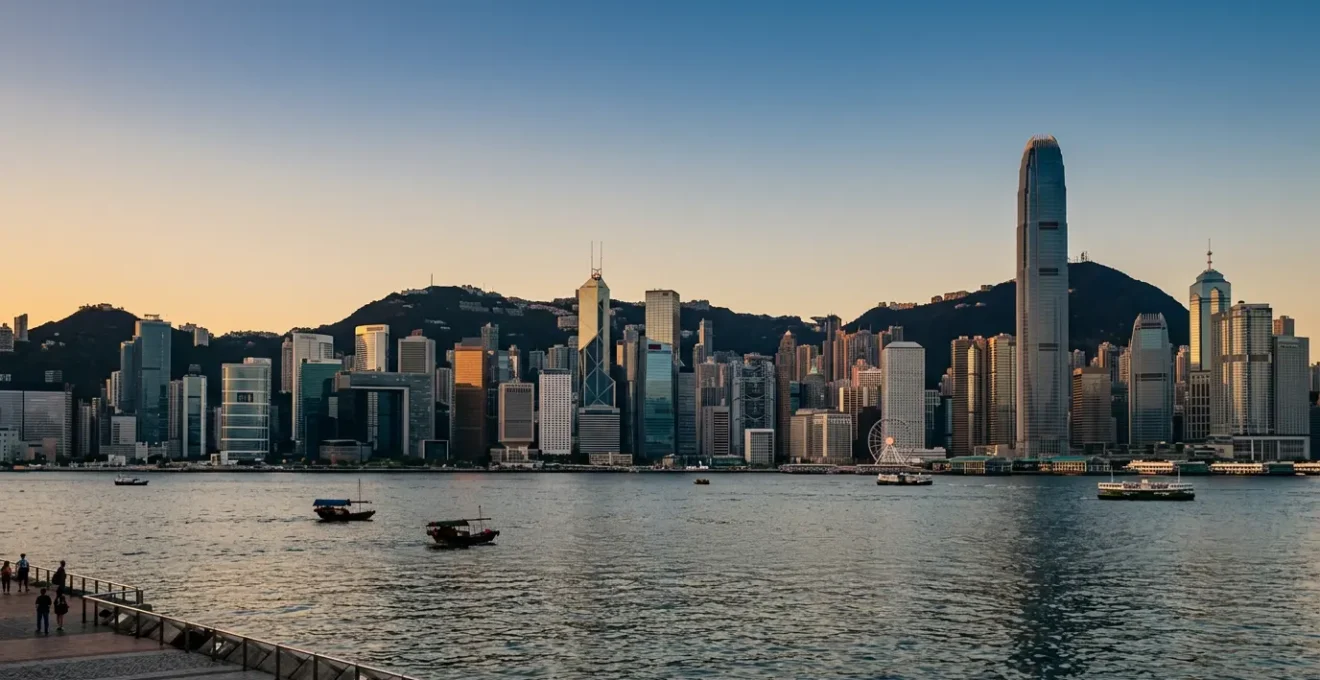
The Hong Kong skyline is an architectural text written in steel and glass, narrating a complex story of conflict between Western modernism and ancient Chinese metaphysics.
- Iconic buildings like the HSBC Main Building and the Bank of China Tower are not just structures, but participants in a visible « Feng Shui battle » that shaped the city’s financial district.
- Features that seem purely aesthetic, such as holes in skyscrapers, are often a blend of spiritual belief in « dragon gates » and pragmatic engineering for wind and ventilation.
Recommendation: To truly understand Hong Kong, an architect must learn to read this vertical dialogue, seeing the city not as a collection of objects but as a dynamic, and often contentious, ecosystem.
For the British architect or design enthusiast visiting Hong Kong for the first time, the initial impact of the skyline is one of overwhelming verticality. It’s a breathtaking forest of steel and glass, a testament to human ambition and density. The common instinct is to catalogue the tallest, the newest, the most glittering additions to this famous vista. But this approach misses the profound narrative embedded within the cityscape. To truly appreciate it, one must look beyond the gleaming façades and learn to read the architectural dialogue that has unfolded here for decades.
This is not merely a collection of standalone monuments. The Hong Kong skyline is a physical manifestation of the city’s unique cultural friction: a battleground where the rational, grid-based logic of Western modernism collides with the fluid, mystical principles of Feng Shui. It’s a story of symbolic capital, where a skyscraper’s design can be an act of political assertion, and where maintenance cranes can be re-interpreted as defensive cannons. This urban fabric is a complex ecosystem where ancient beliefs in spiritual topography directly influence billion-dollar engineering decisions.
This guide moves beyond a simple inventory of famous buildings. Instead, it offers a framework for decoding the hidden forces at play. We will explore the legendary Feng Shui feuds, the practical reasons behind seemingly bizarre design choices, and the unintended ecological consequences of this illuminated metropolis. By understanding the conflicts, compromises, and sheer ingenuity behind the structures, you will learn to see the skyline not just as a sight to behold, but as a story to be read.
This article provides a detailed exploration of the architectural and cultural narratives that define Hong Kong’s urban landscape. The following summary outlines the key topics we will delve into, from spiritual battles in the financial district to essential viewing lists for any design professional.
Summary: An Architectural Historian’s Guide to Hong Kong’s Vertical Narrative
- Why Does the HSBC Building Have Cannons Pointing at the Bank of China?
- How Does the Skyline Lighting Impact Migratory Birds During Autumn?
- Ozone or Sevva: Which Rooftop Bar Justifies the £20 Cocktail Price?
- Why Are There Holes in the Middle of Hong Kong’s Residential Skyscrapers?
- How to Book a Junk Boat Trip That Includes the Skyline Light Show?
- How Did I.M. Pei’s Design Challenge Traditional Feng Shui Beliefs?
- Is the M+ Museum of Visual Culture Worth the Entry Fee?
- Which 5 Skyscrapers Must Every Architecture Student See in Central?
Why Does the HSBC Building Have Cannons Pointing at the Bank of China?
The relationship between the HSBC Main Building and the Bank of China (BoC) Tower is the most dramatic chapter in Hong Kong’s architectural dialogue. It’s not just a rivalry between banks; it’s a publicly visible clash of ideologies expressed through design. When I.M. Pei’s BoC Tower was completed in 1990, its sharp, angular form was immediately seen as hostile in the world of Feng Shui. Its knife-like edges were believed to project negative energy, or ‘sha qi’, directly at its neighbours, including the British Government House and the headquarters of its main competitor, HSBC.
Norman Foster’s HSBC Building, completed five years earlier, was a marvel of high-tech design and, notably, Feng Shui compliance. Its open ground floor allows positive energy (‘qi’) to flow from the mountains to the water, and its design is meticulously balanced. The perceived threat from the BoC Tower demanded a response. While never officially confirmed as such, the solution was a masterclass in symbolic architecture.
The HSBC Feng Shui Cannons: A Case Study in Architectural Defense
To counteract the ‘killing energy’ from the Bank of China Tower, the HSBC Building installed two maintenance cranes on its roof. Shaped like cannons and pointed directly at the BoC Tower, they serve as a symbolic defence. This architectural gesture is one of the world’s most famous examples of a « Feng Shui battle. » The perceived negative energy from the BoC Tower was blamed for a series of misfortunes at the nearby Government House and a local economic downturn. Following the installation of its « cannons, » HSBC reported no significant negative impacts, cementing the legend in the city’s folklore. This demonstrates how metaphysical beliefs can drive tangible, multi-million-dollar architectural decisions in a global financial hub.
This « battle » illustrates a core tenet of Hong Kong’s urbanism: buildings are not passive objects. They are active participants in a dynamic environment, capable of both generating and deflecting metaphysical forces. For an architect, it is a fascinating example of how cultural narratives can shape a skyline as much as structural engineering.
How Does the Skyline Lighting Impact Migratory Birds During Autumn?
While the skyline’s narrative is often dominated by human-centric stories of finance and Feng Shui, there is a significant ecological subplot unfolding every night. Hong Kong’s intense illumination, including the famous « Symphony of Lights » show, creates one of the most light-polluted urban environments on Earth. This has profound consequences for nocturnal wildlife, particularly for the millions of migratory birds that use the East Asia-Australasian Flyway, a critical flight path on which Hong Kong is a vital stopover point.
For these birds, which often navigate by celestial cues like the moon and stars, the city’s artificial glow is disorienting. The phenomenon, known as « fatal light attraction, » can draw them off course and into the city’s dense vertical landscape. The result is exhaustion, depletion of energy reserves, and, tragically, collisions with the very glass façades that make the skyline so spectacular. The issue of bird-window collisions is a growing concern for conservationists, who are documenting the silent toll of this engineered ecology.
Being an important stop-over point of the East Asia-Australasian Flyway for migratory birds, Hong Kong’s excessive outdoor lightings may affect migratory as well as non-migratory birds. It may disorient physiological cycles and the movement of animals.
– UKEssays Environmental Sciences, Light Pollution In Hong Kong Environmental Sciences Essay
This conflict between aesthetic spectacle and ecological impact is becoming a key part of the city’s architectural discourse. A recent report found that 284 birds died and 25 were injured in window collisions across 16 districts between 2022 and 2023, highlighting the tangible cost of light pollution. This has led to calls for bird-friendly building design, including fritted glass and reduced nighttime lighting during peak migration seasons in spring and autumn.
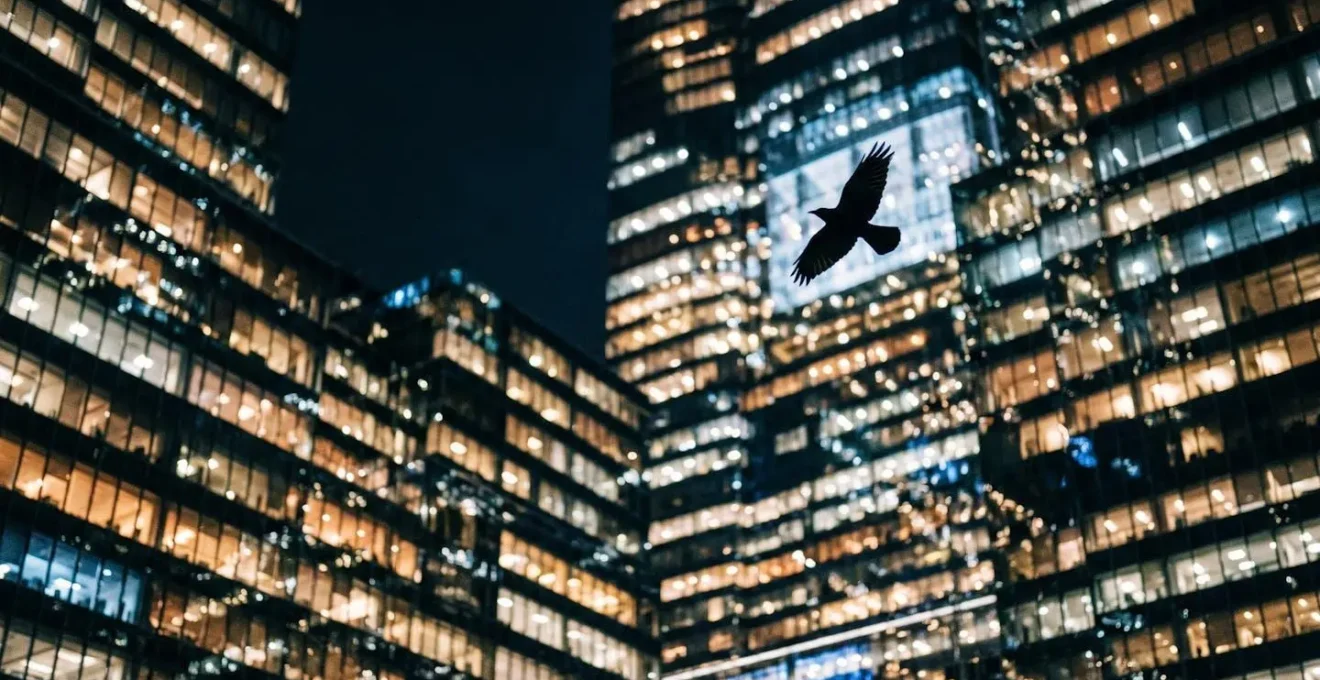
For visiting architects, this issue presents a critical design challenge: how can a city known for its vibrant, illuminated identity evolve to mitigate its environmental impact? It forces a re-evaluation of what constitutes « good » urban design, expanding the definition to include not just human experience but also the well-being of the natural ecosystems it displaces.
Ozone or Sevva: Which Rooftop Bar Justifies the £20 Cocktail Price?
For an architecture enthusiast, the £20 cocktail at a Hong Kong rooftop bar is not an expense; it’s an admission ticket to a specific architectural experience. The choice between the city’s two most famous sky-high venues, Ozone and Sevva, is not about mixology, but about perspective and narrative. They offer two fundamentally different ways of engaging with the skyline.
Ozone, located on the 118th floor of the International Commerce Centre (ICC) in Kowloon, is an exercise in overwhelming scale. As one of the highest bars in the world, it offers a god-like, top-down view. You are not *in* the skyline; you are *above* it. The view abstracts the city into a glittering circuit board, a map of light and shadow. The interior design by Wonderwall is futuristic and cavernous, reinforcing the feeling of being in a space station observing a distant world. The price here buys you a sense of detachment and awe at the sheer magnitude of the urban project below. It’s a macro-view, perfect for comprehending the city’s scale.
Sevva, by contrast, sits atop the Prince’s Building in Central, right in the heart of the action. Its terrace places you at eye-level with the legends of the skyline: Foster’s HSBC Building, Pei’s Bank of China Tower, and the IFC complex. Here, you are an active participant in the architectural dialogue. You can appreciate the textures, the structural details, and the spatial relationships between these iconic towers. The atmosphere is less about futuristic awe and more about classic metropolitan glamour. The price at Sevva buys you intimacy and a front-row seat to the history you’ve come to study. It’s a micro-view, ideal for analysis and appreciation of detail.
So, which justifies the price? For the historian and design buff, Sevva often provides more value. While Ozone’s height is a novelty, Sevva’s perspective offers a richer, more contextualised understanding of the architectural forces that define Central’s core. It allows you to inhabit the very space where the city’s most important architectural stories were written.
Why Are There Holes in the Middle of Hong Kong’s Residential Skyscrapers?
Among the most curious features of Hong Kong’s residential architecture are the large, gaping holes that punctuate some of the city’s largest tower blocks, most famously at The Repulse Bay complex. For many visitors, these voids seem like a bizarre structural or aesthetic choice. However, they are a perfect example of how spiritual topography and pragmatic engineering can converge in Hong Kong design.
The most widely cited explanation is rooted in Feng Shui. The city’s landscape is seen as a living system, inhabited by dragons that reside in the mountains behind the city. Every day, these dragons must travel down to the water to drink and bathe. The massive residential blocks built along the coastline risk blocking their path. According to belief, obstructing a dragon’s path invites misfortune and bad luck upon the inhabitants.
Such ‘dragon gates’ are designed to let these mythical flying beasts pass from their hilltop homes down to the water each day and then return again each night.
– 99% Invisible, Here Be Dragons: How Feng Shui Shapes the Skyline of Hong Kong
This mystical narrative, however, is beautifully complemented by sound architectural and environmental principles. In a city as dense as Hong Kong, large buildings can create a « wall effect, » obstructing not just mythical creatures but also air and light. These gaps enhance natural ventilation, allowing wind to pass through the building clusters rather than being deflected, which is crucial for comfort in a subtropical climate and for dispersing pollutants. They also help to break up the visual mass of colossal structures and allow more natural light to reach surrounding areas.
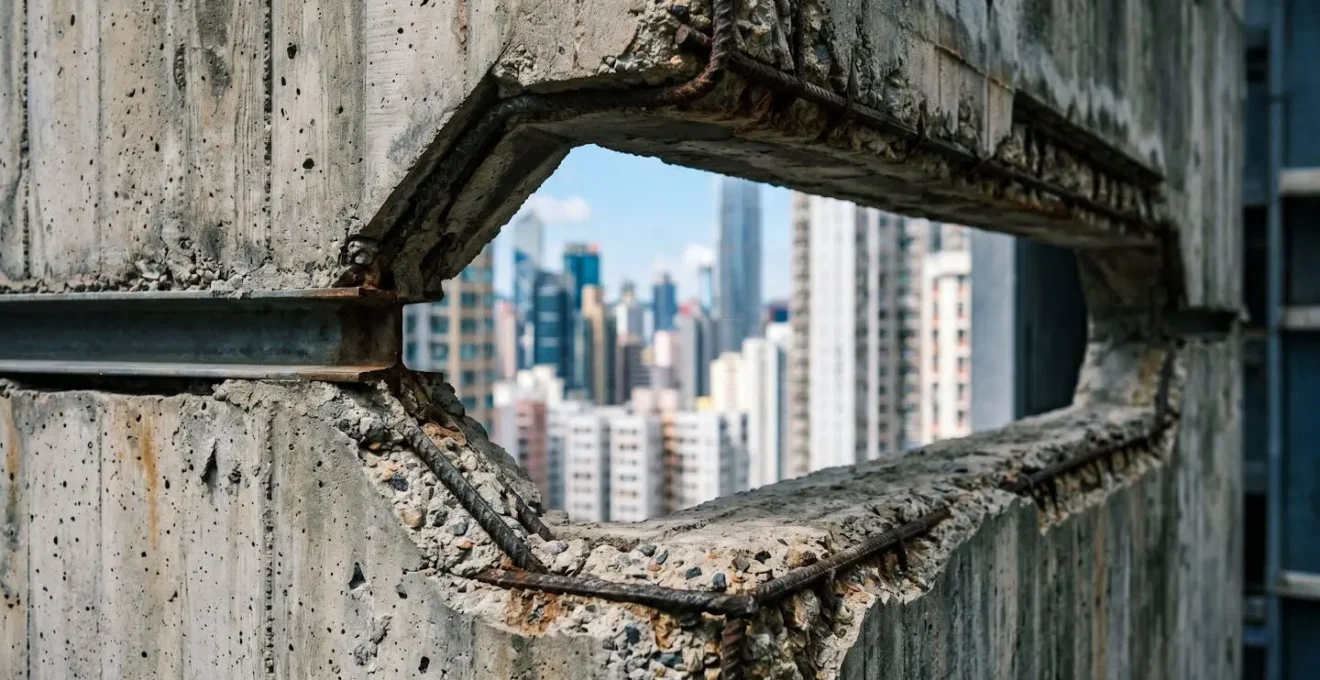
The Repulse Bay: From Colonial Hotel to Dragon Gate Icon
The Repulse Bay, a luxury residential complex completed in 1986, is perhaps Hong Kong’s most iconic « dragon gate » building. Interestingly, the hole was not originally a Feng Shui consideration. As a CNN report on the phenomenon explains, the ‘spirit dragon’ narrative emerged locally as a way for residents to process the loss of the beloved colonial-era hotel that previously occupied the site. While the myth provided a cultural justification, the design also serves critical practical functions. The void helps to mitigate the environmental « wall-effect » of such a high-density development and improves air circulation, demonstrating a perfect synthesis of cultural symbolism and pragmatic design that is uniquely Hong Kong.
These « dragon gates » are therefore a quintessential Hong Kong solution: a design feature that satisfies ancient spiritual beliefs while simultaneously addressing modern environmental and engineering challenges.
How to Book a Junk Boat Trip That Includes the Skyline Light Show?
Experiencing the Hong Kong skyline from the water, especially during the nightly « Symphony of Lights, » is an essential ritual for any visiting architect. It offers a dynamic, kinetic perspective that a static viewpoint from a bar or hilltop cannot match. Booking the right trip, however, requires a little insider knowledge to avoid the more generic tourist traps.
The two most iconic options are the AquaLuna and the Dukling. The AquaLuna is a modern vessel built in a traditional junk style, known for its distinctive red sails. It offers a more polished, comfortable experience with lounge-style seating and an included drink. It is reliable, easy to book online, and its routes are specifically timed to catch the 8 PM light show from a prime position in Victoria Harbour. The Dukling, on the other hand, is a genuinely historic fishing junk, offering a more rustic and authentic experience. A trip on the Dukling is less about luxury and more about connecting with the city’s maritime heritage.
For a more tailored experience, consider a private charter. Numerous companies like Hong Kong Junks or Island Junks offer private rentals, which, while more expensive, allow a small group to dictate the route and timing. This is an excellent option for a delegation of architects who might want to linger in specific spots to study the interplay of light on certain building façades.
When booking, focus on these key factors:
- Timing: Ensure the tour is explicitly advertised as a « Symphony of Lights » cruise. These typically depart around 7:30-7:45 PM to get into position.
- Departure Pier: Most tours depart from Tsim Sha Tsui (Kowloon side) or Central (Hong Kong Island side). Choose whichever is more convenient, as they all converge in the middle of the harbour.
- Duration: A standard light show cruise lasts about 45-60 minutes. Longer harbour tours are available but may not be focused on the 8 PM show.
- Vessel Type: Decide between the polished comfort of a modern replica like AquaLuna, the historical authenticity of Dukling, or the flexibility of a private charter.
Booking in advance online is highly recommended, especially during peak tourist seasons (October-December), as the best tours sell out quickly.
How Did I.M. Pei’s Design Challenge Traditional Feng Shui Beliefs?
The Bank of China Tower is more than just a skyscraper; it is a profound and deliberate statement. Designed by the Pritzker Prize-winning architect I.M. Pei, it represents a conscious decision to prioritize the universal principles of modernist architecture over the deeply ingrained local traditions of Feng Shui. This choice was not accidental but ideological, making the tower the most controversial and intellectually significant building in the city’s history.
The Bank of China Tower is the only major building in Hong Kong that doesn’t follow the 3,000-year-old Chinese practice of feng shui, the belief that the energy of your environment affects well-being and prosperity.
– Atlas Obscura, HSBC Building Feng Shui Cannons
Pei’s design was a direct challenge on multiple levels. Its most aggressive features are the sharp, triangular forms and the massive X-shaped trusses on its façades. In Feng Shui, sharp angles and edges are considered « sha qi » or « killing energy, » projecting hostility towards their surroundings. The ‘X’ symbol is particularly problematic in Chinese culture, where it can be associated with being ‘crossed out,’ or even with death. This starkly contrasted with the prevailing practice among Hong Kong developers, who would invariably consult a Feng Shui master to ensure a building’s design was harmonious and auspicious.
I.M. Pei’s Modernist Ideology vs. Feng Shui Tradition
Trained in the international modernist tradition at MIT and Harvard, I.M. Pei’s design for the Bank of China Tower was an assertion of architectural principle over what he considered local superstition. As detailed in an analysis of Hong Kong’s architectural rivalries, Pei reportedly refused to consult a Feng Shui master, a radical break from convention. His design, with its « knife-edge » angles and symbolic ‘X’ bracing, was immediately blamed for a series of misfortunes, from the Governor’s ill health to economic slumps. However, despite the initial firestorm of controversy, the tower has since been embraced as a bold and beautiful icon of the city. This evolution demonstrates Hong Kong’s remarkable capacity to absorb cultural conflict and transform a symbol of discord into a celebrated part of its identity.
For the student of architecture, the BoC Tower is a critical case study in context and intent. It poses a fundamental question: Should architecture bow to local cultural beliefs, or should it stand as a pure expression of its own artistic and structural logic? Pei’s bold answer remains one of the most powerful statements on the Hong Kong skyline.
Is the M+ Museum of Visual Culture Worth the Entry Fee?
For a tourist, the value of the M+ Museum’s entry fee is determined by the art within its galleries. For an architect, however, a significant portion of the value is in the building itself. Designed by the renowned firm Herzog & de Meuron, M+ is not just a container for art; it is a masterful piece of urban and architectural design that engages in a sophisticated dialogue with Hong Kong.
Firstly, its location is strategic. As the cornerstone of the ambitious West Kowloon Cultural District, it acts as an anchor, reorienting the city’s cultural centre of gravity away from the hyper-commercialism of Central. The building’s horizontality is a radical statement in a city defined by the vertical. Its sprawling, low-slung podium contrasts deliberately with the forest of towers across the harbour, creating a space for civic gathering and repose. It is an architectural argument for the importance of public space in a city starved of it.
The most iconic feature is the massive vertical slab that rises from the podium. This is not just a tower; it is a dynamic media façade. This giant LED screen transforms the building’s surface into a canvas, broadcasting digital art and commissioned works directly onto the city. It engages in a nightly conversation with the commercial-driven light show of the main skyline, offering a cultural counterpoint. From an architectural perspective, this is a brilliant fusion of structure, media, and urbanism, turning the museum’s skin into an exhibition space in its own right.
Inside, the architects have played with space and light in a way that is both monumental and human-scaled. The discovery of a « found space »—a massive subterranean cavern excavated around the Airport Express railway tunnels that run beneath the site—is a stroke of genius, turning an infrastructural constraint into a dramatic, raw exhibition area. So, is it worth the fee? Absolutely. For an architecture enthusiast, the fee buys access to a masterfully executed building that addresses key urban questions of public space, cultural identity, and the role of a civic institution in a vertical city. The building *is* one of the most important exhibits.
Key takeaways
- The Hong Kong skyline is a physical record of a decades-long « architectural dialogue » between Western modernism and traditional Feng Shui.
- Features like the HSBC « cannons » and « dragon gates » in residential towers are not mere eccentricities but are rooted in a complex blend of spiritual belief, symbolic defence, and pragmatic engineering.
- Understanding the intent behind a building, such as I.M. Pei’s deliberate defiance of Feng Shui, is crucial to decoding its significance beyond its aesthetic form.
Which 5 Skyscrapers Must Every Architecture Student See in Central?
Hong Kong is a living museum of high-rise architecture, a city where the story of the modern skyscraper can be read across its skyline. With a density that is almost unparalleled—the city contains over 9,000 high-rise buildings, with 567 of those soaring above 150m—it can be difficult to know where to focus. For any architecture student or design professional, a walking tour of Central’s core offers the most concentrated lesson in the evolution of architectural thought, engineering, and cultural expression. The elevated walkway system allows for a unique, pedestrian-level engagement with these giants.
This curated list focuses not just on height, but on historical and conceptual significance. Each of these five buildings represents a pivotal moment in Hong Kong’s architectural narrative, from early modernist solutions to contemporary approaches in sustainability and heritage conservation. They are the essential case studies that every architect should experience firsthand to understand the forces that have shaped this extraordinary vertical city. They tell a story of technological innovation, economic ambition, cultural conflict, and, more recently, a growing consciousness of the city’s own built heritage.
Your Central Architectural Walking Tour: 5 Essential Skyscrapers
- Jardine House (1972) – Early Modernism: Recognizable by its 1,748 distinctive circular porthole windows, this 52-storey building is a masterclass in structural ingenuity. The portholes were not just an aesthetic choice; they were designed to reduce the structural weight and wind load in Hong Kong’s typhoon-prone climate while maximizing interior light.
- HSBC Main Building (1985) – High-Tech Architecture: Norman Foster’s masterpiece was the world’s most expensive building upon completion. Its revolutionary suspension structure, with floors hung from exposed steel masts, and its ground-level public atrium, exemplify high-tech principles and a nod to Feng Shui with its use of rooftop mirrors to reflect light down into the atrium.
- Bank of China Tower (1990) – Postmodernism Meets Politics: I.M. Pei’s iconic 367m tower was the city’s first major skyscraper to defiantly ignore Feng Shui principles. Its sharp, asymmetrical geometry and exposed ‘X’ bracing were seen as aggressive ‘killing energy’ and remain a powerful statement of modernist ideology.
- Two International Finance Centre (2003) – Post-Handover Confidence: Soaring to 415m, this elegant, tapering tower designed by César Pelli became a symbol of Hong Kong’s economic ambition after the 1997 handover. Its direct connection to the Airport Express station positions it as a grand gateway to the city.
- The Murray (2018) – Adaptive Reuse: Originally a 1969 government office block, this building was transformed into a luxury hotel by Foster + Partners. The project preserved the building’s distinctive recessed square windows and arches, showcasing a critical shift in Hong Kong towards heritage conservation and sustainable adaptive reuse.
Walking between these five structures, you are tracing the very DNA of Hong Kong’s architectural evolution. Each one is a chapter in the city’s story, a response to the challenges and aspirations of its time. To an architect, this is the most valuable lesson the city has to offer.
Now armed with the ability to decode the skyline, your next visit to Hong Kong can be transformed. Go beyond mere sightseeing and engage in an act of architectural analysis. Every building has a story, and you now have the tools to read them.