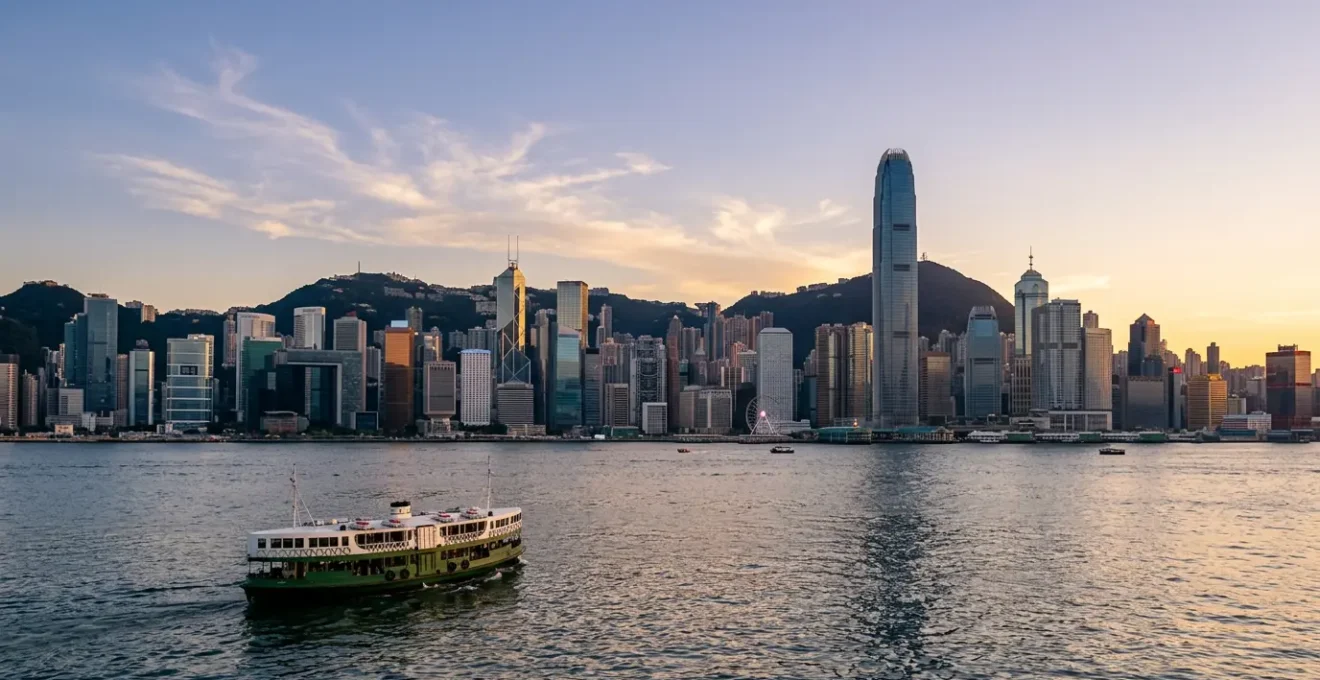
A Hong Kong stopover is more than a break; it’s a strategic tool that makes the long-haul flight from the UK to Australia more efficient and enjoyable.
- It offers a distinct circadian advantage over Middle Eastern hubs, helping you arrive less jet-lagged.
- The city’s hyper-dense layout and world-class transit allow you to experience more in 48 hours than sprawling alternatives.
Recommendation: Use Hong Kong as a biological reset and cultural primer, turning the exhausting journey into a valuable part of your overall trip.
The prospect of a 24-hour flight from London to Sydney or Melbourne is a daunting one for any traveller. The default mindset is often one of endurance: find the quickest route, brace for the jet lag, and just get it over with. Many look to hubs like Dubai or Singapore to split the journey, treating the stopover as a necessary inconvenience. These are fine choices, but they often overlook a more strategic option.
What if the stopover wasn’t just a pause, but a calculated tool to improve your entire travel experience? What if it could actively reduce jet lag, offer a more profound cultural immersion, and do so with unparalleled efficiency? This is where Hong Kong distinguishes itself, not just as another option, but as the logically superior hub for UK travellers heading Down Under. It’s a city built on a principle of ‘experience density’—where mountains meet skyscrapers and ancient traditions coexist with futuristic finance.
Forget the generic advice. The key to a successful long-haul journey isn’t just surviving it; it’s about mastering it. The true advantage of Hong Kong lies in its unique geographical position for managing your body clock, its hyper-efficient transport that makes a 48-hour visit feel like a week, and an authentic, gritty character that provides a stark, refreshing contrast to the polished perfection of its rivals.
This guide will deconstruct the strategic benefits of a Hong Kong stopover. We’ll explore the science behind its jet lag advantage, provide a practical blueprint for a visit under £100 a day, and offer insider tips to navigate the city’s unique transport systems like a seasoned local. It’s time to stop thinking of the layover as a layover and start seeing it as your first destination.
To help you plan the most effective layover, this article breaks down the essential strategic considerations, from managing your body clock to navigating the city’s transport like a local. Explore the sections below to build your perfect 48-hour itinerary.
Summary: Why Hong Kong Is the Smartest 48-Hour Stopover on Your Way to Australia
- Why Is a Hong Kong Stopover Better Than Dubai for Circadian Rhythms?
- How to Spend Less Than £100 per Day During a Hong Kong Layover?
- Hong Kong or Singapore: Which City Offers More in a 2-Day Visit?
- What Are the Current Entry Rules for British Citizens Entering Hong Kong?
- How to See the Big Buddha and The Peak in Just 12 Hours?
- Why Are Hotel Rooms in Hong Kong So Small Compared to Western Standards?
- Red vs Green Minibus: Which One Can You Flag Down Anywhere?
- How to Use the Citymapper App to Navigate Hong Kong Like a Local?
Why Is a Hong Kong Stopover Better Than Dubai for Circadian Rhythms?
The biggest challenge of the UK-Australia route isn’t the flight time; it’s the 10-hour time difference your body is forced to endure. A stopover is the obvious solution, but not all stopovers are created equal. The choice of hub has a direct biological impact. A stop in Dubai (GMT+4) from London (GMT+0) is a small four-hour jump. You then face a further six-hour jump to Sydney (GMT+10). This breaks the journey but does little to help your body clock (suprachiasmatic nucleus) adjust gradually.
Hong Kong (GMT+8) offers a far more intelligent « stepping stone. » The initial flight from the UK lands you in a time zone that is already 80% of the way to your final destination. This allows your body to make one significant adjustment and then only a minor two-hour hop to eastern Australia. This ‘Circadian Advantage’ means you land in Australia feeling more synchronised and less debilitated by jet lag, giving you a head start on your holiday or business trip.
Moreover, eastward travel is notoriously harder on the body than westward. Actively managing your light exposure is the most powerful tool to combat this. A morning arrival in Hong Kong provides the perfect opportunity to immediately start this process by exposing yourself to bright, natural sunlight, which is the primary signal for resetting your internal clock. By following a structured protocol, you can effectively command your body to adapt faster.
Your Action Plan: Light Exposure Protocol for Eastward Travel
- In the 3-4 days before eastward travel, gradually move bedtime and wake-up time earlier by 30-60 minutes per day.
- Minimise evening light exposure during these preparation days to help your circadian clock advance.
- Maximise morning light exposure during preparation days; aim for bright light immediately upon waking.
- Upon morning arrival in Hong Kong, immediately expose yourself to 2+ hours of outdoor sunlight.
- Avoid napping before 8 PM local Hong Kong time to force your internal clock to advance its schedule.
- Consider taking 3.0 mg of melatonin 6.5 hours before your target bedtime in the new time zone to aid the shift.
By treating your stopover as a strategic tool for acclimatisation, you transform dead travel time into a productive part of your journey, ensuring you arrive ready to go.
How to Spend Less Than £100 per Day During a Hong Kong Layover?
Hong Kong’s reputation as a city of high finance and luxury shopping can be misleading for the short-stay traveller. In reality, it is one of the most budget-friendly world cities if you live like a local. The goal of a sub-£100 per day stopover is not just achievable; it’s comfortable. In fact, data shows that on average, budget travelers spend approximately £62 per person per day, based on the expenses of previous visitors.
The first key is transport. A single Octopus card, available at the airport, is your passport to the city. It covers the MTR (metro), buses, ferries, and even trams and minibuses. A 48-hour stay will likely cost no more than £15-£20 in total transit fees, including the iconic Star Ferry crossing, which offers million-dollar views for about 25p.
The second, and more enjoyable, key is food. Avoid the expensive Western-style restaurants in Central. Instead, dive into the world of Dai Pai Dongs (open-air food stalls) and local canteens (cha chaan tengs). A hearty meal of wonton noodle soup or roast goose on rice can be found for under £5. For breakfast or lunch, nothing beats the experience of authentic dim sum.

As this image shows, the focus is on craftsmanship and flavour, not expensive decor. You can have a fantastic, filling dim sum meal for less than £10 per person. The rest of your budget can be allocated to a budget-friendly guesthouse in areas like Tsim Sha Tsui or Mong Kok, and the countless free activities: hiking the Dragon’s Back trail, exploring temples, or simply walking the neon-lit streets of Kowloon.
A stopover here doesn’t have to break the bank. It’s an opportunity to experience a rich culinary culture and vibrant street life at a fraction of the cost you might expect.
Hong Kong or Singapore: Which City Offers More in a 2-Day Visit?
For UK travellers, the stopover debate often boils down to two titans: Hong Kong and Singapore. Both are safe, clean, and efficient English-speaking hubs. However, when the clock is ticking on a 48-hour layover, their fundamental differences in geography and character become critical. Singapore is defined by its calculated polish and pristine, planned environment. Hong Kong, in contrast, thrives on a certain chaotic charm and serendipity.
The primary advantage for a short visit is Hong Kong’s ‘experience density’. Its hyper-vertical and compact geography, combined with an unparalleled public transport network of ferries, trains, and buses, means you can transition between wildly different environments with breathtaking speed. You can be in the heart of the world’s most intense urban jungle in Central and, 30 minutes later, be standing on a remote beach or at the trailhead of a rugged mountain path. This rapid transition from urban to nature is something Singapore, with its more horizontally spread-out layout, simply cannot match.
This density allows for a greater variety of experiences in a shorter time. You can island-hop, explore traditional fishing villages, and immerse yourself in distinct neighbourhoods all within a few hours. A recent comparative analysis for stopover travellers highlights these key differences, which are crucial for anyone with limited time.
| Criteria | Hong Kong | Singapore |
|---|---|---|
| Urban to Nature Transition Time | 30 minutes (Central to Dragon’s Back trailhead) | 45-60 minutes to nature reserves |
| Distinct Neighborhoods Accessible in 4 Hours | 5-6 (Central, Kowloon, Lantau Island via ferry, traditional villages) | 3-4 (spread out layout requires more transit time) |
| Compact Geography Advantage | Hyper-vertical, ferry connections enable island-hopping | Horizontal spread, more reliant on MRT/buses |
| Character | Chaotic charm, serendipitous discoveries, authentic contrasts | Calculated polish, pristine planned environment |
| Natural Hiking Access | Wild country parks, rugged trails (40% of land area) | Manicured gardens, man-made environments |
| Free High-Quality Experiences | Star Ferry, temples, escalators, harbor walks, hiking trails | Gardens by the Bay (partially free), harbor walks |
While Singapore offers a flawless and relaxing break, Hong Kong provides a more dynamic, memorable, and ultimately more efficient stopover experience. It’s a city that rewards curiosity and proves that 48 hours is more than enough time for a genuine adventure.
What Are the Current Entry Rules for British Citizens Entering Hong Kong?
Navigating entry requirements can be a source of anxiety for any international traveller, but for British citizens, entering Hong Kong for a stopover is remarkably straightforward and stress-free. The process has been streamlined over the years, making it one of the most accessible entry points in Asia. The most important piece of information is the visa-free arrangement.
As the UK Foreign, Commonwealth & Development Office confirms, the rules are clear and generous. In their official travel advice, they state:
You can visit Hong Kong for up to 6 months without a visa.
– UK Foreign, Commonwealth & Development Office, Hong Kong Travel Advice – Entry Requirements
This removes the primary hurdle and administrative burden for travellers. There is no need for pre-arrival applications, embassy visits, or fees. For a 48-hour layover, you are well within this 180-day limit. The on-arrival process is equally simple, having been digitised to eliminate the old paper landing cards. However, it’s crucial to be aware of the exact steps and, more importantly, the strict rules on prohibited items.
Here is the step-by-step process British citizens should expect:
- Passport Validity: Ensure your British passport is valid for at least one month after your planned departure date from Hong Kong.
- Visa-Free Entry: No pre-arrival visa is needed. You’ll be granted entry for up to 180 days upon arrival.
- No Landing Card: The requirement for a paper landing card was abolished in 2024, speeding up the process.
- Immigration Slip: The immigration officer will scan your passport and give you a small printed slip with your name and permitted stay duration.
- Keep The Slip: Do not lose this slip. Staple it into your passport immediately as it is your official proof of legal entry.
- Onward Travel: Be prepared to show proof of your flight to Australia/NZ and evidence of sufficient funds for your stay, although this is rarely requested for short stopovers.
- CRITICAL – Prohibited Items: Do not bring e-cigarettes or any CBD products. These items are strictly illegal in Hong Kong and carry severe penalties, including fines and imprisonment. The personal allowance for traditional cigarettes is also very low (19 cigarettes).
Overall, Hong Kong’s open and efficient entry process for British citizens further solidifies its status as the most hassle-free and logical stopover hub in the region.
How to See the Big Buddha and The Peak in Just 12 Hours?
Combining Hong Kong’s two most iconic sights—the Tian Tan Buddha (Big Buddha) on Lantau Island and the panoramic skyline view from Victoria Peak—in a single day seems ambitious, but it is entirely possible with a strategic plan. This is a classic « mission » for a stopover traveller, and success hinges on choosing the right transport sequence. It’s a full-day commitment, requiring roughly 10-12 hours, but the payoff is immense.
The key is to tackle the Big Buddha in the morning to avoid the worst of the crowds and heat, and to save The Peak for the late afternoon and evening to witness the spectacular transition from daylight to the « Symphony of Lights » that illuminates the harbour. The journey between the two involves traversing from an outlying island back to the heart of Hong Kong Island. Your choice of route will depend on your priorities: scenery, speed, or budget. For instance, as a resource like Rome2rio’s journey planner can help visualise, there are multiple transport combinations, each with different time and cost implications.
As an expert, I’ve compiled a playbook that breaks down the best options based on different traveller profiles. This allows you to choose the itinerary that best suits your personal style.
| Traveler Type | Big Buddha Route | Peak Route | Estimated Time | Estimated Cost | Pro-Tip |
|---|---|---|---|---|---|
| The Scenester | Ferry to Mui Wo, then bus to Ngong Ping | Bus 15 up (sit top deck, left side), Peak Tram down after sunset | 11-12 hours total | £25-30 | Ferry offers unique harbor views; avoid weekend crowds |
| The Pragmatist | MTR to Tung Chung, then cable car up & down | MTR to Central, Bus 15 both ways | 10-11 hours total | £35-40 | Most time-efficient; cable car queues lighter early morning |
| The Time-Saver | MTR to Tung Chung, cable car up, bus down | Taxi directly to Peak, Peak Tram down at sunset | 9-10 hours total | £60-70 | Taxi to Peak costs ~£50-60 but saves 1+ hour queue time |
| Budget Optimizer | MTR + Bus 23 both ways (no cable car) | Bus 15 up, walk Lugard Road loop, Bus 15 down | 11-12 hours total | £12-15 | Skip paid attractions; free Wisdom Path walk & Lugard Road views superior |
By following one of these proven strategies, you can confidently tick off two of the world’s great travel experiences in a single, unforgettable day, making the most of every moment of your Hong Kong layover.
Why Are Hotel Rooms in Hong Kong So Small Compared to Western Standards?
First-time visitors to Hong Kong, particularly those accustomed to hotel standards in the US or even Europe, are often taken aback by the size of their hotel rooms. It’s a common experience to open the door to a room that feels compact, with the bed taking up most of the floor space and a bathroom that is a marvel of spatial efficiency. This isn’t a sign of a low-quality hotel; it’s a fundamental characteristic of the city’s real estate reality.
The explanation is simple: space is the ultimate luxury in Hong Kong. As travel writer Lauren Juliff notes in her analysis of the city’s travel costs, this is a universal feature:
Not only are the prices for hotels sky-high in this city, but the hotel rooms are uniformly minuscule. Yes, space on these islands is at an absolute premium.
– Lauren Juliff, Never Ending Footsteps – The Cost of Travel in Hong Kong
This premium on space is a direct result of extreme population density. With a population of over 7.5 million people packed into a territory with very limited usable land (much of it is steep, protected parkland), Hong Kong has one of the highest population densities in the world. Every square foot has an incredibly high value, and this is reflected in the design of everything from apartments to hotel rooms.
Instead of viewing this as a negative, it’s more helpful to reframe it as part of the authentic Hong Kong experience. You are not paying for sprawling square footage; you are paying for an unbeatable location. A compact room in areas like Sheung Wan, Tsim Sha Tsui, or Causeway Bay places you right in the pulsating heart of the city, with world-class transport, food, and attractions just steps from your door. Hotels are brilliantly designed to maximise functionality within a small footprint, providing everything you need for a comfortable stay. For a 48-hour stopover, where your time will be spent exploring, the room is simply a clean, safe, and convenient base of operations.
Embrace the efficiency. The real room is the city itself, and by that measure, your accommodations are boundless.
Red vs Green Minibus: Which One Can You Flag Down Anywhere?
While the MTR and Star Ferry are the headline acts of Hong Kong’s transport system, the real key to unlocking the city’s hidden corners lies in mastering its minibus network. These 19-seater vans zip through streets and over hills that trains and double-deckers can’t reach, offering a faster and often more scenic alternative. However, for a newcomer, the system can be baffling, as it’s split into two distinct types: red and green.
Understanding the fundamental difference is crucial. Green Minibuses (GMBs) operate like conventional buses. They have fixed routes, fixed fares, and designated stops. You can’t hail them in the middle of the street; you must wait at a marked stop. They typically accept Octopus cards, making payment simple.
Red Minibuses (RMBs), on the other hand, are the wild cards of the system. They operate on semi-flexible routes, and their drivers can adjust the path based on traffic or passenger destinations. Most importantly, red minibuses are the ones you can flag down anywhere along their route (unless in a no-stopping zone). You pay in cash as you exit, and you must shout out to the driver when you want to get off. This makes them incredibly flexible but requires a bit more confidence and local knowledge.
For a stopover traveller, green minibuses are the safer bet for predictable journeys, like taking the GMB 40 from Causeway Bay to the southern beaches of Repulse Bay and Stanley. Red minibuses are for more spontaneous trips, but using them effectively requires a little more insight, especially regarding payment and communication with the driver.
Knowing which minibus to catch and how to use it is a true rite of passage that elevates you from a tourist to a savvy traveller, opening up parts of the city you would otherwise never see.
Key Takeaways
- Strategic Advantage: A Hong Kong stopover is not just a break; it’s a tool to mitigate jet lag thanks to its favourable time zone placement for UK-Australia travel.
- Experience Density: The city’s compact geography and efficient transit allow you to experience a wider variety of activities (urban, nature, culture) in 48 hours than in sprawling competitors.
- Accessible Authenticity: Hong Kong offers a rich, authentic, and budget-friendly experience if you embrace local transport, food, and the logic behind its compact living spaces.
How to Use the Citymapper App to Navigate Hong Kong Like a Local?
Having the right digital tools on your phone can make the difference between a stressful, confusing stopover and a seamless, efficient one. While Google Maps is the default for many travellers, in Hong Kong, it has a significant blind spot: its integration of the minibus network is poor. To truly navigate the city like a local and harness the full power of its transport system, the essential app is Citymapper.
Citymapper’s key advantage in Hong Kong is its superior integration of both red and green minibus routes. It provides real-time data, route numbers, and walking directions to the nearest stop, something other apps fail to do reliably. This allows you to plan multi-modal journeys that a tourist might never consider—for example, combining the MTR with a specific minibus to reach a remote trailhead in Sai Kung or a hidden beach on the south side of Hong Kong Island. It turns the entire transport network into a coherent, accessible system.
However, Citymapper is just one part of the ultimate digital toolkit for a savvy traveller. To master food, weather, and payments, a few other apps are essential. Your goal is to arrive with a phone that is already equipped for the mission ahead.
Here is the essential digital navigation toolkit for your 48-hour Hong Kong stopover:
- App 1 – Citymapper (Navigation Core): Download before you arrive. Use its ‘Multi-Modal Trip’ feature to plan journeys combining MTR, ferry, and minibus to reach destinations like Tai O or Stanley Market efficiently.
- App 2 – OpenRice (Food Discovery): This is Hong Kong’s equivalent of Yelp or TripAdvisor, but focused entirely on food. Use it to find authentic local restaurants, read reviews (many in English), and discover hidden Michelin Bib Gourmand gems.
- App 3 – MyObservatory (Weather): This is the official app of the Hong Kong Observatory. It provides hyper-local weather alerts, which are crucial for safety, especially during typhoon season (June-September).
- Essential Setup – Digital Octopus: Before you even leave the airport, load your Octopus card details into Apple Wallet or Google Pay. This allows for seamless tap-and-go payment across almost all transport, including green minibuses, ferries, and the MTR.
By leveraging the right technology, you remove the friction from travel, freeing up your time and mental energy to simply enjoy the incredible density of experiences Hong Kong has to offer.
Frequently Asked Questions About a Hong Kong Stopover
Which minibus can I flag down anywhere?
Red minibuses operate on flexible routes and can be flagged down anywhere along their route (except restricted areas). Green minibuses have fixed routes and designated stops only – they cannot be hailed randomly.
How do I tell the driver I want to get off a red minibus?
Shout ‘Yau lok, m’goi!’ (有落,唔該) in Cantonese, which means ‘getting off, thank you.’ The driver will stop at the next safe location.
What payment methods do red and green minibuses accept?
Red minibuses are cash-only and you pay when exiting. Always have exact change. Green minibuses accept Octopus cards, and some may accept cash, but the card is standard.
When should I choose a minibus over the MTR?
Minibuses are superior for destinations not directly served by the MTR system. For example, the Green Minibus 40 from Causeway Bay to Stanley Market offers a scenic and direct coastal route that the train system cannot match, saving significant time.