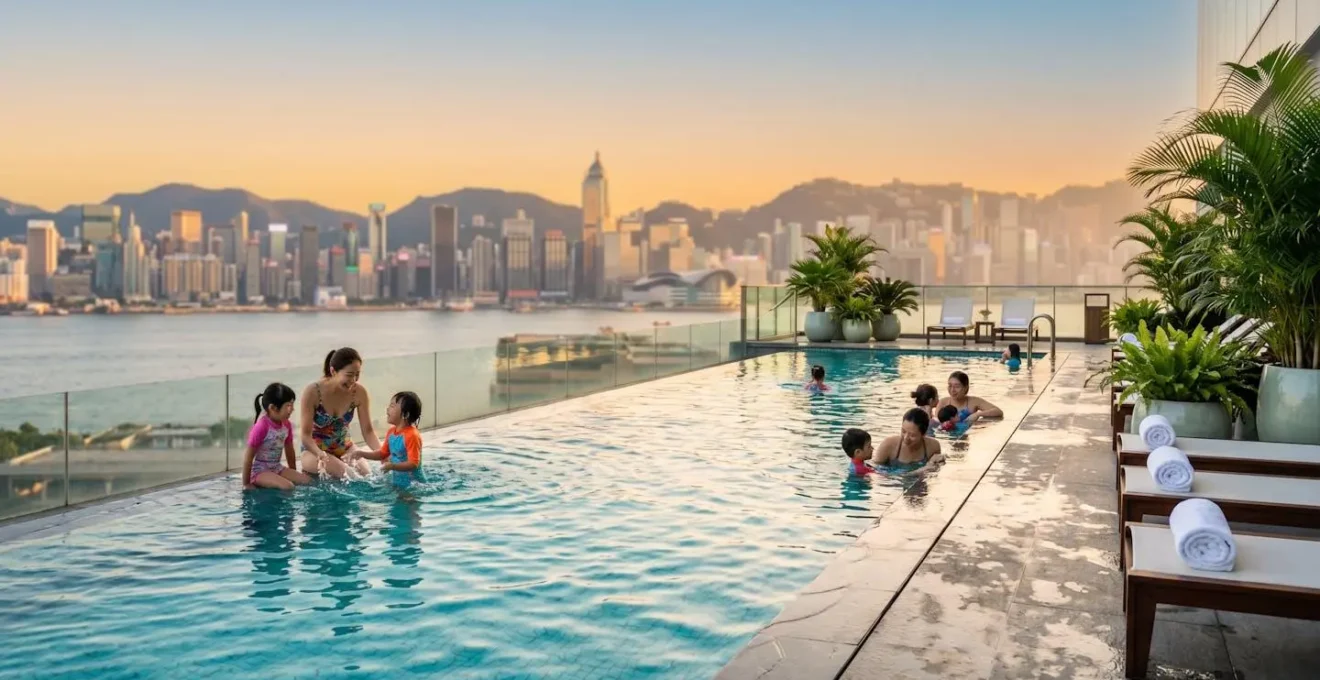
The secret to a successful Hong Kong family trip isn’t just finding a hotel with a pool, but choosing an urban oasis that solves the city’s unique logistical challenges for parents.
- Architectural and legal constraints, not lack of demand, make connecting rooms a rarity in boutique hotels.
- A hotel’s location (Kowloon vs. Island vs. Disney) drastically impacts travel time, cost, and cultural immersion.
Recommendation: Prioritize hotels in Tsim Sha Tsui for a balance of family-friendly amenities, transport links, and authentic cultural experiences, treating your hotel as a strategic logistical hub.
The thought of navigating Hong Kong’s exhilarating, vertical, and often sweltering streets with children in tow can be daunting. The city’s energy is its magic, but for parents, that energy can quickly drain young batteries. The default solution? Find a hotel with a pool. It seems simple enough—a guaranteed way to beat the heat and burn off excess energy. Many travel guides will point you toward the shiniest five-star towers, showcasing infinity pools with jaw-dropping harbour views.
But this approach only scratches the surface. In a city this dense and dynamic, your hotel choice is more than just a place to sleep; it’s a strategic decision that can make or break your trip. The real challenge isn’t finding a pool; it’s finding a true urban oasis that functions as a logistical hub, anticipating and solving the real-world problems parents face. What if the key to a stress-free family vacation wasn’t the view from the pool, but the hotel’s ability to provide safe cribs, reliable English-speaking babysitters, and a breakfast buffet that satisfies even the pickiest eaters?
This guide moves beyond the glossy photos to tackle the practical questions every parent secretly asks. We’ll explore the hidden reasons behind the scarcity of connecting rooms, weigh the pros and cons of staying near Disneyland, and even offer a strategy for protecting your snacks from mischievous macaques. By the end, you’ll be equipped to choose not just a hotel, but the right command center for your family’s Hong Kong adventure.
To help you navigate these crucial decisions, this article breaks down the essential considerations for choosing the perfect family-friendly hotel in Hong Kong. The following sections will guide you through everything from room logistics to dining and location strategy.
Summary: Hong Kong’s Best Hotel Pools for Kids: A Parent’s Survival Guide
- Why Are Connecting Rooms Hard to Find in Hong Kong Boutique Hotels?
- Is It Better to Stay at a Disney Hotel or Commute from the City?
- Are Hotel Babysitting Services in Hong Kong Safe and English-Speaking?
- Which Hotels Offer the Best Kid-Friendly Western Breakfast Buffets?
- Do Hong Kong Hotels Provide Safe Cribs for Infants?
- Why Is a Hong Kong Stopover Better Than Dubai for Circadian Rhythms?
- How to protect your snacks from wild macaques on the path to the statues?
- Kowloon vs Hong Kong Island: Which Side Is Better for First-Time Visitors?
Why Are Connecting Rooms Hard to Find in Hong Kong Boutique Hotels?
One of the first logistical hurdles for families booking a Hong Kong stay is finding adjoining rooms. It’s a common frustration: you find a charming boutique hotel, only to discover connecting rooms are simply not an option. This isn’t due to a lack of demand, but a direct consequence of Hong Kong’s unique architectural and regulatory environment. The city’s hotels operate under some of the highest occupancy rates in the world; government data shows that even with new supply, Hong Kong hotels maintained an average occupancy rate of 87%, making every square foot of space a premium asset.
The primary barrier, however, is structural. Hong Kong’s Hotel and Guesthouse Accommodation Ordinance imposes incredibly strict building and fire safety codes. These regulations are designed to ensure safety in one of the most densely populated places on Earth. A deep dive into the official guidelines reveals that hotels must adhere to rigorous standards for fire-resisting construction, emergency lighting systems, and minimum widths for access routes.
Creating an opening between two rooms for a connecting door is not a simple renovation. It involves compromising a firewall, which requires complex and expensive structural work to maintain safety compliance. For boutique hotels, which are often located in older or mixed-use buildings with tight floor plans, the cost and engineering challenges of providing connecting rooms are often prohibitive. This is a crucial piece of context for families: the scarcity of connecting rooms is a feature of the city’s safety-first design, not a flaw in hotel service.
Is It Better to Stay at a Disney Hotel or Commute from the City?
The quintessential family question: do you immerse yourself completely in the Disney bubble or use a city hotel as your base? The answer depends entirely on your family’s priorities, budget, and tolerance for travel. Staying on-site at a Disney hotel offers undeniable convenience. You get early park entry, the ability to pop back to the room for a midday nap, and a completely seamless, themed experience. However, this comes at a significant premium and isolates you from the vibrant culture of Hong Kong itself.
Commuting from a city hotel in an area like Tsim Sha Tsui or even Tung Chung near the airport presents a different value proposition. It’s more budget-friendly, opens up a world of authentic dining options, and allows you to experience the real Hong Kong. The MTR system is incredibly efficient, making the journey to Disneyland manageable. The trade-off is the travel time and the loss of perks like early access. This decision is a classic battle between a resort-in-the-city experience versus a full cultural immersion.
This comparative table breaks down the key factors to help you decide which approach is the best fit for your family’s adventure.
| Factor | Disney On-Site Hotels | City Hotels (Tsim Sha Tsui) | Near Airport (Tung Chung) |
|---|---|---|---|
| Price Range (per night) | HKD 2,800+ to HKD 70,229+ | HKD 1,200 – 2,500 | HKD 1,500 – 2,000 |
| Travel Time to Park | 5-10 min walk/shuttle | 50 minutes (MTR) | 20 minutes (MTR) |
| Early Park Entry | ✓ (1 hour before opening) | ✗ | ✗ |
| Re-entry Allowed | ✓ Free shuttle | ✗ (HKD 20-60 round trip) | Limited |
| Cultural Exposure | Limited Disney bubble | ✓ Full Hong Kong experience | ✓ Citygate Outlets access |
| Dining Options | Hotel restaurants only | ✓ Extensive local options | Moderate local options |
Are Hotel Babysitting Services in Hong Kong Safe and English-Speaking?
For parents dreaming of a quiet dinner with views of Victoria Harbour, the quality of hotel babysitting services is a non-negotiable concern. The good news is that major international hotel chains in Hong Kong take this service very seriously. However, the model of service varies. Some hotels use their own trained, in-house staff, while many partner with professional third-party agencies. It’s crucial to know which model your hotel uses.
For peace of mind, it’s essential to perform your own due diligence—a process we call « family-proofing » your stay. Don’t hesitate to ask the concierge pointed questions. Reputable services, like the platform Babysitter.HK, which has over 5,000 nannies, set a high standard for the industry. Their professionals typically have a minimum of three years of experience, undergo background checks, and hold certifications in first-aid and childcare. Most are fluent in English and have experience with international families.
When vetting a hotel’s service, whether in-house or third-party, use this checklist to ensure you’re getting a qualified and trustworthy caregiver:
- Source: Is the babysitter hotel staff or from an agency? If an agency, ask for its name and verify its reputation.
- Certifications: What specific qualifications do they have? Inquire about first-aid/CPR, nursery, or child tutoring credentials.
- Experience: How many years of professional childcare experience does the sitter possess?
- Language Skills: Confirm fluency in English beyond basic pleasantries, especially for clear communication in an emergency.
- Screening Process: Ask about the specifics of their background checks, reference verification, and interview procedures.
- Emergency Protocols: What is the procedure in case of a medical issue? How will they contact you, and what is the plan for getting to the nearest hospital?
Which Hotels Offer the Best Kid-Friendly Western Breakfast Buffets?
A hotel breakfast can be a moment of peaceful preparation for the day ahead or a stressful negotiation with a picky eater. For families, a great breakfast buffet is less of a luxury and more of a strategic necessity. In Hong Kong, a city renowned for its culinary scene, hotel breakfasts are a serious affair. The best ones offer a vast spread that caters to both adventurous palates and children who just want familiar comfort food.
Look for hotels with live cooking stations for fresh eggs and pancakes, a variety of Western staples like pastries, cereals, and yogurts, and a colorful fruit selection. Some top-tier family hotels go the extra mile with dedicated kids’ corners, lower-height counters, and even activities like face painting during Sunday brunch. While the price can seem steep, with a typical range for hotel breakfast buffets in Hong Kong from HKD 298 to HKD 398 per adult, the value lies in the convenience and the ability to fuel up the entire family for a long day of exploring without a fuss.
Here’s a look at some of the top-rated hotel breakfast buffets in Hong Kong known for their family-friendly offerings.
| Hotel | Buffet Highlights | Kid-Friendly Features | Price (Adult/Child) | Location |
|---|---|---|---|---|
| Hyatt Regency Hong Kong TST | Live cooking stations, western & Asian mix, gluten-free options | Special kids’ menu, family Sunday brunch with activities, face painting | HKD 278 / HKD 139 | Tsim Sha Tsui |
| Four Seasons Hotel Hong Kong | Continental & American breakfast, Japanese options, wellbeing menu | Complimentary children’s breakfast, high-chair availability | HKD 270-395 / Free | Central IFC |
| Grand Hyatt Hong Kong | Dedicated children’s pool area, diverse buffet, pool toys provided | Playground, garden, complimentary cribs, highchairs | Contact hotel | Wan Chai |
| Ocean Park Marriott Hotel (Marina Kitchen) | Interactive kitchen, seafood bar, crab legs, sashimi | Kids’ dessert station, family-friendly atmosphere | HKD 298 / HKD 188 | Ocean Park area |
| Eaton HK | Multiple stations (Chinese & Western), fresh juice bar, cappuccino bar | Diverse options, dietary restrictions accommodated, spacious layout | Varies with package | Jordan |
Do Hong Kong Hotels Provide Safe Cribs for Infants?
Traveling with an infant brings its own set of safety considerations, with a safe sleeping space being paramount. Most reputable, family-friendly hotels in Hong Kong, especially luxury properties like the Mandarin Oriental, Four Seasons, and Grand Hyatt, offer complimentary cribs upon request. They understand the needs of traveling families and provide amenities like highchairs and child-friendly safety features.
However, there is a critical detail parents from North America or Europe must be aware of. The term « crib » in a Hong Kong hotel context almost always refers to a portable travel cot, often known by the brand name « Pack ‘n Play. » These are perfectly safe and widely used, but they do not typically meet the same strict CPSC/ASTM standards as the full-size wooden or metal cribs common in Western homes. The mattresses are thinner and the sides are made of mesh.
This is not a reflection of lower safety standards, but a difference in product type and local norms. For most families, these travel cots are completely sufficient and convenient. But if your infant is only used to a specific type of crib or you have particular concerns, you should clarify the exact model with the hotel beforehand. For ultimate peace of mind, some families opt to bring their own travel-certified portable crib, though this adds significant bulk to your luggage.
Why Is a Hong Kong Stopover Better Than Dubai for Circadian Rhythms?
When flying from Europe or North America to destinations like Australia or New Zealand, a stopover is essential for breaking up the journey. The two most common hubs are Dubai and Hong Kong. While Dubai offers glamour and impressive attractions, Hong Kong holds a distinct, science-backed advantage for families trying to manage jet lag: its time zone. Hong Kong is geographically better positioned to help reset your family’s internal clocks, or circadian rhythms. A stopover here breaks the journey into more manageable segments, making the time shift less abrupt and brutal on little bodies.
Beyond the time zone advantage, Hong Kong offers a more compelling environment for combating travel fatigue. The goal of a stopover is to adjust to the new time by staying active during daylight hours. Hong Kong’s blend of urban exploration, nature trails, and engaging attractions provides endless opportunities to do just that. And after a long day of exploring, the value of a hotel pool becomes immeasurable. As the editorial team at Time Out Hong Kong aptly puts it:
The humid and sometimes oppressive weather in Hong Kong makes you yearn for a refreshing swim to cool off.
– Time Out Hong Kong editorial team, Time Out Hong Kong – Most Beautiful Hotel Pools article
This is the core of the « urban oasis » strategy. A refreshing pool isn’t just a fun activity; it’s a powerful tool in your circadian strategy, helping to revive tired kids, wash away the grime of a long flight, and create a positive anchor to the new daytime hours. This combination of a strategic time zone and a refreshing, engaging environment makes Hong Kong a superior choice for a family-friendly stopover.
How to protect your snacks from wild macaques on the path to the statues?
A trip to see the Ten Thousand Buddhas Monastery or a hike in Kam Shan Country Park (Monkey Hill) is a classic Hong Kong experience. It can also turn into a stressful encounter if you’re not prepared for the local residents: the wild macaques. These monkeys are clever, bold, and have learned to associate tourists with food. Protecting your snacks—and your belongings—requires a « stealth mode » approach, not confrontation.
The biggest mistake is underestimating their intelligence. They recognize food packaging, the crinkle of a plastic bag, and even the logos of popular convenience stores. They are also drawn to shiny objects like phones, sunglasses, and water bottles. The key is to make yourself and your family as uninteresting as possible. This means hiding all potential « treasures » out of sight and understanding their body language to avoid escalating a situation.
Engaging with them, feeding them (which is often illegal), or trying to scare them away can lead to aggressive behavior. The best defense is a good offense based on camouflage and avoidance. Follow this checklist to ensure your encounter with Hong Kong’s macaques remains a delightful photo opportunity, not a chaotic struggle for your snacks.
Your Action Plan: The Macaque Stealth Mode Strategy
- Go Opaque: Use zip-up backpacks with no external pockets. Store all food inside matte, solid-colored bags, and avoid any crinkly or transparent packaging that signals « food. »
- Establish a No-Food Zone: Do not eat or drink anything within 20 meters of visible monkeys. Keep all bags completely sealed while in their territory.
- Secure Shiny Objects: Put away phones, cameras, jewelry, and sunglasses in interior pockets. Macaques associate shiny items with tourist rewards.
- Avoid Eye Contact: Direct eye contact is a sign of aggression in the macaque world. Keep your gaze down and move calmly and predictably.
- Don’t Use a Decoy: Never try to trick or bait monkeys with a small amount of food. This is dangerous, encourages their aggressive habits, and reinforces the human-food connection.
Key takeaways
- The availability of connecting rooms in Hong Kong is primarily limited by strict fire safety regulations, not a lack of family-friendly focus.
- Staying at a Disney hotel offers ultimate convenience but at a high cost and with limited cultural exposure compared to a city-based hotel.
- For first-time family visitors, Kowloon (specifically Tsim Sha Tsui) often provides a better balance of accessibility, dining options, and value than Hong Kong Island.
Kowloon vs Hong Kong Island: Which Side Is Better for First-Time Visitors?
The final strategic decision is choosing which side of Victoria Harbour to make your home base. Hong Kong Island (home to Central, Wan Chai, and Causeway Bay) is the financial heart, with a polished, international feel, upscale dining, and iconic sights like Victoria Peak. Kowloon (home to Tsim Sha Tsui, Mong Kok, and Jordan) feels more grounded, chaotic, and traditionally Chinese, bustling with street markets and local eateries.
For first-time families, Kowloon often emerges as the superior choice. Areas like Tsim Sha Tsui (TST) are a perfect logistical hub. They offer a wider range of hotels with family-friendly amenities at more competitive prices. The pavements can be crowded, but the waterfront promenade is fantastic for a stroller walk with epic views of the island’s skyline. TST is a major MTR interchange, providing easy access to all corners of the city, and the iconic Star Ferry to Central is an attraction in itself.
Hong Kong Island is fantastic, but its steep hills can be a challenge with strollers, and the overall cost of dining and accommodation is higher. Kowloon offers a more immersive, action-packed experience that often captivates children, from the dazzling lights of Nathan Road to the wonders of the Space Museum. Ultimately, the choice depends on your family’s travel style, but Kowloon provides a powerful combination of convenience, culture, and value.
This table summarizes the atmosphere and practical considerations for each side to help you find your ideal base of operations.
| Factor | Kowloon (Tsim Sha Tsui/Mongkok) | Hong Kong Island (Central/Wan Chai) |
|---|---|---|
| Vibe & Energy | Bustling street markets, local culture, shopping districts | Financial hub, upscale dining, colonial heritage |
| Stroller-Friendliness | Mixed – crowded pavements, some incline challenges | Better pavement quality, more space, steeper inclines to Peak |
| MTR Access | ✓ Excellent – Tsim Sha Tsui hub, multiple lines | ✓ Excellent – Central hub, Airport Express |
| Family Attractions | Avenue of the Stars, Space Museum, cultural museums, waterfront promenade | Victoria Peak, Hong Kong Park, Science Museum, tram rides |
| Hotel Availability | More connecting room options, mid-range to luxury | Premium hotels with babysitting, fewer connecting rooms |
| Dining Variety | ✓ Extensive street food, local eateries, affordable | High-end restaurants, international cuisine, more expensive |
| Best For | Action-seekers, budget-conscious families, authentic local experience | Chill explorers, luxury seekers, panoramic views, expat-friendly areas |
With these insights, you are now equipped to look past the marketing photos and choose a hotel that serves as a true urban oasis for your family. By selecting a strategic base that addresses practical needs, you can spend less time worrying about logistics and more time creating unforgettable memories in the incredible city of Hong Kong.