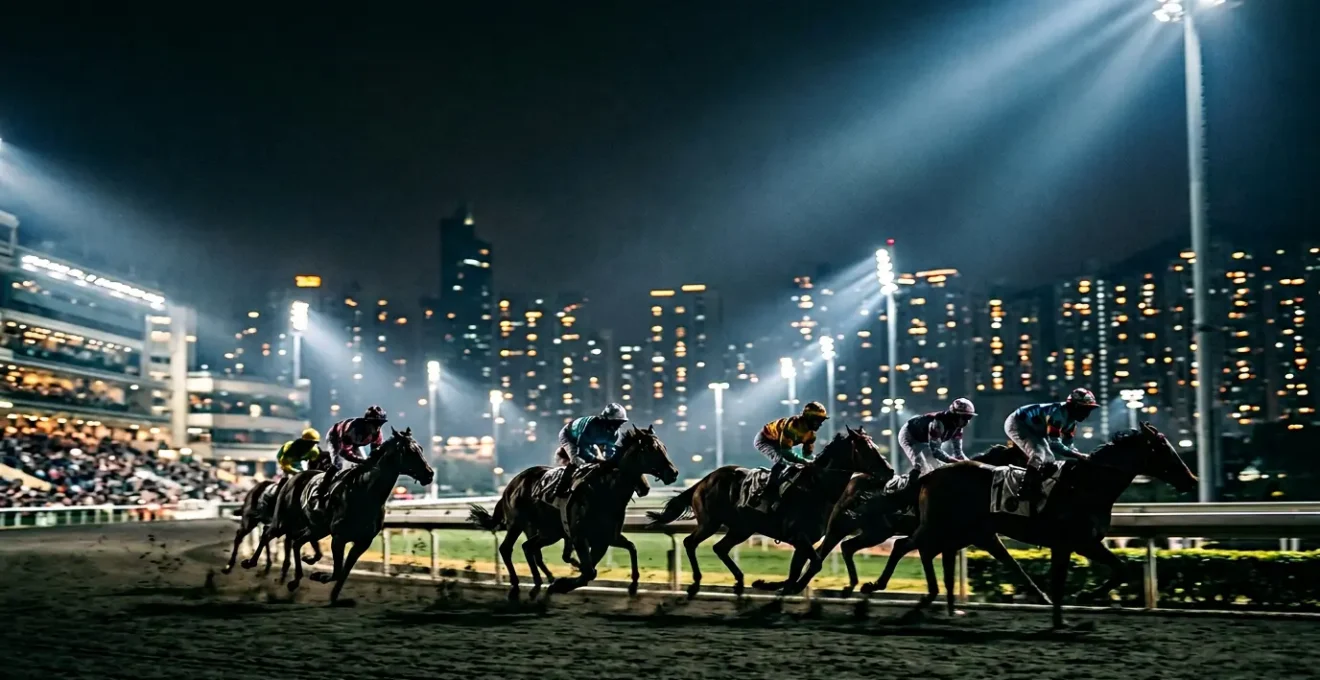
In summary:
- Shift your goal from capturing a sharp photo of a horse to capturing the chaotic, electric atmosphere of the race night.
- Use specific camera techniques like panning, slow shutter speeds, and managing mixed lighting to tell a sensory story.
- Reframe every aspect of the event—the crowd, the betting, the lights—as a photographic opportunity to capture emotion and energy.
- Forget the tripod; a monopod is the professional’s choice for the crucial balance of stability and mobility needed trackside.
The roar of the crowd, the thunder of hooves on turf, the city lights of Hong Kong glittering in the background—photographing the horse races at Happy Valley is a bucket-list item for many photographers. Most online guides will tell you the basics: use a fast shutter speed, crank up your ISO, and hope for the best. They teach you how to freeze a horse in motion, a technical exercise that often results in a sterile image, devoid of the very energy that makes the experience so magnetic.
But what if the goal wasn’t just to get a sharp picture of a horse? What if the real challenge, and the greater reward, was to capture the sensory overload of the entire night? This guide approaches the task from a different perspective. We’ll move beyond the platitudes of sports photography and explore how to use your camera as a tool for atmospheric storytelling. It’s not about freezing a single moment, but about bottling the electric chaos of the event—the kinetic energy of the race, the drama in the stands, and the dance of a thousand different lights.
This isn’t a guide on how to take a technically perfect picture. It’s a guide on how to take a photograph that *feels* like a Wednesday night at Happy Valley.
To help you master this art, this article breaks down the experience into its core sensory components. Each section tackles a common question about the event, reframing it as a unique photographic challenge and providing you with the strategies to capture its essence.
Summary: A Photographer’s Guide to the Happy Valley Experience
- Is the Noise Level at the Trackside Too Loud for Young Children?
- Why Is Standing by the Railing the Most Visceral Experience?
- Are the Food Trucks at Happy Valley Worth the Queue and Price?
- How to Escape the Happy Valley Crowd Quickly After the Last Race?
- Do Locals and Expats Mix in the Public Stands During Races?
- When to Set Up Your Tripod to Catch the Symphony of Lights Perfectly?
- How to Edit Temple Smoke Photos to Enhance the « God Rays » Effect?
- How to Bet on Horse Races at Happy Valley as a Complete Beginner?
Is the Noise Level at the Trackside Too Loud for Young Children?
The sound at Happy Valley is a physical presence. It’s a wall of noise built from the frantic race commentary, the roar of thousands of spectators, and the percussive beat of hooves on the ground. For a photographer, this presents a unique challenge: how do you capture a sound in a silent medium? The answer is to stop trying to photograph the source of the sound and start photographing the *reaction* to it. The noise is written on the faces and in the body language of everyone present.
Instead of a high-magnification lens aimed at the track, turn your attention to the crowd. Look for the tense shoulders of a gambler leaning into a shout, the shared, wide-eyed gaze of friends as the horses round the final turn, or even someone covering their ears in a moment of overwhelming sound. These are the visual cues that tell the story of the noise. By focusing on these human elements, you translate the auditory chaos into a visual narrative of sensory overload. Your photograph won’t have a soundtrack, but the viewer will feel the noise just the same.
Action Plan: Photographing Sound and Energy
- Set shutter speed to 1/30s to create intentional motion blur, suggesting the chaotic energy and overwhelming sound of the crowd.
- Frame your shots to include visual sound indicators like the crowd’s reactions, gamblers’ intense expressions, or their animated gestures.
- Use continuous burst mode to capture the peak emotional expressions that erupt during the race’s climax or major announcements.
- Position yourself to capture body language that screams ‘noise’—fans leaning forward, mouths agape, arms gesturing wildly.
- Review your images to find the one where motion blur creates a sense of ‘visual noise’ in the background while a key emotional expression remains sharp.
Ultimately, the sound is a key character in the Happy Valley story. By photographing its effect on people, you create a more immersive and emotionally resonant image than any clean shot of the track ever could.
Why Is Standing by the Railing the Most Visceral Experience?
Being at the railing is an assault on the senses. You feel the ground vibrate, you hear the jockeys’ calls, and you are literally sprayed with the dirt and turf kicked up by the world’s finest equine athletes. It’s raw, immediate, and utterly visceral. From a photographic standpoint, this is the front line. Your job here is not just to see the race, but to make the viewer *feel* it. This involves a shift in focus from the grand spectacle to the gritty, textural details.
This is where you capture the explosive power of the race at a micro-level. The spray of dirt from the hooves isn’t just a byproduct; it’s a visual testament to the speed and force on display. A macro shot here can be more powerful than a wide shot of the entire field.
Of course, the railing is also the prime location for a classic action photography technique: the pan shot. This is where you track a moving horse with your camera, using a slower shutter speed (try starting between 1/60s and 1/125s) to create a tack-sharp subject against a beautifully blurred background of lights and crowd. A successful pan shot conveys a sense of immense speed and dynamism that a frozen image cannot. It takes practice, and you should expect a low success rate, but one perfect pan is worth a hundred static shots. For an in-depth guide, it’s worth studying the work of professionals who explain their panning techniques for motorsports, as the principles are identical.
Standing by the railing isn’t just about getting a closer view; it’s about immersing yourself in the physical reality of the race and translating that intense, tactile experience into a powerful photograph.
Are the Food Trucks at Happy Valley Worth the Queue and Price?
While a food critic might debate the culinary merits, a photographer sees the food truck area for what it truly is: a cinematic lighting playground. This part of the racecourse is a chaotic jumble of light sources. You have the warm, inviting glow of tungsten and neon from the vendors, the harsh, cool-white spill from the main track floodlights, and the mosaic of a thousand cell phone screens. Trying to « correct » this lighting is a fool’s errand. The key is to embrace the chaos.
Your camera’s automatic white balance will struggle here. This is the time to switch to RAW format, which gives you maximum control in post-processing. Set a custom white balance for one of the main light sources (like the tungsten glow of a food stall) and let the other colors fall where they may. The resulting color contrast between warm yellows and cool blues creates a dramatic, high-energy, almost cyberpunk aesthetic. This is not a problem to be solved; it’s a mood to be captured. In fact, these mixed lighting environments typically span from 3200K to 5600K, a massive range that is a source of creative potential.
Focus on the human element within this light. Capture a silhouette against a brightly lit menu, the steam rising from a bowl of noodles catching the neon glow, or the interplay of light and shadow on the faces of people in the queue. You are documenting a small, vibrant scene within the larger drama of the race night, and the key is to let the light be a character in your story.
So, are the food trucks worth it? For the photographer seeking to capture the full, complex atmosphere of Happy Valley, absolutely. They offer a rich palette of light, color, and human interaction that is integral to the overall experience.
How to Escape the Happy Valley Crowd Quickly After the Last Race?
For the average racegoer, the end of the night is a logistical problem: a mad dash to the MTR. For the photographer, it’s the final act of the drama—the great exodus. Instead of rushing for the exit, slow down and watch. The river of people flowing out of the stadium, illuminated by phone screens and the residual glow of the stadium lights, is a powerful visual narrative waiting to be captured.
This is the perfect opportunity for long-exposure photography. Find a high vantage point overlooking a corridor or stairway. With your camera on a stable surface (a monopod pressed against a wall will do), set a slow shutter speed—anywhere from 2 to 4 seconds. As the crowd moves, their phone screens will paint ribbons of light across your frame, transforming individual people into an abstract flow of energy. The static, brutalist architecture of the stadium provides a stark, stationary contrast to the fluid motion of the departing crowd.
These images are not about individuals. They are about the collective, a visual representation of a shared experience coming to an end. The light trails create a sense of melancholy beauty, a quiet postscript to the high-octane energy of the races. You’re not just taking a picture of people leaving; you’re creating an abstract piece that speaks to themes of movement, time, and the ephemeral nature of the event.
So, the best way to « escape » the crowd is to not escape at all. Stay behind, and you might just capture one of the most poignant and artistically satisfying images of the night.
Do Locals and Expats Mix in the Public Stands During Races?
Happy Valley is famously one of Hong Kong’s great social melting pots, a place where finance professionals and construction workers, locals and expats, stand shoulder-to-shoulder, united by the thrill of the race. Photographing this dynamic requires a delicate touch and a deep sense of ethics. Your goal is not to be a voyeur, but a respectful observer of shared human emotion.
This is where a telephoto lens, in the 85mm to 135mm range, becomes your most important tool. It allows you to isolate moments from a distance, capturing genuine interactions without intruding. Look for the universal language of the racetrack: the shared laughter over a near-win, the collaborative deciphering of a betting form, the collective groan of a losing favorite, or the simple, friendly gesture of passing binoculars. These are the moments that transcend cultural and linguistic barriers.
To photograph these interactions ethically, focus on the story, not the identity. Use a wide aperture (f/2.8 to f/4) to create a shallow depth of field, which will isolate your subjects from the busy background and render other faces into an anonymous blur. Your composition should emphasize the interaction itself—the hands, the gestures, the shared line of sight. By focusing on these universal emotions, you tell the story of mixing and mingling without singling out or objectifying any individual. You are capturing the spirit of the place: a community, however temporary, forged in the fires of hope, tension, and shared spectacle.
The answer to the question is a resounding yes, and your challenge as a photographer is to document this beautiful, chaotic harmony with the sensitivity and respect it deserves.
When to Set Up Your Tripod to Catch the Symphony of Lights Perfectly?
This question contains a flawed premise. For an event as fluid and fast-paced as night racing at Happy Valley, a tripod is often more of a hindrance than a help. It’s bulky, slow to reposition, and makes you a static observer in a dynamic environment. The professional’s choice for this work is almost always a monopod. It gives you a crucial 2-3 stops of stabilization—enough to shoot at slower, more creative shutter speeds—while retaining almost all of your mobility.
In the world of night sports photography, this is a well-established truth; as many experts note, professional night sports photographers increasingly favor monopods because they provide a critical balance of stability and freedom. A monopod allows you to quickly change your angle, drop to a lower perspective, or pivot to follow an unexpected moment without the cumbersome process of collapsing and re-extending tripod legs. It also dramatically reduces fatigue from holding a heavy telephoto lens for hours.
So, when does a tripod have its place? Its role is limited to very specific, static shots. You might use one before the gates open for a pristine panoramic shot of the glowing, empty stadium. Or, after the crowds have gone, you could use it for the long-exposure light trail shots we discussed earlier. During the races themselves, however, it anchors you in place while the story is moving all around you. The « Symphony of Lights » at Happy Valley isn’t a single, fixed event; it’s the constant, chaotic interplay of track lights, city lights, and human energy. To capture it, you must be able to move with it.
Ditch the tripod. Embrace the monopod. Your freedom of movement—and the dynamic quality of your photos—will thank you for it.
How to Edit Temple Smoke Photos to Enhance the « God Rays » Effect?
While Happy Valley has no temples, it has its own form of secular divinity: the light. On a humid Hong Kong night, the powerful stadium floodlights carve through the atmospheric haze, dust, and occasional drizzle, creating their own dramatic « god rays. » This is the « temple smoke » of the racetrack. Learning to see and enhance these beams of light in your photographs is key to capturing the venue’s larger-than-life, cinematic atmosphere. The effect is often subtle in-camera, but it can be dramatically enhanced in post-processing.
The process begins in your editing software, like Lightroom or Photoshop. Your goal is to increase the contrast between the light beams and the surrounding darkness. A counter-intuitive first step is to gently reduce the « Dehaze » or « Clarity » sliders. This will soften the image slightly and make the atmospheric haze more visible, which is the very medium that makes the light beams appear. Then, using a radial or gradient filter, you can selectively increase the exposure and highlights specifically along the path of the light beam.
To complete the cinematic look, use split toning. Add a touch of warm yellow or orange to the highlights (the light beams themselves) and a cool blue or teal to the shadows (the rest of the scene). This classic color combination enhances the visual drama and gives the image a futuristic, Blade Runner-esque feel that is perfectly suited to the Hong Kong cityscape backdrop. Finally, a subtle vignette can help darken the edges of the frame, drawing the viewer’s eye directly to the magnificent drama of the light.
By treating the floodlights not as simple illumination but as powerful graphic elements, you can transform a standard night shot into a piece of atmospheric art.
Key takeaways
- Your primary goal is atmospheric storytelling, not just technical perfection.
- Embrace motion blur, mixed lighting, and challenging conditions as creative opportunities.
- The human element—the crowd’s emotions and interactions—is as important as the race itself.
How to Bet on Horse Races at Happy Valley as a Complete Beginner?
For the photographer, the question isn’t « how to bet, » but « how to photograph the story of the bet. » The act of betting is a complete narrative arc in miniature, packed with hope, tension, ritual, and a climactic release of either joy or disappointment. This is the heart of the human drama at Happy Valley, and your camera is the perfect tool to document it.
Break the process down into its visual moments. Start with the « study »: close-ups of furrowed brows poring over racing forms, the texture of the worn paper, the abstract marks of a highlighter. Then move to the « ritual »: the queue at the betting window, the anxious shuffling of feet, the exchange of cash for a small slip of paper that holds so much hope. Focus on the hands—clutching a pen, passing money, gripping the betting slip. These gestures are rich with narrative power.
The climax of this story isn’t on the track, but in the moments after the race. It’s the sight of a ticket held aloft in celebration or a crumpled slip dropped in disappointment. These are the powerful, emotional payoffs you’re looking for. By following this narrative thread, you are no longer just a sports photographer; you are a documentarian, a storyteller capturing the universal human experience of taking a chance. Your series of photos can tell a more compelling story about the heart of horse racing than a single picture of the winning horse ever could.
Go to the track not with the intention to win money, but with the goal of documenting this rich human tapestry. The resulting images will be your true jackpot.