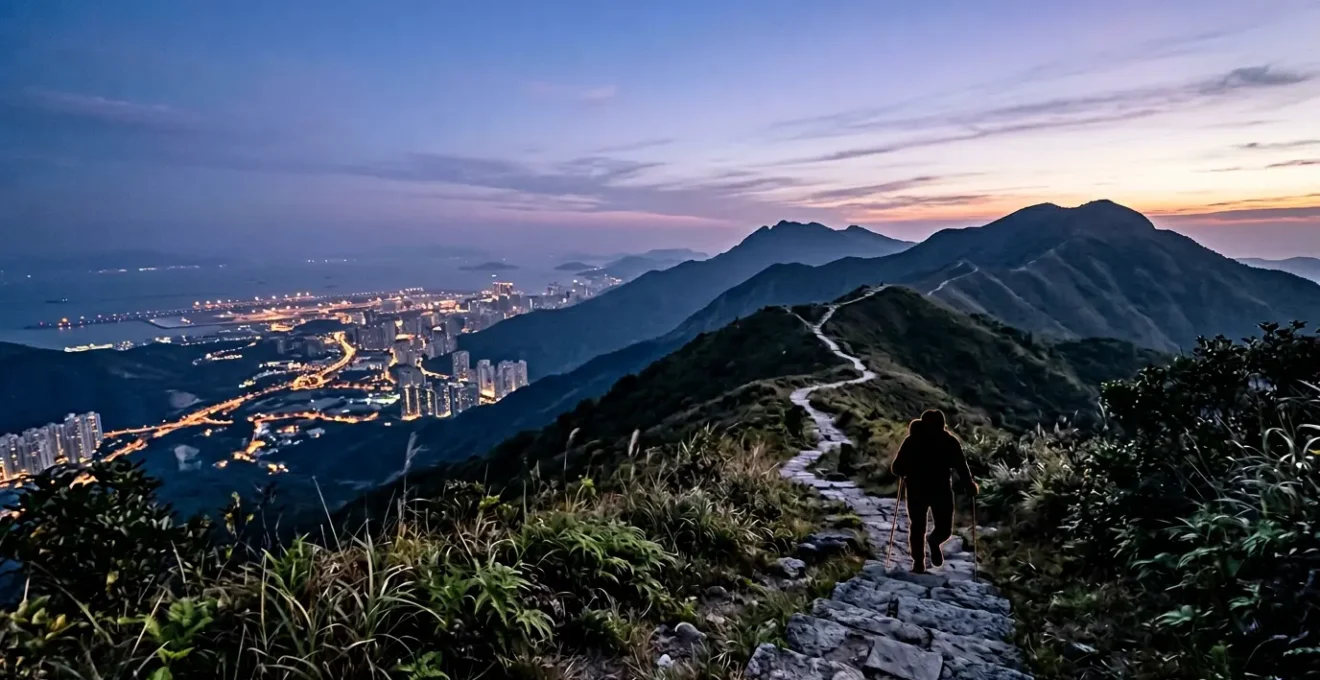
Successfully hiking Lantau Peak for sunrise goes far beyond a 3 a.m. alarm; it requires mastering the unwritten rules of Hong Kong’s trails.
- Logistical challenges like the extreme scarcity of Lantau’s blue taxis are the primary point of failure, not the hike’s difficulty.
- Understanding local conditions—from wildlife encounters to the complete lack of resources on the trail—is critical for safety and enjoyment.
Recommendation: Approach the sunrise hike not as a single objective, but as a test of your overall ‘Trail IQ’—the holistic knowledge this guide is designed to build.
The image is seared into the memory of every hiker who’s done it: standing on the second-highest peak in Hong Kong, shivering in the pre-dawn chill, as the first rays of light shatter the darkness over the South China Sea. The Lantau Peak sunrise is more than a hike; it’s a rite of passage. Most online guides give you the basic recipe: book a blue taxi for 3 a.m., bring a headlamp, and climb for two hours. Simple, right? But as any seasoned guide on these trails will tell you, that simple plan often falls apart before you even reach the trailhead.
The real challenge isn’t the steepness of the climb. It’s navigating the unique and often unforgiving « rhythm » of Lantau Island. It’s about knowing why you can’t get a taxi, what to do when a ton of water buffalo blocks your path, and why bringing enough water is a non-negotiable law of the mountains. A successful sunrise mission isn’t about brute force; it’s about possessing a higher level of Trail IQ. It’s about understanding the ‘why’ behind every piece of advice.
But what if the key to conquering this one iconic hike was actually to understand the broader ecosystem of hiking in Hong Kong? What if preparing for Lantau Peak also prepared you for any trail this incredible landscape has to offer, from the misty heights of Sunset Peak to the famous ridges of Hong Kong Island?
This guide will give you the step-by-step plan for the Lantau Peak sunrise. But more importantly, it will equip you with the essential local knowledge to tackle that challenge with confidence. We’ll answer the most critical questions that separate the prepared from the frustrated, building your Trail IQ so your adventure is memorable for all the right reasons.
To give you a complete picture and build your expertise for hiking across Hong Kong, this guide is structured to answer the most pressing questions. From Lantau’s specific challenges to other iconic local trails, each section provides a crucial piece of the puzzle for your next adventure.
Contents: Your Complete Guide to Hiking in Hong Kong
- Why Is Sunset Peak Famous for Its Silvergrass in Autumn?
- What Should You Do If You Encounter Water Buffalo on Lantau Trails?
- Why Is Getting a Taxi from Lantau South Difficult on Weekends?
- What Do the Wooden Columns of the Wisdom Path Actually Signify?
- How to Hike from the Buddha to Shek Pik Reservoir?
- Why Must You Bring All Your Own Water When Hiking Remote Trails?
- Which Ridge Point Offers the Best Panorama of Tai Tam Bay?
- Is the Dragon’s Back Hike Suitable for Beginners with No Hiking Gear?
Why Is Sunset Peak Famous for Its Silvergrass in Autumn?
While Lantau Peak (Fung Wong Shan) gets the glory for its sunrises, its sister peak, Sunset Peak (Tai Tung Shan), offers an equally iconic, yet completely different, spectacle. The fame comes from a breathtaking natural phenomenon: the seas of silvergrass (Miscanthus) that cover its slopes. Between November and December, these grasses bloom, transforming the entire upper mountain into a rolling ocean of shimmering gold and silver plumes, especially under the warm, low light of a late afternoon.
This isn’t just a patch of pretty grass; it’s a vast, immersive landscape. As the wind blows, waves of light ripple across the hillsides, creating a photographer’s paradise. The trail winds through head-high plumes, making you feel completely enveloped by nature. The visual below captures this golden hour magic, where the mountain seems to be draped in a blanket of light.
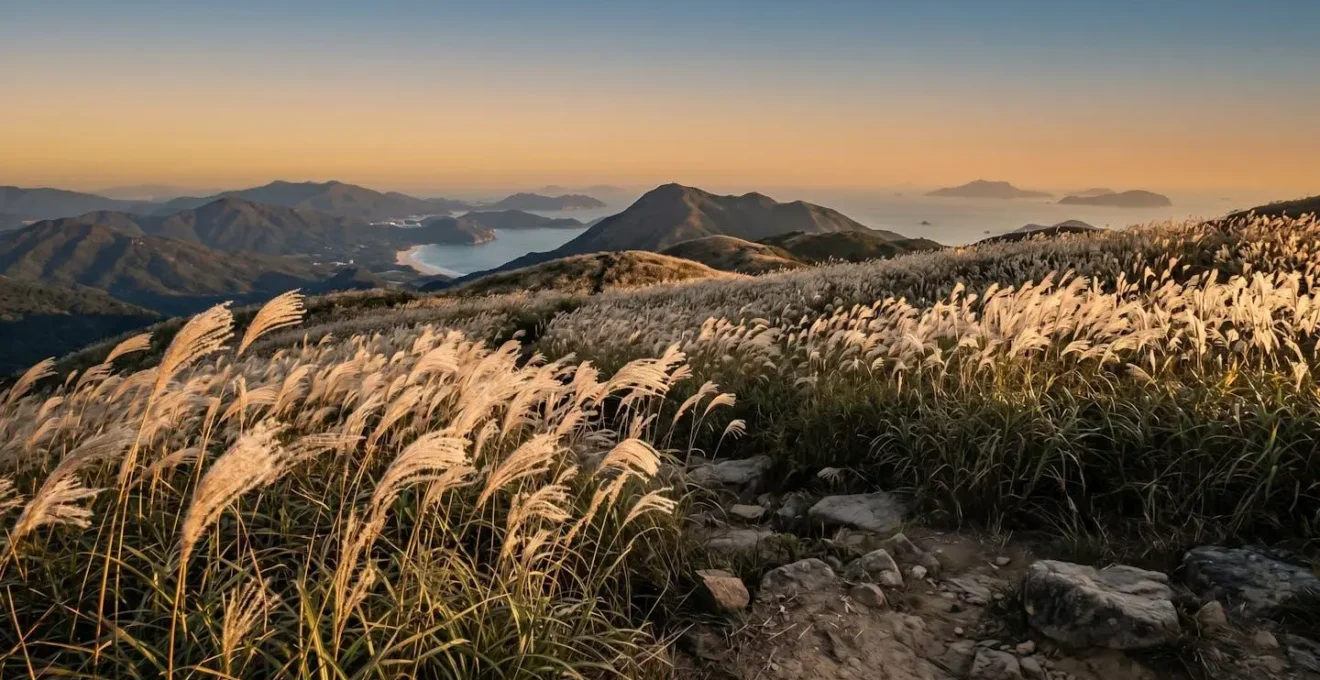
As you can see, the effect is mesmerizing. It’s a powerful reminder that Lantau’s beauty isn’t just about the summit view; it’s about the seasonal rhythms and textures of the landscape itself. For hikers, visiting during silvergrass season provides a completely different experience, one focused on the soft, ethereal beauty of the trail rather than just the rugged peak.
What Should You Do If You Encounter Water Buffalo on Lantau Trails?
Coming face-to-face with a herd of feral water buffalo is a quintessential Lantau experience. These are not zoo animals; they are large, powerful, and wild. While generally placid, they command respect. A 2022 survey confirmed the presence of around 180 water buffalo across Hong Kong, with the largest populations right here on Lantau, particularly in the wetlands of Pui O and on the plateaus you’ll cross. Knowing how to react is a fundamental piece of your Trail IQ.
The primary rule is simple: give them space. Your goal is to be boring and non-threatening. Sudden movements, loud noises, or trying to get too close for a photo can be perceived as a challenge. These animals have a distinct musky odor, and often your nose will alert you to their presence before you see them. When you do, stop and assess the situation. Panicking is the worst thing you can do. Instead, follow a clear set of safety guidelines to ensure a peaceful encounter for both you and the buffalo.
- Give animals space and time to exit the scene—maintain a minimum distance of 5-10 meters.
- Stay calm and avoid sudden movements or loud noises that might startle them.
- Never attempt to feed wild buffalo, as this dangerously alters their natural behavior.
- If a buffalo blocks the trail, wait patiently or take a wide detour rather than trying to pass closely.
- Keep dogs on a leash and maintain extra distance, as buffalo may perceive dogs as threats.
- Watch for warning signs: if a buffalo stops grazing, makes direct eye contact, or positions its body toward you, slowly back away without turning your back.
Why Is Getting a Taxi from Lantau South Difficult on Weekends?
This is the single biggest logistical hurdle for any hike on Lantau, especially the sunrise mission. The frustrating answer lies in a simple, brutal statistic: there are only 75 licensed blue taxis designated to serve the entirety of Lantau Island. Compare that to the fleet of over 15,000 red urban taxis, and you begin to see the problem. On a weekend, when thousands of hikers and beachgoers descend on the island, this tiny fleet is stretched impossibly thin.
Hong Kong operates a three-tiered taxi system, strictly segregated by color and service area. Red taxis (urban) and green taxis (New Territories) are forbidden from operating in most of South Lantau, where the main trailheads are. This means your only option is a blue Lantau taxi. The table below illustrates this stark reality.
| Taxi Type | Color | Fleet Size | Service Area | Flag Fall (HK$) |
|---|---|---|---|---|
| Urban Taxis | Red | 15,250 | Hong Kong Island, Kowloon, New Territories (excluding most of south Lantau) | 27.00 |
| New Territories Taxis | Green | 2,838 | Designated New Territories areas only (cannot enter urban areas) | 23.50 |
| Lantau Taxis | Blue | 75 | Lantau Island, Chek Lap Kok Airport, HK-Zhuhai-Macau Bridge (exclusive access to south Lantau) | 22.00 |
For a Lantau Peak sunrise hike, you need to be at the Pak Kung Au trailhead by 3:30-4:00 AM. This means you must pre-book a blue taxi days, sometimes a week, in advance. Do not assume you can simply call one on the night. Understanding this transport bottleneck is the most critical piece of logistical planning. Without a confirmed taxi, your sunrise dream will end before it even begins.
What Do the Wooden Columns of the Wisdom Path Actually Signify?
As you descend from Lantau Peak towards Ngong Ping, you’ll encounter one of Hong Kong’s most profound and serene installations: the Wisdom Path. These aren’t just decorative posts; they are a giant, outdoor artistic and spiritual representation of one of the world’s most famous Buddhist texts, the Heart Sutra. The 38 timber columns, each 8 to 10 meters tall, are arranged to form a figure-of-eight (∞), a powerful symbol of infinity.
The significance goes even deeper. As the Hong Kong Tourism Commission explains, the layout is designed to harmonize with the natural landscape. The inscription on the columns is the Chinese version of the Heart Sutra, based on the calligraphy of a celebrated master. The entire installation is a journey of walking meditation.
The Heart of the Sutra: Professor Jao Tsung-I’s Gift
The Wisdom Path exists thanks to the vision of Professor Jao Tsung-I, an internationally renowned master of academia and art. In 2002, he donated his original calligraphy of the Heart Sutra to Hong Kong with the specific request that it be transformed into a large-scale outdoor installation. Completed in 2005 at the foothills of Lantau Peak, the 38 wooden columns mimic ancient bamboo slips used for writing. The text displayed is from Xuanzang’s famed Tang Dynasty translation of the Sanskrit ‘Prajñāpāramitāhṛdaya’ (The Heart of the Perfection of Wisdom). Most significantly, the column at the highest point of the path is left completely blank. This isn’t an error; it’s a deliberate representation of the Sutra’s core concept of ’emptiness’ (Śūnyatā), turning a simple walk into a profound philosophical experience.
Visiting the Wisdom Path isn’t a detour; it’s an essential part of the Lantau Peak experience. It provides a moment of quiet contemplation after the physical exertion of the hike, connecting the natural beauty of the mountain with a deep cultural and spiritual layer. It’s a perfect example of the ‘Beyond the Summit’ philosophy—the journey is enriched by the experiences along the way.
How to Hike from the Buddha to Shek Pik Reservoir?
After conquering Lantau Peak and visiting the Tian Tan Buddha, many hikers simply take the bus back to civilization. However, for those with energy and a desire to see a different face of Lantau, a fantastic trail continues onwards and downwards to the stunning Shek Pik Reservoir. This route, part of the official Lantau Trail, takes you from the spiritual heart of Ngong Ping down to the island’s largest body of water, offering incredible coastal views along the way.
This is a challenging descent, primarily on stone steps, that tests your knees and thighs, but the reward is immense. You’ll traverse the Nam Tin Mum ridge and be treated to panoramic vistas of the South Lantau coast before the turquoise waters of the reservoir come into full view. It’s a perfect way to experience the transition from high mountain peaks to the lush, water-rich valleys of the island.
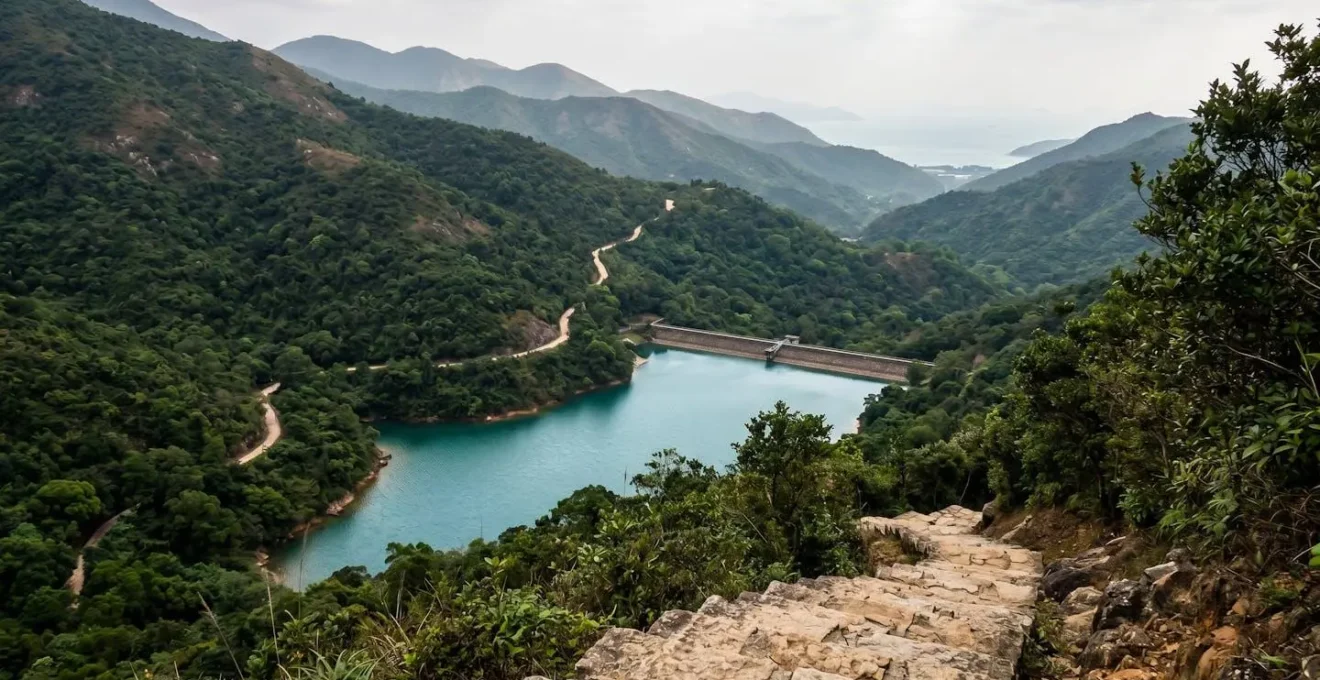
The journey from the crowds at the Big Buddha to the tranquility of the reservoir is a hike of beautiful contrasts. For a clear path, follow these key stages:
- Start at the Big Buddha (Tian Tan Buddha) at Ngong Ping and find the trail markers pointing toward Shek Pik.
- Follow the Lantau Trail distance posts in descending order (from L027 towards L018) as you navigate the mountain path.
- Pass through the Nam Tin Mum ridge section, where you’ll get sweeping views over Tong Fuk Village and the coastline.
- Continue your descent on the south face, with the clear waters of Shek Pik Reservoir becoming increasingly visible below.
- Be prepared for significant downhill sections on stone steps, which require careful footing and can be strenuous.
- Upon reaching the reservoir area, look for the impressive dam wall and its historical carvings.
- From the Shek Pik Reservoir bus stop, you can easily catch bus routes 1 or 3M to get back to Mui Wo or Tung Chung.
Why Must You Bring All Your Own Water When Hiking Remote Trails?
This rule is the most fundamental and unforgiving law of Hong Kong hiking. On remote trails like the ascent to Lantau Peak or the exposed ridges of Sunset Peak, there are simply no resources. No shops, no vending machines, and crucially, no potable water sources. Every drop of water you will need for the entire duration of your hike must be in your backpack before you take your first step.
Underestimating this is the most common and dangerous mistake hikers make. Hong Kong’s heat and humidity can be brutal, even on days that don’t seem overly hot. You lose water through sweat at an astonishing rate. As the experts at Wild Hong Kong Adventure Tours state in their safety guidelines:
Dehydration is a real risk on hot days. In the warmer months bring a few liters.
– Wild Hong Kong Adventure Tours, Lantau Peak Sunrise Climb Safety Guidelines
The concept of « a few liters » is not an exaggeration. For a strenuous hike like Lantau Peak, a minimum of 2-3 liters per person is standard, and more on a hot day. Dehydration leads to fatigue, cramps, heat exhaustion, and in severe cases, heat stroke—a life-threatening emergency. Your water supply is your lifeline. The image below isn’t just a picture of a bottle; it’s a symbol of self-sufficiency, the core principle of safe hiking.

Do not assume you can « buy something on the way. » The trail is not a city street. Your hiker’s awareness must include a realistic assessment of your needs and the discipline to carry the necessary supplies. This responsibility is entirely on you.
Which Ridge Point Offers the Best Panorama of Tai Tam Bay?
Once your Trail IQ is honed on Lantau, you’ll be ready to explore Hong Kong Island’s iconic trails. The Dragon’s Back ridge is famous, but the real prize for photographers is the breathtaking panorama of Tai Tam Bay, with its sparkling water, luxury yachts, and the colorful village of Stanley nestled on the far shore. While many hikers snap a quick photo from the main viewing point, the truly spectacular shot requires a bit more effort and knowledge.
The « best » viewpoint is subjective, but professional photographers often bypass the most crowded spot. The key is to find a composition that uses the trail itself as a leading line, guiding the viewer’s eye into the grand vista of the bay. This often means stopping a few hundred meters before or after the main summit of Shek O Peak. Capturing that « postcard » shot also depends heavily on timing and technique, turning a simple photo opportunity into a rewarding photographic challenge.
To elevate your photos from simple snaps to stunning landscapes, consider these tips from photographers who know this ridge intimately:
- Scout the ridge before your main shoot: walk 200-300 meters in both directions from the obvious peak to find alternative compositions with better leading lines.
- Time your visit for late afternoon (3-5 PM) when the sun illuminates the entire bay and Stanley hillsides, creating a warm, golden glow.
- For wide-angle shots (24-35mm), use a smaller aperture like f/8-f/11 to ensure everything from the foreground trail to the distant islands is in sharp focus.
- For telephoto compression (70-200mm), isolate elements like yachts on the water or the colorful Stanley houses, creating a sense of depth by layering different parts of the scene.
- Morning shoots can be dramatic with backlit silhouettes, but be prepared to bracket your exposures to capture detail in both the bright sky and the darker foreground.
- Consider the « less obvious » viewpoint: a spot several hundred meters before Shek O Peak often provides a better-balanced composition with the trail winding into the frame.
Key Takeaways
- True preparation for a major hike like Lantau Peak is about mastering logistics (like taxis) and self-sufficiency, not just physical training.
- Developing ‘Trail IQ’ means understanding and respecting the local environment, from seasonal flora like silvergrass to wildlife encounters with water buffalo.
- The best hiking experiences in Hong Kong often lie ‘Beyond the Summit,’ in the cultural sites you discover (Wisdom Path) and the alternative trails you explore (Shek Pik).
Is the Dragon’s Back Hike Suitable for Beginners with No Hiking Gear?
The Dragon’s Back is often touted as Hong Kong’s best urban hike, and for good reason. Its accessibility and stunning coastal views make it incredibly popular. But the question of its suitability for absolute beginners with zero specialized gear is nuanced. The answer is: yes, but with significant caveats. The hike’s difficulty is dramatically affected by weather, and « no gear » does not mean « no preparation. »
On a cool, dry day, the trail is a relatively gentle and manageable walk. However, in the oppressive heat and humidity of a Hong Kong summer, the completely exposed ridge can become a dangerous place for the unprepared. The lack of shade is a major factor that beginners often underestimate. The difficulty is not static; it’s a matrix of conditions, as shown below.
| Weather Condition | Temperature | Difficulty Rating (Beginners) | Key Challenges | Recommended? |
|---|---|---|---|---|
| Cool, Dry Day | Under 24°C | 3/10 | Gentle slopes, manageable distance, minimal shade requirements | Yes – ideal conditions |
| Warm, Moderate Humidity | 24-28°C | 5/10 | Increased water needs, sun exposure on ridge | Yes – with preparation |
| Hot, High Humidity | Over 30°C | 7/10 | Heat exhaustion risk, complete lack of shade, physical strain amplified | Not recommended |
| Rainy or Typhoon Warning | Any | 9/10 | Slippery surfaces, reduced visibility, safety hazards | No – avoid entirely |
You don’t need expensive hiking boots or a technical backpack. However, a « minimum viable kit » composed of everyday items is absolutely essential for safety and comfort. Thinking you can stroll along this trail in flip-flops with a small bottle of water is a recipe for a miserable, and potentially dangerous, experience.
Your Essential Checklist: Minimum Viable Kit for Dragon’s Back
- Footwear: Running trainers or sneakers with good tread are sufficient. Avoid flat-soled fashion sneakers, flip-flops, or sandals, which are unsuitable for rocky sections.
- Water Capacity: Any backpack that can carry a minimum of 1.5 liters of water per person. Hydration is non-negotiable on this exposed ridge.
- Sun Protection: A wide-brimmed hat or cap, sunscreen (SPF 30+), and sunglasses are mandatory. The ridge has zero shade.
- Clothing: Wear a moisture-wicking t-shirt (avoid cotton, which stays wet) and comfortable shorts or light pants.
- Nutrition & Planning: Bring light snacks for energy and save some for the often-underestimated 1.5 km road walk from the trail’s end to the Big Wave Bay bus stop.
With this comprehensive knowledge, you’re no longer just a tourist with a map; you’re a hiker equipped with genuine Trail IQ. You understand the ‘why’ behind the rules and the rhythm of the landscape. The next step is to choose your challenge—be it the epic Lantau Peak sunrise or the accessible Dragon’s Back—and put this wisdom into practice on the trail.