Contrary to the view of Man Mo Temple as a place of mere superstition, its rituals serve as powerful sociological tools for Hong Kong students. This article deconstructs how these ancient practices provide tangible psychological anchors, helping to manage the intense pressure of the city’s academic system and formalize the process of intention-setting for success.
In the high-stakes, pressure-cooker environment of Hong Kong’s education system, students leave no stone unturned in their quest for academic excellence. Beyond intensive tutoring and sleepless nights, another, more ancient, practice endures: the pre-exam pilgrimage to Man Mo Temple. For the casual observer, this might appear as simple superstition—a desperate plea to the gods for good fortune. This perspective, however, misses the profound sociological and psychological functions these rituals perform for a community navigating immense stress.
This is not about choosing faith over study. Instead, it’s about understanding how these traditions coexist with modern life. The act of visiting the temple is a form of performative tradition that provides a structured outlet for anxiety and a powerful method for focusing intent. From a sociological standpoint, the temple acts as a living laboratory where symbolic actions produce tangible psychological outcomes. The scent of incense, the physical act of touching a sacred object, and the structured process of asking for a fortune are not magical solutions; they are sophisticated cultural technologies for building confidence and resilience.
This article moves beyond a surface-level description to analyze the « why » behind the rituals. We will explore how specific practices at Man Mo Temple function as psychological anchors, how to engage with them respectfully as a cultural observer, and how they fit into the broader symbolic landscape of Hong Kong. It is an examination of how ancient wisdom provides modern comfort.
To navigate this fascinating intersection of culture, faith, and education, this guide breaks down the essential practices and etiquette of the temple. The following sections will provide both the practical « how-to » and the deeper sociological « why » for each key experience.
Summary: The Sociological Significance of Man Mo Temple Rituals
- Why Should You Touch the Golden Pens for Academic Success?
- How to Fit Man Mo Temple into a Hollywood Road Walking Tour?
- Is the Smoke at Man Mo Temple Too Intense for Children?
- How to Make a Sesame Oil Donation at the Temple?
- Are You Allowed to Use Flash Photography Inside Man Mo Temple?
- How to Use Fortune Sticks Correctly to Ask a Question About Your Future?
- Why Should You Not Buy Shoes or Cut Your Hair During CNY?
- How to Visit a Hong Kong Temple Without Offending Local Worshippers?
Why Should You Touch the Golden Pens for Academic Success?
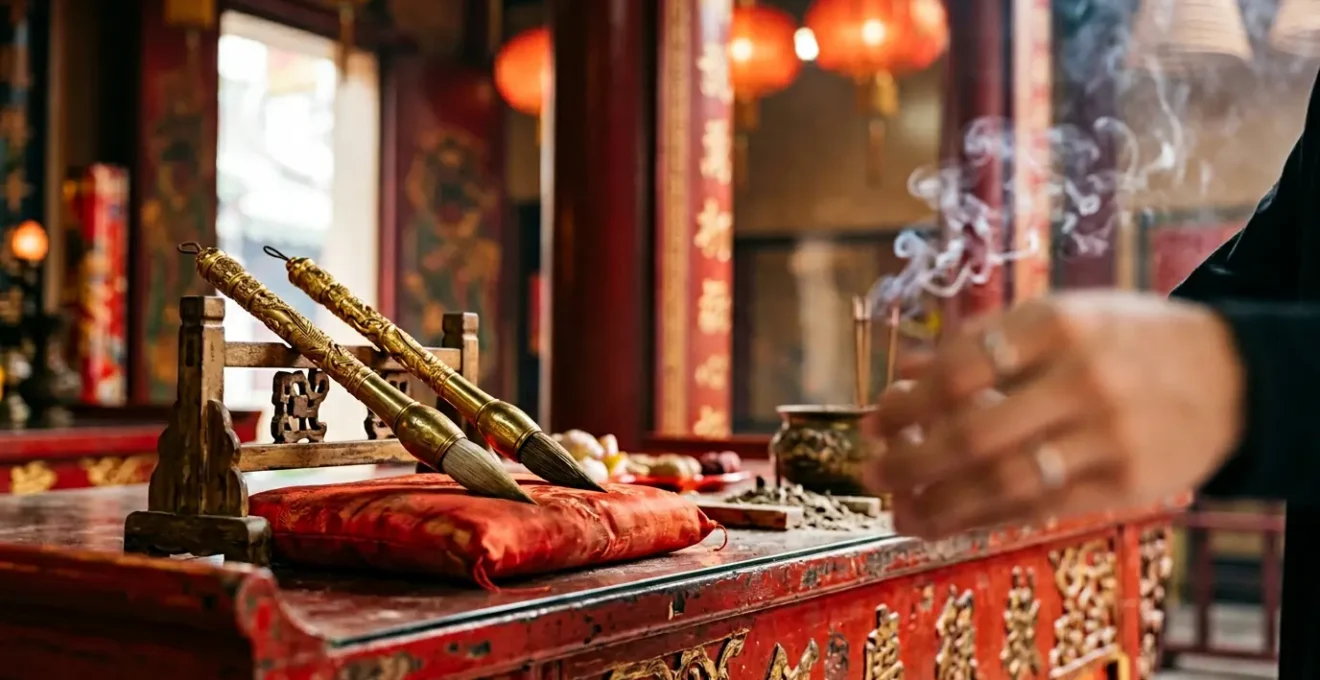
The act of touching the Man Cheong Bi, or the sacred golden calligraphy brushes, is perhaps the most famous academic ritual at Man Mo Temple. For students, this is far more than a gesture of hope; it is an act of psychological anchoring. In sociology, we observe how a physical action can make an abstract goal—like passing an exam—feel concrete and achievable. By touching the pens dedicated to Man Cheong, the God of Literature, students physically connect with the very idea of scholarly prowess and eloquence.
This ritual demonstrates powerful symbolic efficacy. While the act itself doesn’t transfer knowledge, it formalizes the student’s intention and provides a moment of focused visualization. In a moment of high anxiety, this structured, culturally endorsed action can significantly boost a student’s confidence, creating a self-fulfilling prophecy where belief in success contributes to the focus required to achieve it. The ritual transforms passive worry into an active step towards a goal.
Following the prescribed steps is not about dogmatic adherence but about engaging fully in this process of intention-setting. Each step, from the respectful bow to the silent wish, is designed to deepen the psychological impact of the act, making it a powerful tool for mental preparation.
Your Action Plan: The Academic Success Ritual
- Enter the temple through the right-hand door, following the natural clockwise flow of energy and showing respect to the deities.
- Approach the altar with a small, respectful bow before touching the golden pens, acknowledging the presence of Man Cheong.
- Gently touch the sacred golden calligraphy brushes (Man Cheong Bi) with both hands while focusing your mind on a specific, single academic goal.
- Make a silent, specific wish related to your studies, such as clarity of thought, eloquence in expression, or success in a particular examination.
- Maintain a moment of quiet reflection, visualizing your academic success before stepping back and bowing again as you leave the altar area.
Therefore, touching the golden pens is less a plea for divine intervention and more a culturally sanctioned technique for channeling focus and building the self-belief necessary to succeed.
How to Fit Man Mo Temple into a Hollywood Road Walking Tour?
Man Mo Temple is not an isolated relic; it is the historical and spiritual anchor of Hollywood Road, an area that perfectly encapsulates Hong Kong’s defining temporal contrast. To visit the temple is to step directly from a street buzzing with contemporary art galleries, chic cafes, and antique shops into a space of sacred, centuries-old tradition. Understanding this context is key for any cultural observer.
A walking tour of Hollywood Road offers a narrative of Hong Kong’s evolution. In fact, a recent feature highlighted how the area masterfully blends its colonial past with a vibrant, creative present. According to a feature in Lufthansa’s magazine, Hollywood Road was named the world’s second-coolest street for 2024 by Time Out magazine. The 1-kilometer stretch connects the Central and Sheung Wan districts, creating a curated path through history and modernity. Visitors can explore traditional ladder streets like Po Hing Fong, hunt for treasures on Cat Street (Upper Lascar Row), and admire the transformation of the former Central Police Station into the Tai Kwun Centre for Heritage & Arts, a project by renowned architects Herzog & de Meuron.
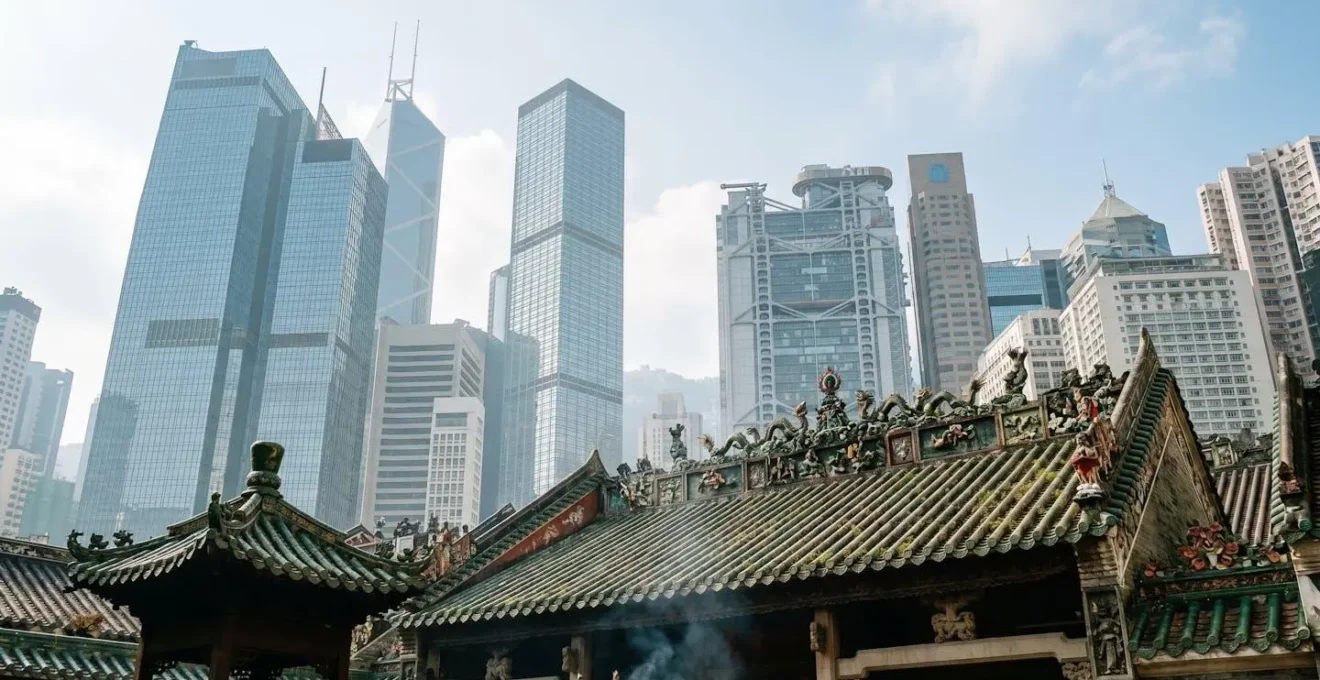
Fitting the temple into this walk is simple. Start in Central near Tai Kwun, walk west along Hollywood Road, and you will naturally arrive at the temple’s entrance. The visual transition is stark and powerful, as the ornate green-tiled roof of the temple stands in defiance against the glass-and-steel skyscrapers behind it. A visit to Man Mo Temple thus becomes the climax of the walk, a moment to pause and reflect on the deep cultural roots that ground this relentlessly modern city.
This journey highlights that the temple’s enduring relevance comes not from being separate from modern life, but from being deeply embedded within it.
Is the Smoke at Man Mo Temple Too Intense for Children?
The first sensory experience upon entering Man Mo Temple is the thick, fragrant smoke from countless incense coils and sticks. From a sociological perspective, this smoke is not a nuisance; it is the physical manifestation of prayer, a visible cloud of collective hopes and wishes rising to the heavens. However, for a visitor, especially one with children or respiratory sensitivities, this potent atmosphere can be a genuine concern. The question of intensity is valid, as the sensory experience is an integral, and sometimes overwhelming, part of the temple’s authenticity.
The health concern is not unfounded. The smoke is composed of fine particulate matter, and its concentration can be significant in enclosed spaces. In fact, scientific research demonstrates that incense burning produces around 45 mg of particulate matter per gram burned, considerably more than cigarettes. While a short visit is unlikely to cause lasting harm to a healthy individual, the density of the smoke can be irritating for young children, asthmatics, or those with allergies.
However, this doesn’t mean families must avoid the temple. A strategic approach can balance cultural immersion with comfort. The key is to manage exposure by choosing the right time and place within the temple complex. By following a few simple guidelines, visitors can appreciate the temple’s spiritual atmosphere without being overwhelmed by it.
- Plan your visit on weekday mornings (8-10 AM) when smoke levels are lowest. Avoid the 1st and 15th days of the lunar month when burning peaks.
- Stay near the main entrance and in open-air courtyards where natural ventilation is better.
- Explore the less-crowded side halls like Lit Shing Kung, which typically have lower smoke concentration.
- Limit time spent directly in front of the main altar, where the massive hanging incense coils create the densest smoke.
- Consider using the outdoor courtyard as a « breathing zone » for children to take breaks.
Ultimately, managing the smoke is about finding a respectful balance, allowing for a meaningful visit that honors both the sacred traditions and personal well-being.
How to Make a Sesame Oil Donation at the Temple?
At many altars in Man Mo Temple, you will see small red lamps, their flames burning continuously. Making a donation for sesame oil to keep these lamps lit is a common practice that goes far beyond a simple monetary transaction. As the Hong Kong Tourism Board notes, « The temple is a place where the faithful can pray for good luck and success. » The oil donation is a physical way of contributing to that spiritual ecosystem. Sociologically, it’s an act of reciprocity—by helping to maintain the temple’s « eternal flame, » a worshipper symbolically adds fuel to their own aspirations.
This practice is deeply connected to the Cantonese concept of « ga yau » (加油), which literally means « add oil » but is used as a phrase of encouragement, equivalent to « Go for it! » or « Keep it up! ». By donating oil, a student is literally « adding oil » to the lamp of the God of Literature, which in turn becomes a powerful metaphor for adding energy and effort to their own studies. This ritualized intention-setting transforms a financial donation into a symbolic commitment to personal endeavor.
The Eternal Flame and its Community Roots
The sesame oil donation system has deep historical roots in Hong Kong’s development. As detailed in cultural heritage documents, the 1908 Man Mo Temple Ordinance established a formal link between the temple and the Tung Wah Hospital, one of the city’s first and most important charitable institutions. Temple revenue, including from donations, helped fund the hospital’s services. Therefore, a donation for the eternal flame wasn’t just a spiritual act; it was a contribution to the community’s well-being. This historical connection between spiritual light and social welfare adds another layer of meaning to the practice, framing it as an act of both personal hope and public good.
To make a donation, you simply approach one of the counters or donation boxes, which are clearly marked. There is no fixed amount; it is a gesture of goodwill. In return for your donation, you are participating in a century-old tradition that links personal ambition with the perpetual flame of wisdom and community support.
This simple act beautifully illustrates how personal prayer and community contribution are intertwined in the cultural fabric of Hong Kong.
Are You Allowed to Use Flash Photography Inside Man Mo Temple?
The short and absolute answer is no. Using flash photography inside Man Mo Temple is strictly prohibited, and this rule embodies a core tension for the cultural observer: the desire to capture a moment versus the duty to respect a living, sacred space. The prohibition is not arbitrary. Firstly, the sudden, bright light is highly disruptive to worshippers engaged in quiet prayer and reflection. It shatters the contemplative atmosphere that is essential to the temple’s function. From a sociological viewpoint, using a flash marks you as an intrusive outsider, prioritizing your own documentation over the experience of the participants.
Secondly, the intense light from a flash can cause cumulative, irreversible damage to the temple’s fragile artifacts. The centuries-old wood carvings, intricate altar decorations, and painted surfaces are vulnerable to fading and degradation from harsh light. Respecting the no-flash rule is a direct contribution to the preservation of this vital piece of cultural heritage for future generations.
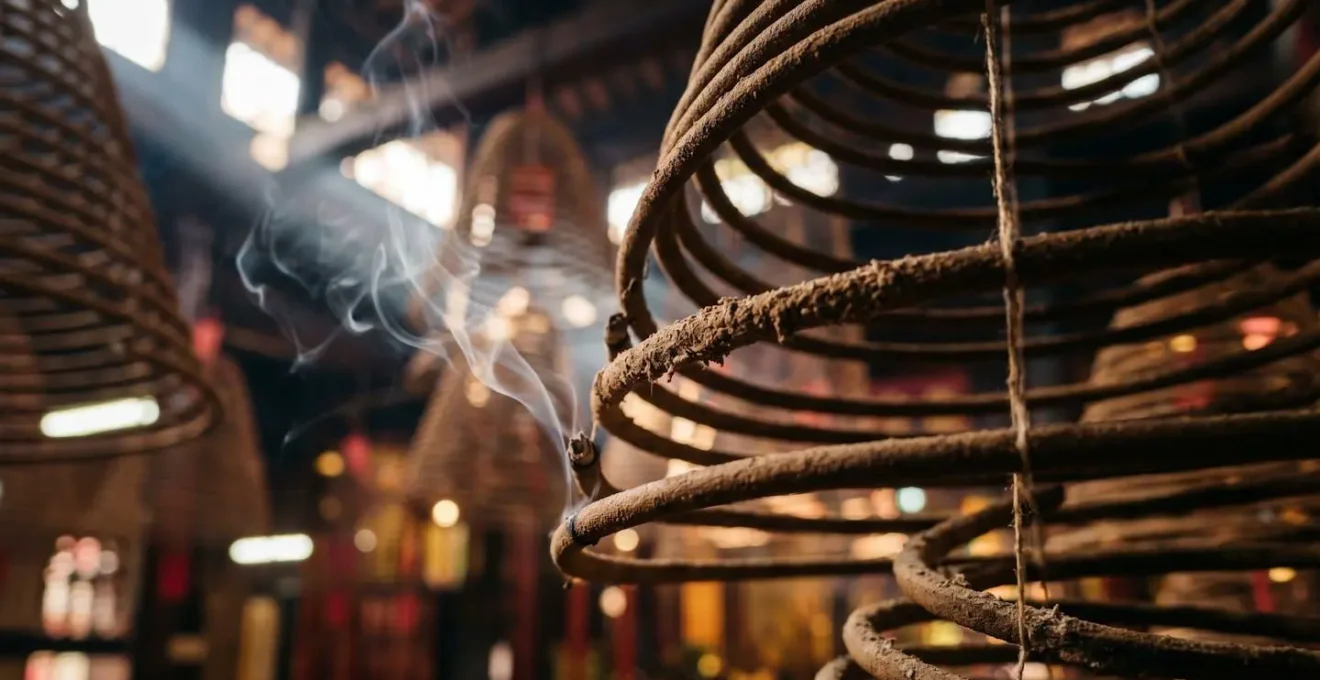
However, this doesn’t mean photography is forbidden. The temple’s interior, with its dramatic shafts of light cutting through incense smoke, is incredibly photogenic. The challenge—and the reward—is to capture this atmosphere using only the available natural light. This requires a more mindful and technically skilled approach to photography, which in itself is a more respectful way to engage with the space.
- Disable Flash Completely: Do this before you even enter the temple.
- Use a Wide Aperture: Settings like f/1.8 or f/2.8 will let in more light, capturing the moody atmosphere.
- Increase ISO Moderately: An ISO between 800-1600 can compensate for low light, but be mindful of digital noise.
- Focus on Details: Capture smoke catching the light, the texture of wood, or the interplay of shadows rather than broad, dark shots.
- Be Discreet: Never take photos of people in prayer without explicit permission. Always yield to worshippers.
By forgoing the flash, the photographer shifts from being a mere tourist to a patient observer, learning to see and appreciate the temple on its own terms.
How to Use Fortune Sticks Correctly to Ask a Question About Your Future?
The practice of Kau Cim, or using fortune sticks, is one of the most interactive rituals at Man Mo Temple. To an outsider, it may look like a game of chance. Sociologically, however, it is a highly structured process for externalizing a problem and seeking guidance. The ritual’s rigid steps force the individual to move from a state of vague anxiety to focused inquiry. It is not about passively receiving a predetermined fate, but about actively engaging in a dialogue with tradition to gain clarity.
The process is meticulous, transforming a simple question into a significant event. Each step has a symbolic purpose, from purifying the sticks in incense to validating the result with moon blocks. The most crucial part is not the stick that falls, but the interpretation that follows. The poetic verse on the corresponding fortune paper is often archaic and ambiguous, requiring a temple soothsayer to contextualize its ancient wisdom for a modern dilemma. This final step is a form of counseling, where the individual’s problem is reframed through the lens of classical Chinese philosophy.
A famous tale recounts Lin Sheng, a Qing Dynasty scholar who repeatedly failed imperial exams and faced hardship. One day, he prayed fervently at Man Mo Temple to Man Cheong, drawing a fortunate lot predicting academic success. Inspired, he studied diligently and passed the exams the following year, becoming a local official. This story became legendary, drawing countless students to pray for success.
– Hong Kong Funs Cultural Heritage Documentation, Man Mo Temple Legends and Miraculous Stories
This story highlights the ritual’s power to inspire action. The fortune did not replace studying; it provided the psychological impetus to persevere. To engage in this ritual correctly is to respect its structured process:
- Kneel before the main altar and hold the bamboo container of fortune sticks.
- Purify the container by passing it through incense smoke.
- Clearly state your name and a single, specific question.
- Shake the container until only one stick falls out.
- Validate the stick’s selection using the Jiaobei (moon blocks).
- Take the numbered stick to the counter to receive the corresponding fortune paper.
- Seek interpretation from the temple soothsayer (for a small fee) to understand the verse’s meaning for your situation.
- If the fortune is good, keep it. If it is bad, tie it to the temple’s designated racks to leave the misfortune behind.
Ultimately, Kau Cim serves as a powerful tool for reflection, turning a moment of uncertainty into an opportunity for focused introspection and renewed motivation.
Why Should You Not Buy Shoes or Cut Your Hair During CNY?
While visiting Man Mo Temple, particularly around Chinese New Year (CNY), you are stepping into a rich symbolic ecosystem where actions carry significant weight. The well-known taboos against buying shoes or cutting hair during this period are not arbitrary rules; they are rooted in the linguistic and symbolic logic of the Cantonese language. Understanding this « cultural grammar » is essential for a cultural observer to grasp the worldview that underpins temple rituals.
These prohibitions are based on homophones—words that sound alike but have different meanings. This linguistic wordplay is a cornerstone of folk beliefs in Hong Kong. The goal is to avoid any action that sounds like a negative outcome, thereby ensuring the new year starts with a foundation of pure positive energy, or what could be called a ‘Perfect Start’.
The Linguistics of Luck in Hong Kong
The logic behind CNY taboos is a fascinating insight into Cantonese culture. The word for ‘shoes’ (鞋, haai) sounds almost identical to the word for ‘sighing’ (唉, aai). To buy shoes during the new year period is to symbolically invite a year of sadness and hardship. Similarly, ‘hair’ (髮, faat) is a homophone for ‘to prosper’ (發, faat), as in the famous new year greeting « Gong hei faat choi » (wishing you prosperity). Therefore, cutting one’s hair is seen as symbolically severing one’s good fortune for the coming year. Other related taboos, like not washing clothes (washing away luck) or not sweeping the floor (sweeping out fortune), follow the same symbolic logic, revealing a deep-seated cultural belief in the power of performative acts to shape reality.
These practices may seem like superstitions to an outsider, but from a sociological perspective, they are deliberate, mindful actions taken to align oneself with positive forces. They are part of the same symbolic universe as the rituals at Man Mo Temple. Just as a student touches the golden pens to symbolically align with academic success, a family avoids buying shoes to symbolically reject sorrow. It is a coherent system of meaning where everyday actions are imbued with ritual significance.
Grasping this connection between language and luck provides a much deeper appreciation for the motivations behind the behaviors you will observe in and around the temple.
Key Takeaways
- Rituals at Man Mo Temple are not just superstitions but sophisticated sociological tools for managing anxiety and focusing intention in a high-pressure society.
- The temple’s power lies in its symbolic efficacy, where physical acts like touching pens or donating oil serve as psychological anchors for abstract goals like academic success.
- Respectful observation involves understanding the cultural grammar behind the rituals, including linguistic taboos and the importance of preserving the sacred, contemplative atmosphere.
How to Visit a Hong Kong Temple Without Offending Local Worshippers?
With Hong Kong’s cultural sites attracting a growing number of international visitors, the question of etiquette becomes paramount. Provisional data from the Hong Kong Tourism Board suggests the city could see a significant increase in arrivals, and for cultural observers, the goal is to participate, not just spectate. Visiting a living temple like Man Mo requires a shift in mindset from that of a tourist to that of a respectful guest. The space is not a museum; it is an active center for community worship, and your presence should honor that primary function.
The core of temple etiquette revolves around a single principle: mindfulness. This means being aware of your physical presence, your volume, and the invisible boundaries of sacred space. Worshippers need an unimpeded path to the altars, and the area directly in front of them is the most sacred. As a visitor, your role is to occupy the periphery, observing quietly and allowing the spiritual life of the temple to flow uninterrupted. This is not about a restrictive list of rules, but about cultivating an attitude of humility and respect.
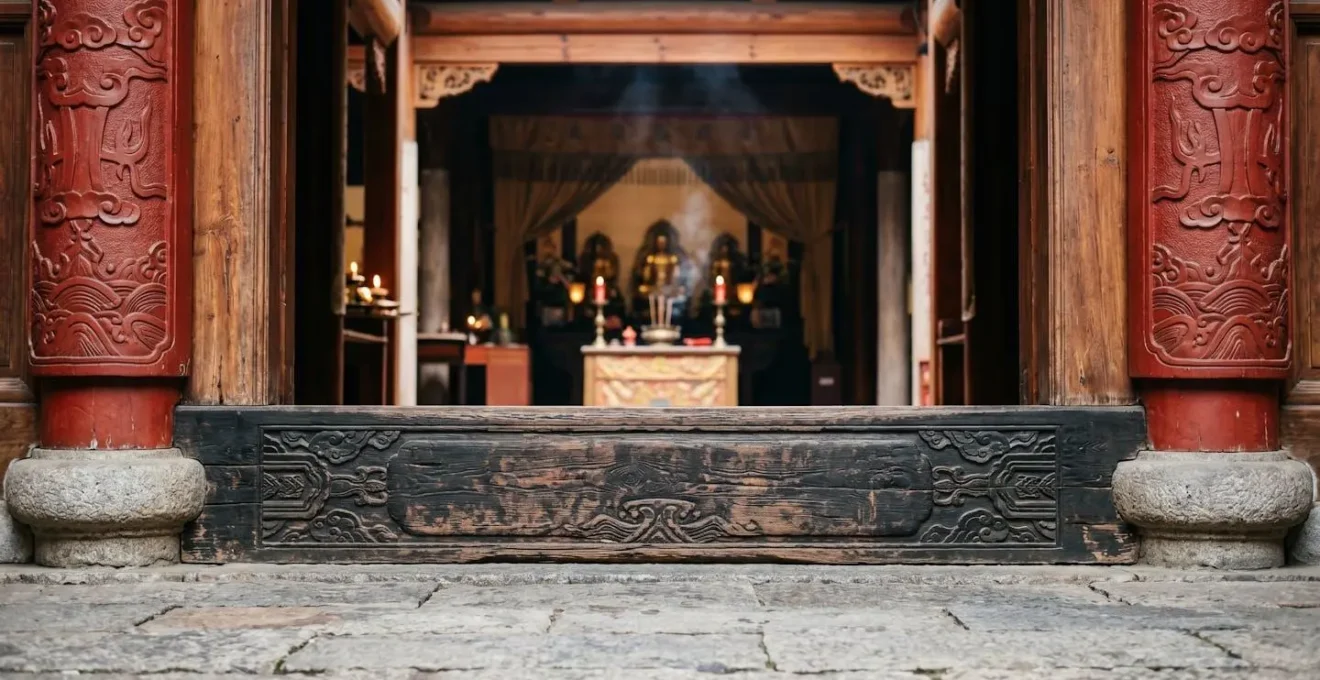
Simple gestures can signal your awareness and respect. One of the most important yet commonly overlooked rules is to never step on the wooden door sills; always step over them. These thresholds are considered the shoulders of deities, and stepping on them is a profound sign of disrespect. Following the clockwise flow of traffic—entering through the right door and exiting through the left—also helps maintain order and harmony within the space.
- Always step over the wooden door sills, never on them.
- Enter through the right-hand door and exit via the left-hand door to follow the clockwise flow.
- Stay to the sides of walkways to allow worshippers a clear path to the altars.
- Be most quiet and brief in the area directly before the main altar.
- Learn to say « Mm goi » (唔該), a versatile Cantonese phrase for « excuse me » or « thank you. »
- Dress modestly, covering shoulders and knees.
- Speak in hushed tones and maintain a contemplative atmosphere.
- Never interrupt a worshipper or walk between them and the altar they are addressing.
Armed with this sociological understanding and a commitment to mindful observation, your visit to Man Mo Temple can transform from a simple photo opportunity into a meaningful exchange, enriching your understanding of Hong Kong’s living culture.