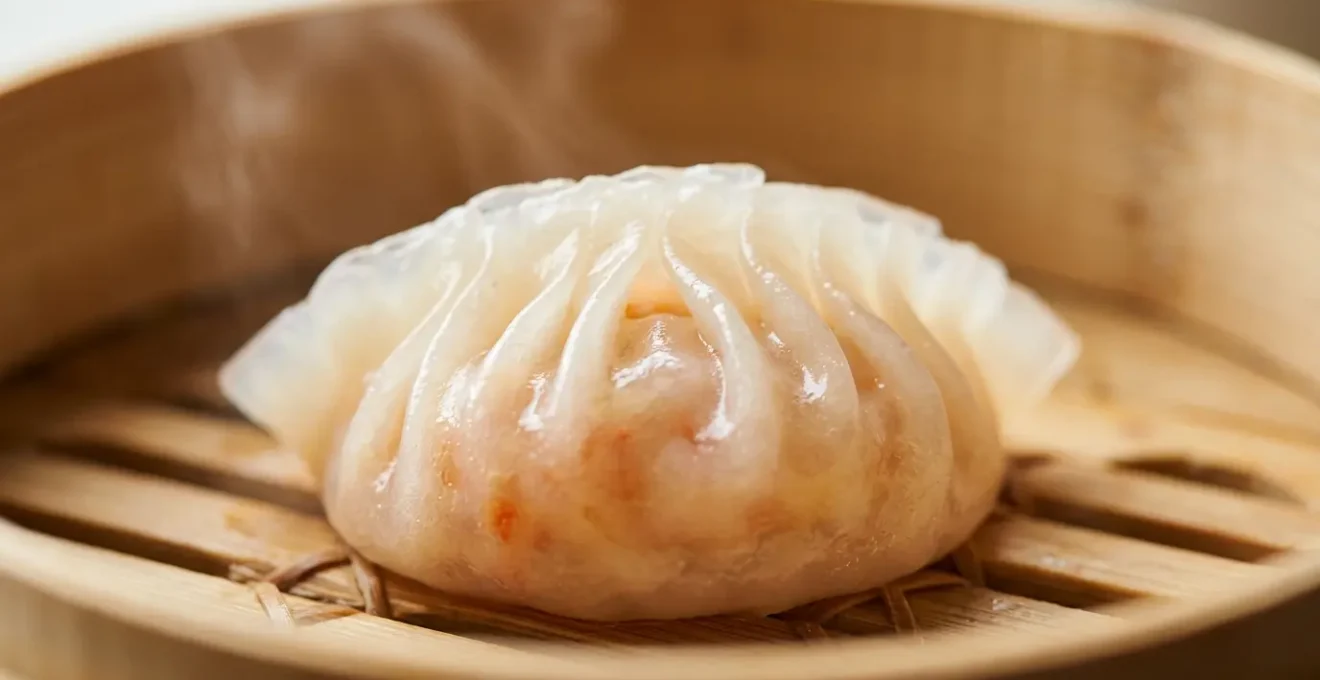
A perfect har gow is not a matter of opinion; it’s a technical pass/fail exam based on non-negotiable standards.
- The skin must possess a precise balance of translucency and elasticity, achieving the coveted bouncy, chewy texture known as the ‘QQ’ factor.
- The shrimp must deliver a clean, crisp ‘snap’ when bitten, a definitive sign of true freshness over inferior frozen product.
Recommendation: Always taste the first dumpling plain. Sauce is a diagnostic tool for failure, not a flavour enhancer.
The scene is tragically familiar. A bamboo steamer arrives, steam ghosting into the air. Inside sit four shrimp dumplings, glistening under the restaurant lights. You lift one, it tears, and the filling slumps out in a wet heap. Or worse, it holds together, but the first bite is a gummy, starchy tragedy, the wrapper a thick, flavorless paste eclipsing a mushy, nondescript shrimp. This is the moment a delightful yum cha experience dies. Most diners sigh, douse the next one in chili oil, and accept defeat. This is a mistake.
Let’s dispense with the platitudes. You’ve been told to look for “thin skin” and “lots of pleats.” This is amateur advice. It’s like judging a luxury watch by whether it’s “shiny.” The evaluation of a har gow is not a subjective tasting; it is a forensic examination of craftsmanship. The wrapper’s thickness is just one variable in an equation of structural integrity, filling quality, and the artisan’s signature. A wrapper can be thin and yet fail spectacularly, lacking the crucial elasticity—the QQ factor—that defines greatness.
This guide is not about enjoyment. It is about judgment. It provides the exacting standards to conduct a proper audit of your shrimp dumpling. We will dissect the myths from the benchmarks, learn to identify the tell-tale signs of fresh versus frozen ingredients, and understand why everything—from the number of pleats to the basket it’s served in—is a piece of evidence. This is your training to separate the true dim sum artisans from the production-line pretenders.
Table of Contents: A Forensic Examination of the Perfect Har Gow
- Is the « 13 Pleats » Rule for Har Gow a Myth or a Standard?
- Should You Dip Har Gow in Soy Sauce or Chili Oil?
- How to Taste the Difference Between Fresh and Frozen Shrimp Dumplings?
- Why Do Har Gow Always Come in Bamboo Baskets of Four?
- How to Pick Up a Har Gow Without Breaking the Skin?
- Which Street Market Is Best for Kitchenware: Shanghai Street or Temple Street?
- How to Tell Sweet Zongzi from Savory Zongzi Before Unwrapping?
- Baked vs Steamed Pork Buns: Which Style Is the True Hong Kong Staple?
Is the « 13 Pleats » Rule for Har Gow a Myth or a Standard?
The number of pleats on a har gow is one of the most discussed, yet misunderstood, metrics of quality. The common wisdom states that more is better, with numbers ranging from a traditional minimum of seven to a masterful thirteen. But fixating on a raw number is a rookie mistake. The pleat count is not the goal; it is the evidence of a chef’s discipline, consistency, and intent. It is a signature, not a score.
While a clumsy, thick-skinned dumpling with five uneven folds is an obvious failure, the true distinction lies between a chef who can produce nine perfect pleats every single time and one who haphazardly aims for thirteen and delivers a mix of ten, twelve, and fourteen. Consistency is the hallmark of a master. The pleats themselves should be delicate, uniform in size, and tightly sealed, creating a beautiful crescent without adding bulk to the wrapper.
Case Study: Tim Ho Wan’s Precision Pleating Standard
At Tim Ho Wan, the Michelin-starred dim sum institution, the standard is absolute. As dim sum master Jean-Pierre Choy notes, their chefs are trained to execute a specific technique. According to an interview in The Manual, the dim sum experts at Tim Ho Wan fold a whopping 13 pleats into each har gow. This isn’t about hitting a magic number; it’s about a non-negotiable benchmark of precision that is replicated thousands of times a day across their kitchens. This evolution from a traditional range (7-10) to a specific, branded number (13) shows how modern masters use pleat count as a signature of their house style, prioritizing uniformity and delicacy above all else.
Therefore, when you judge the pleats, look not just at the quantity but at the quality of the execution. Are they even? Is the skin thin at the crest? Does every dumpling in the basket look identical? This is the true test of an artisan’s hand, where discipline is made visible.
Should You Dip Har Gow in Soy Sauce or Chili Oil?
The condiment tray is the first line of defense for a failing kitchen. A diner who immediately reaches for the soy sauce or chili oil is an amateur, but a restaurant that relies on it is a fraud. The purpose of a perfectly crafted har gow is to showcase the clean, sweet flavor of the shrimp and the delicate, neutral taste of the wheat starch skin. To obscure this with a blunt instrument like soy sauce is an insult to the chef—assuming the chef has earned that respect.
The cardinal rule is this: the first dumpling is always tasted plain. This is your unadulterated baseline, your moment of truth. Does the natural sweetness of the shrimp sing? Is the wrapper clean on the palate, or does it have a pasty, raw flour taste? Is there a subtle, savory broth that bursts forth? If the answer to any of these is no, then the dumpling has already failed.
Only after this initial forensic taste test can you consider a condiment. Think of sauce not as a flavor enhancer, but as a condiment as diagnostic. If you feel the need to douse the dumpling in heavy sauce, it’s because you are correcting a flaw: a bland filling, a pasty skin, or an overall lack of character. A truly great har gow needs almost nothing. The professional choice in Hong Kong is often a tiny drop of red vinegar to cut the richness, or perhaps a high-quality, fragrant-not-fiery chili crisp that complements without masking. Some old-school connoisseurs even opt for Worcestershire sauce, a classic Hong Kong affectation. But a flood of soy sauce is an admission of defeat.
How to Taste the Difference Between Fresh and Frozen Shrimp Dumplings?
The single greatest determinant of a har gow’s quality is the state of its primary ingredient: the shrimp. The difference between a dumpling made with pristine, fresh shrimp and one made with previously frozen, thawed shrimp is not a matter of subtle nuance; it is a chasm of quality that can be detected by any discerning palate. The science is simple and unforgiving. Research from America’s Test Kitchen shows that within just 24 hours of thawing, shrimp muscle tissue begins to degrade and turn mushy as enzymes break down the cell walls. This is the enemy.
Your evaluation, therefore, is a series of sensory tests designed to detect this textural decay. First is The Snap Test. When you bite into the filling, a high-quality, fresh shrimp should yield a distinct, crisp ‘snap’. This is the feeling of firm cell walls bursting. A frozen shrimp, damaged by ice crystals, will have a softer, water-logged, or unforgivably mushy texture. There is no faking this. The snap is the sound of quality.
Second, search for The Broth Secret. A perfectly made har gow, steamed with precision, will trap a small amount of savory shrimp broth inside the wrapper. This is a natural result of the fresh shrimp cooking and releasing its juices. When you bite into it, this flavorful liquid provides a secondary texture and a burst of pure umami. Frozen shrimp, having already lost much of their moisture during the freezing and thawing process, rarely produce this internal broth. If they do, it’s often watery and flavorless. The absence of this broth is a significant red flag.
Finally, perform The Aroma Test. Before the dumpling even touches your lips, bring it close and inhale. A fresh har gow will have a clean, sweet, and faintly oceanic scent. A dumpling made with inferior, older, or poorly handled frozen shrimp will smell of nothing, or worse, carry a faint but detectable ‘freezer’ odor. Trust your nose; it is an essential tool in your forensic kit.
Why Do Har Gow Always Come in Bamboo Baskets of Four?
The bamboo steamer is not a quaint, aesthetic choice; it is a critical piece of functional equipment. Any establishment serving har gow in a metal or, heaven forbid, plastic steamer is broadcasting its own ignorance. As Lui Ming, a master of the craft, explained to Daily Sabah, the material is integral to the result: » Bamboo steamers absorb moisture and there won’t be condensation on the lid. » This is crucial. Metal and plastic lids cause condensation to drip back down onto the dumplings, creating gummy, water-logged spots on the delicate skins—an unforgivable flaw.
Furthermore, bamboo is not merely a container; it is an ingredient. It imparts a subtle, clean, earthy fragrance to the dumplings that cannot be replicated. This is why workshops like Tuck Chong Sum Kee, a fifth-generation bamboo steamer company in Hong Kong, are so vital. As detailed by the South China Morning Post, they represent a craft that understands the steamer’s role in the cooking process. The bamboo’s ability to regulate moisture is what prevents sogginess and maintains the wrapper’s perfect texture.
So why are they always served in fours (or sometimes threes)? This standard is a perfect intersection of economics, portion control, and spatial efficiency. For the restaurant, it’s a manageable price point for a premium item. For the diner, it’s an ideal portion size for sharing among a small group without overcommitting. And for the steamer itself, it’s the optimal use of real estate, allowing for even steam circulation around each dumpling. The four-piece standard persists because it works, balancing the functional demands of the bamboo steamer with the commercial and social rituals of yum cha.
How to Pick Up a Har Gow Without Breaking the Skin?
A broken har gow is a tragedy. While a clumsy diner can be at fault, the primary responsibility lies with the dumpling’s structural integrity. A well-made wrapper, perfectly steamed, should be elastic enough to withstand a competent lift. If it tears under the slightest pressure, it is likely over-steamed, has been sitting too long, or was poorly constructed from the start. However, your technique is the final variable in this equation, and executing it perfectly is a sign of a seasoned eater.
Pinching the delicate, pleated top is an amateur move destined for failure. The correct method involves creating a supportive base. To achieve this, you must master the chopstick cradle. The illustration below demonstrates the proper, supportive placement that minimizes stress on the delicate skin.
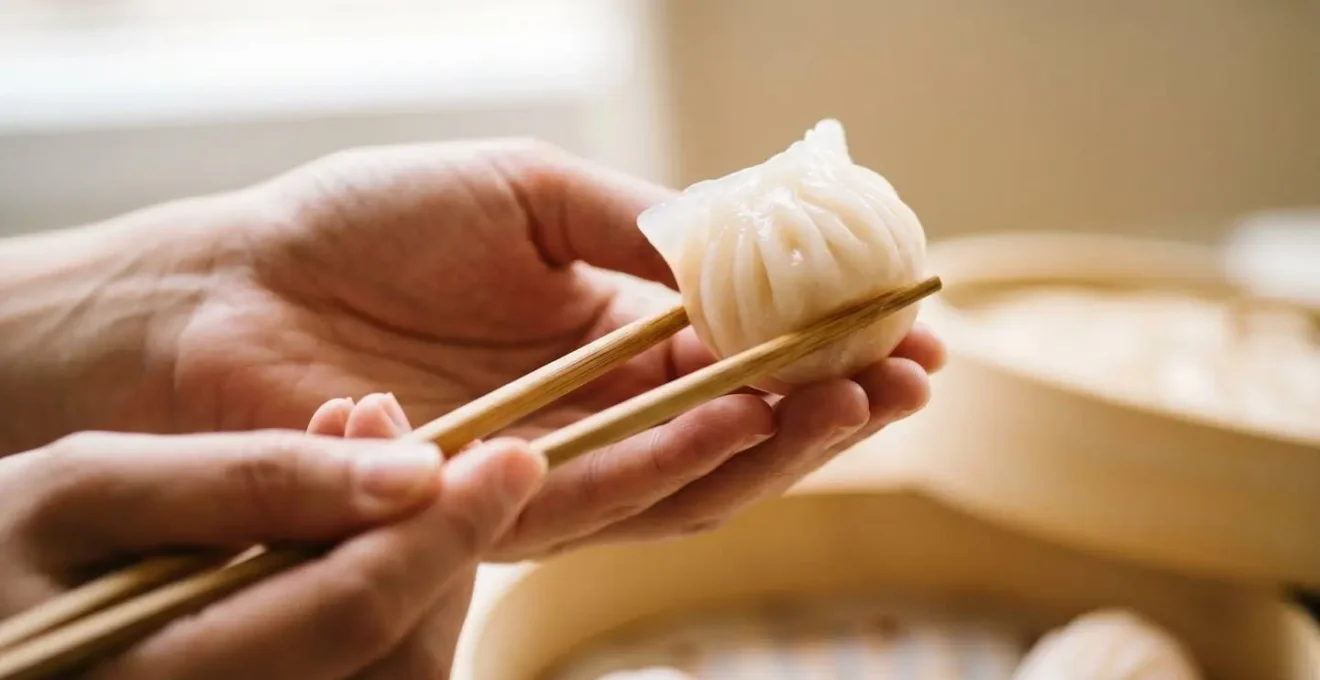
The technique requires precision and a gentle hand. It is a multi-step process that begins before you even attempt to lift the dumpling from its basket. Following these steps will not only maximize your chances of success but also serve as a final diagnostic test of the dumpling’s quality.
Your Action Plan: The Chopstick Cradle Technique
- Step 1 – The Gentle Twist: Before lifting, give the dumpling a very gentle twist or nudge in the basket. A freshly steamed and well-made har gow should release easily from its paper or cloth lining. If it is firmly stuck, it has likely been over-steamed or has been sitting too long, causing the starch to turn to glue—a clear quality failure.
- Step 2 – The Cradle Position: Position your chopsticks on either side of the dumpling’s wider, heavier base. Do not pinch. Instead, slide them underneath to create a cradle that supports the full weight of the dumpling from below. Lift smoothly and steadily. This method puts zero pressure on the fragile pleated crest.
- Step 3 – The Pro Move (Spoon Assist): If the dumplings appear especially delicate or if you are in any doubt, do not risk failure. Use your chopsticks to gently guide the har gow onto your ceramic spoon, and then lift the spoon to your mouth. This is not an admission of defeat; it is a professional move that prioritizes enjoying the dumpling intact over a clumsy, broken mess.
Which Street Market Is Best for Kitchenware: Shanghai Street or Temple Street?
A true connoisseur eventually graduates from judging to replicating. To understand the art of dim sum, one must understand its tools. For the serious foodie traveler in Hong Kong looking to acquire authentic kitchenware, the choice of market is critical. It is a decision between a tourist experience and a cultural immersion. Your destination is not the famous Temple Street Night Market; it is the functional, chaotic, and infinitely more rewarding Shanghai Street in Yau Ma Tei.
Temple Street is for souvenirs. Shanghai Street is for chefs. It is where local restaurateurs and cooks buy their equipment, from giant woks and hand-hammered cleavers to the very bamboo steamers we’ve established as essential. A trip here is not just shopping; it’s fieldwork. You will see the tools of the trade in their natural habitat, used by the people who depend on them. The following table breaks down the fundamental differences between these two iconic streets.
| Feature | Shanghai Street (The Chef’s Haul) | Temple Street (The Tourist’s Treasure Hunt) |
|---|---|---|
| Primary Focus | Professional-grade kitchenware and restaurant supplies | General night market with souvenirs, clothing, and mixed goods |
| Bamboo Steamers | Exact restaurant-quality tiered bamboo steamers from hand-crafted workshops like Man Kee Chopping Board | Limited selection, tourist-grade quality |
| Cleaver Selection | Extensive – Chan Chi Kee Cutlery offers handcrafted cleavers used by professional chefs globally | Minimal specialized knife selection |
| Atmosphere | Working market where local chefs and restaurateurs shop – cultural immersion | Vibrant night market atmosphere – entertainment and browsing |
| Price Point | Professional quality at wholesale prices | Tourist pricing with negotiation expected |
| Best For | Serious cooks wanting to replicate dim sum at home | Souvenir shopping and market atmosphere |
As the analysis from Sassy Hong Kong highlights, the value of Shanghai Street lies in its authenticity. A store like Man Kee Chopping Board at 340-343 Shanghai Street has supplied the city’s chefs for over 65 years. Buying a bamboo steamer here means you are getting the exact same tool used in professional kitchens, not a cheap imitation. This pursuit of authentic tools is the first step in truly appreciating the craft.
How to Tell Sweet Zongzi from Savory Zongzi Before Unwrapping?
The skill of a discerning eater extends beyond a single dish. The ability to perform sensory forensics on a har gow is part of a larger culinary literacy. It is about learning to read the subtle visual cues that a culture embeds in its food. A perfect, parallel example of this is the challenge of identifying the contents of a zongzi—the leaf-wrapped glutinous rice dumplings—before unwrapping it at a market stall. A tourist sees an anonymous pile of green parcels; a connoisseur sees a system of codes.
Just as you learn to read the translucency of a har gow wrapper, you must learn to see the language of zongzi. The most common clue is shape. As a rule of thumb, long, horn-like, or conical shapes are almost always savory, filled with ingredients like pork belly, salted egg yolk, and mung beans. Conversely, the shorter, more compact pyramidal or triangular shapes are typically sweet, containing red bean paste or alkaline-treated rice meant to be dipped in sugar. This is a heuristic, not a law, but it’s an incredibly reliable starting point.
Beyond shape, observe the vendor’s setup. They are not trying to trick you. Often, they will use different colored strings to tie the zongzi, creating a color-code for the fillings. They may also physically separate the sweet and savory types into different baskets or have different price signs. The skill lies in taking a moment to observe and decode the system, rather than pointing blindly. This act of « learning to see » is precisely the same muscle you use to judge a dumpling’s skin or a bun’s glaze. It is the graduation from passive consumption to active, knowledgeable participation in a food culture.
Key Takeaways
- A pleat count is a signature of consistency, not just a number; 13 is a benchmark of precision, but perfect uniformity at any count is the true goal.
- True freshness in a har gow is identified by the crisp « snap » of the shrimp and the presence of a savory inner broth, signs that cannot be faked.
- The bamboo steamer is a functional tool that absorbs moisture and imparts flavor, not just a vessel; its absence is an immediate red flag for quality.
Baked vs Steamed Pork Buns: Which Style Is the True Hong Kong Staple?
To complete one’s education in dim sum, one must understand context. Asking whether a baked or steamed pork bun is the « true » Hong Kong staple is the wrong question. It reveals a misunderstanding of how these dishes function within the city’s culinary ecosystem. Both are iconic, but they occupy different roles and moments in the day. A true staple is defined by its context, and in Hong Kong, context is everything.
The steamed char siu bao is the quintessential morning item, a pillar of the traditional yum cha experience. Its defining characteristic is its pillowy, cloud-like softness, which yields to a burst of savory, saucy barbecue pork. The baked bolo bao (pineapple bun), often with a char siu filling, is a different beast entirely. It represents a textural trinity: the crunchy-sweet cookie-like crust, the soft bread beneath, and the savory filling within. This is an all-day snack, the star of the cha chaan teng (Hong Kong-style diner) and a beloved afternoon tea item. A third contender, the pan-fried sheng jian bao, offers a dual-texture experience with its crispy, caramelized base and soft top, representing a more modern, Shanghainese-influenced favorite.
The following table clarifies the distinct role and context of each major bun style, illustrating that they are not in competition but are complementary pillars of the local cuisine.
| Bun Style | Defining Texture | Time of Day / Context | Where to Find |
|---|---|---|---|
| Steamed Char Siu Bao | Pillowy softness with burst of savory sauce – cloud-like exterior | Quintessential morning yum cha staple | Traditional dim sum restaurants during breakfast/brunch service |
| Baked Bolo Bao (菠蘿包) | Textural trinity: crunchy-sweet crust, soft bread beneath, savory filling | All-day snack or afternoon tea from cha chaan teng (local diner) | Hong Kong-style cafes throughout the day |
| Pan-Fried Sheng Jian Bao | Crispy caramelized base, soft steamed top – dual texture experience | Modern Hong Kong favorite (Shanghainese origin) | Specialty dumpling shops and modern dim sum venues |
As the Hong Kong Tourism Board explains, dim sum itself is a vast and varied tradition. The term refers to the wide array of small items served during yum cha, or « drink tea. » To judge any single item, from a har gow to a char siu bao, requires not only an understanding of its technical execution but also an appreciation for its specific place and purpose in this rich culinary tapestry.
Armed with this knowledge, your duty is clear. Go forth and apply these exacting standards to every dumpling that crosses your path. Tolerate no gummy wrappers, no mushy shrimp, no broken skins. Question the pleats, interrogate the freshness, and use your condiments as the diagnostic tools they are. Elevate the art of dim sum by refusing to accept anything less than perfection.