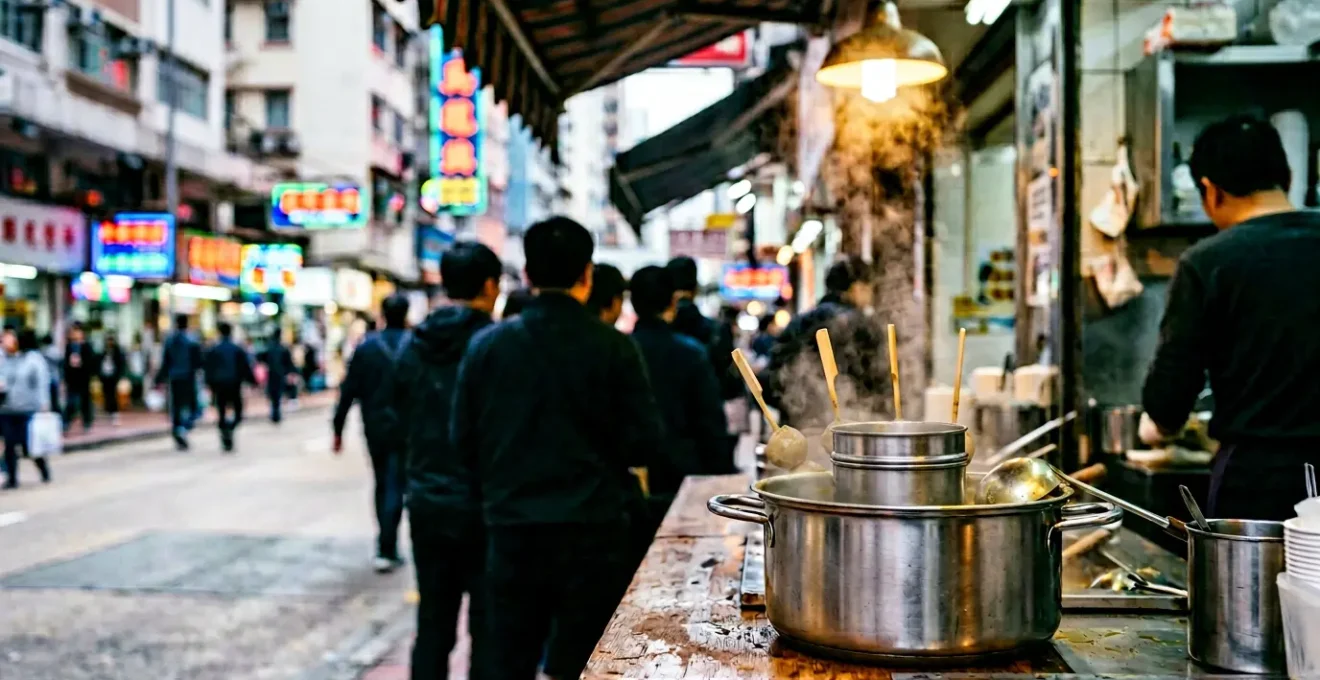
The key to safely enjoying Hong Kong street food isn’t avoiding it, but learning to read the vendors’ « operational safety signals » like a food inspector.
- Focus on processes, not just appearances: high-heat cooking, made-to-order preparation, and correct temperature holding are crucial indicators.
- Understand the local context: payment methods like Octopus and the purpose of different markets reveal a commitment to professional standards.
Recommendation: Shift your mindset from a cautious tourist to a savvy inspector. By observing these signals, you can confidently distinguish safe, high-quality stalls from potential risks.
The streets of Mong Kok and Causeway Bay are a dizzying assault on the senses. The sizzle of hot oil, the steam from bamboo baskets, the pungent aroma of fermented tofu—it’s a chaotic, vibrant symphony of flavor. For any traveler, the desire to dive in is immense, but it’s often met with a nagging fear: is it safe? Cautious visitors, picturing nightmare scenarios after a simple fish ball, often stick to restaurants, missing out on the very soul of Hong Kong’s culinary culture.
Common advice often feels generic and unhelpful. « Look for long queues » or « choose a clean-looking stall » are well-intentioned but vague. What constitutes « clean » in a bustling, open-air environment? A queue could just mean a stall is slow, not necessarily safe. To truly navigate this world with confidence, you need to abandon these platitudes and adopt the mindset of a food safety inspector. The secret isn’t in what you avoid, but in what you actively look for.
This guide will equip you with an inspector’s toolkit. We will move beyond surface-level observations to analyze the operational signals that reveal a vendor’s commitment to hygiene and quality. We will deconstruct the safety protocols behind Hong Kong’s most iconic snacks, understand the logic of its payment systems, and even see how the right kitchenware is a primary indicator of food safety. Forget fear; it’s time to learn how to read the streets like a professional and eat with informed confidence.
This article provides a structured inspection of Hong Kong’s street food scene, from its most beloved snacks to the very tools of the trade. The following sections break down exactly what to look for to ensure every bite is as safe as it is delicious.
Summary: How to Eat Street Food in Hong Kong Without Getting Sick?
- Why Are Curry Fish Balls the Most Popular Street Snack in HK?
- Does Stinky Tofu Taste as Bad as It Smells?
- Chocolate or Original: Which Gai Daan Zai Flavor Is Authentic?
- Why Do Most Street Stalls Still Refuse Credit Cards?
- Is It Rude to Walk and Eat Skewers on the MTR?
- Which Street Market Is Best for Kitchenware: Shanghai Street or Temple Street?
- How to Tell Sweet Zongzi from Savory Zongzi Before Unwrapping?
- Is Temple Street Night Market Still Worth Visiting in the Age of Online Shopping?
Why Are Curry Fish Balls the Most Popular Street Snack in HK?
Curry fish balls are the undisputed king of Hong Kong street food, with millions consumed daily. From an inspector’s perspective, their popularity is intrinsically linked to their inherent safety. The preparation method is a simple yet effective series of critical control points. The fish balls, typically pre-made in certified facilities, are simmered for hours in large vats of boiling curry sauce. This constant high temperature (well above the 60°C / 140°F danger zone) effectively eliminates the risk of bacterial growth, making them one of the safest and most reliable options for a wary traveler.
The simplicity of the snack is its strength. There are no complex, raw ingredients added at the last minute. What you see is what you get: a thoroughly cooked product served steaming hot. When observing a vendor, look for a vigorously bubbling pot of curry. A slow, lukewarm simmer is a red flag. The high turnover also means the product is constantly being replenished, ensuring freshness. The fish ball isn’t just a snack; it’s a demonstration of one of the most fundamental food safety principles: heat kills germs. This makes it the perfect entry point for anyone starting their street food journey.
Therefore, their overwhelming popularity is not just a matter of taste but also a subconscious public trust in a product that is visibly and consistently safe.
Does Stinky Tofu Taste as Bad as It Smells?
The infamous stinky tofu (臭豆腐) is a challenge for many, its pungent, fermented aroma often mistaken for a sign of spoilage. However, from a food safety standpoint, the smell is a red herring. The flavor itself is far more complex and savory than the odor suggests. The fermentation process creates a unique umami profile, which is why it remains a beloved, if divisive, snack. As food experts note, the actual taste is often surprisingly mild.
The flavor of stinky tofu is often mild, despite its strong smell.
– Wikipedia contributors, Stinky tofu – Wikipedia
The most crucial operational signal here is the cooking method: deep-frying at high temperature. The tofu cubes are plunged into oil heated to around 180°C (356°F). This intense heat instantly cooks the exterior to a golden, crispy shell, effectively sterilizing the surface. The smell comes from the volatile compounds of the brine, not from active, harmful bacteria. An inspector’s focus would be on the oil’s quality (it should look clean, not dark and sludgy) and the final product’s temperature—it must be served directly from the fryer, too hot to eat immediately.
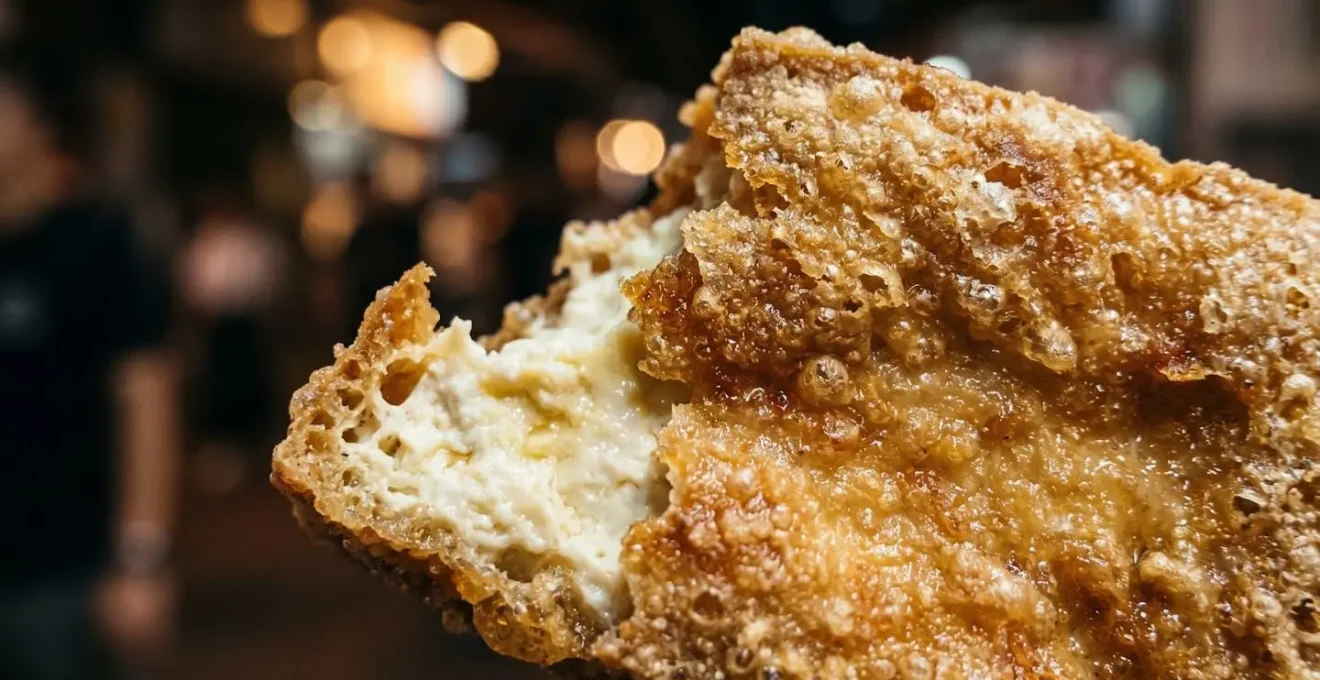
The textural contrast you see above—a crispy, bubbled exterior giving way to a soft, almost creamy interior—is only possible through this high-heat process. This method ensures that what you are eating is not only delicious but has also passed through a definitive safety checkpoint. The smell is part of the experience, not a warning sign.
Ultimately, judging stinky tofu by its cover (or its smell) is a mistake. The real indicator of safety is the sizzle of the fryer.
Chocolate or Original: Which Gai Daan Zai Flavor Is Authentic?
The iconic egg waffle, or *gai daan zai* (雞蛋仔), is a masterclass in texture. While modern stalls offer flavors from chocolate to green tea, the « original » egg flavor is the true classic. It originated in the 1950s as a resourceful solution for street hawkers who used cracked or broken eggs to create the batter. The authentic version is all about the perfect execution of a simple recipe: a golden-brown, crispy shell that yields to a light, fluffy, and slightly chewy interior. This textural contrast, not the flavor, is the ultimate mark of quality and authenticity.
For a food inspector, the key safety signal for an egg waffle is that it must be made-to-order. The batter is a potential breeding ground for bacteria if left at room temperature. A trustworthy vendor will only pour the batter onto the searingly hot, egg-shaped mold after you have paid. The intense, direct heat of the iron press cooks the batter through in minutes, neutralizing any potential risks. A pre-made waffle sitting under a heat lamp is a major red flag, as it has likely fallen into the temperature danger zone.
Food Inspector’s Checklist: Identifying a Safe Egg Waffle
- Visual Check: The waffle must be golden brown with a slight sheen. Pale or burnt spots indicate improper cooking temperature.
- Temperature Assessment: It must be served piping hot, straight from the iron. A lukewarm waffle is an unacceptable risk.
- Sound Indicator: Listen for the sizzle of batter hitting the hot mold. This confirms the cooking process is starting at a safe temperature.
- Queue Observation: A queue of people waiting *after* paying is the best sign. It means every single waffle is being prepared fresh.
- Cooling Protocol: The vendor must place the finished waffle on a cooling rack. Stacking them creates steam and sogginess, a sign of poor practice.
So while chocolate may be tempting, ordering the original flavor from a vendor who follows these steps is the best way to experience the *gai daan zai* as it was intended: fresh, safe, and texturally perfect.
Why Do Most Street Stalls Still Refuse Credit Cards?
The near-universal rejection of credit cards at Hong Kong street stalls isn’t a sign of being technologically behind; it’s a calculated business decision rooted in a culture of efficiency and razor-thin profit margins. The primary reason is cost. Transaction fees of 2-3% would obliterate the profit on a HKD 15 skewer. Instead, the city runs on two primary systems: cash and the Octopus card. The Octopus card is a ubiquitous stored-value card used for everything from public transport to convenience stores. In fact, official data shows that over 99% of Hong Kong residents aged 15 to 64 use it, making it the de facto digital cash.
From a food safety inspector’s perspective, this payment ecosystem has tangible hygiene benefits. Using an Octopus card minimizes cash handling, reducing the cross-contamination risk between money and food preparation. The « tap-and-go » transaction is instantaneous, which is crucial for high-turnover stalls. This speed prevents queues from becoming stagnant and allows the vendor to focus on one thing: cooking. While some newer or more tourist-focused stalls may accept QR code payments like Alipay, they often require a local bank account. For a traveler, the most effective strategy is a combination of small-denomination cash (HKD 10, 20, 50 notes) and a Tourist Octopus Card, which can be purchased at the airport or any MTR station.
Therefore, arriving prepared with cash or a topped-up Octopus card is not just a convenience; it’s a sign of respect for the vendor’s business model and a small but significant step in maintaining the hygienic flow of the stall.
Is It Rude to Walk and Eat Skewers on the MTR?
The answer is an unequivocal yes—it is not just rude, but strictly prohibited. The MTR (Mass Transit Railway) has a clear by-law against eating or drinking in paid areas, including on platforms and inside trains. Violating this rule is not taken lightly; it comes with a potential HKD 2,000 fine for eating or drinking in MTR paid areas. This rule is a cornerstone of public hygiene in a city with one of the world’s most crowded public transport systems. It prevents spills, waste, and strong odors, ensuring a clean environment for millions of daily commuters.
The proper etiquette, observed by all locals, is to finish your snack on the pavement before you even enter the MTR station. It’s perfectly acceptable to stand to the side of a busy sidewalk and enjoy your food. This leads to another challenge: what to do with the used skewer or wrapper? Public trash cans are notoriously scarce on Hong Kong streets, a policy to improve cleanliness and security. The local solution is simple: the vendor will almost always provide a napkin. You are expected to wrap your waste in the napkin and carry it with you until you find a bin, which are typically located just inside MTR station entrances (before the ticket gates) or in shopping malls.
Littering is heavily fined and culturally unacceptable. Embracing this « carry-in, carry-out » mentality is a fundamental part of respecting the local culture and contributing to the public health standards that make the city function.
Which Street Market Is Best for Kitchenware: Shanghai Street or Temple Street?
For a traveler interested in the « how » behind Hong Kong’s street food, understanding the tools of the trade is essential. This brings up the question of where to find authentic kitchenware. While Temple Street is a famous night market, its focus is on tourism, souvenirs, and atmosphere. From an inspector’s standpoint, the serious tools—the kind that ensure food safety and create authentic flavors—are found on Shanghai Street in Yau Ma Tei. This district is where chefs and street food vendors themselves go to buy their equipment. The difference between the two is a lesson in professionalism versus performance.
The « Tool-to-Table Integrity » principle states that the quality of the equipment directly impacts the safety and quality of the food. A vendor using a well-seasoned carbon steel wok from a reputable Shanghai Street shop like Universe Kitchen (宇宙廚具) is making a statement about their commitment to their craft. These tools are designed for high-heat, rapid cooking, which is a key safety control point.

The following table breaks down the fundamental differences. For anyone serious about food, Shanghai Street is not a shopping trip; it’s a field study in professional-grade hygiene and technique.
| Aspect | Shanghai Street (Yau Ma Tei) | Temple Street Night Market |
|---|---|---|
| Primary Purpose | Professional kitchenware district | Tourist-oriented night market |
| Target Customers | Street food vendors, restaurant chefs, serious home cooks | Tourists, souvenir shoppers |
| Product Quality | High-quality carbon steel woks, professional-grade cleavers, authentic ‘spider’ strainers | Decorative items, trinkets, tourist souvenirs |
| Price Range | Mid to high (professional equipment) | Low (mass-produced items) |
| Food Safety Relevance | Tools used by professionals for high-heat, safe cooking | Minimal (entertainment focus) |
| Best For | Understanding the craft of HK cooking, buying authentic equipment | Experiencing atmosphere, fortune tellers, Cantonese opera |
| Operating Hours | Daytime (morning to early evening) | Evening to late night (6 PM onwards) |
| Notable Shops | 宇宙廚具 (Universe Kitchen), I Love Cake (egg waffle molds) | Various stalls (no specialist kitchenware) |
Ultimately, a visit to Shanghai Street provides a deeper appreciation for the fact that safe and delicious street food begins with professional, purpose-built tools.
How to Tell Sweet Zongzi from Savory Zongzi Before Unwrapping?
Zongzi, the pyramid-shaped glutinous rice dumplings wrapped in bamboo leaves, are a common sight, especially around the Dragon Boat Festival. For the uninitiated, buying one can be a gamble between a sweet or savory filling. However, there are clear visual cues. In general, long, cone-shaped zongzi are sweet, often filled with red bean paste or served with syrup. The much larger, more robust pyramid-shaped zongzi are almost always savory, packed with delights like salted pork belly, mushrooms, and salted egg yolk.
Beyond identifying the flavor, an inspector’s primary concern is temperature. Zongzi are pre-cooked and then kept hot for sale. The single most important safety rule is to only buy zongzi from a vendor keeping them in a large, actively steaming container. This practice ensures the dumplings are held above the critical 60°C (140°F) temperature, preventing the growth of harmful bacteria. A zongzi sold at room temperature is a significant food safety risk and must be avoided. This is a critical rule outlined in official food safety guidelines for traditional foods.
Other visual signals include the leaves; fresh, fragrant green leaves suggest recent preparation, whereas dry, brown leaves indicate the zongzi might be old. When in doubt, don’t be afraid to ask the vendor. A simple « tim ding haam? » (sweet or savory?) will get you a quick answer. By combining visual identification with this crucial temperature check, you can confidently select a zongzi that is both to your taste and perfectly safe to eat.
Observing this strict adherence to temperature control is one of the most reliable signals of a vendor’s commitment to food safety.
Key Takeaways
- Heat is Your Ally: Prioritize foods that are either cooked at high heat in front of you (deep-fried, made-to-order waffles) or held at a constant boiling temperature (curry fish balls).
- Observe the Process, Not Just the Product: A vendor’s workflow, from payment handling to their cooling protocol for waffles, reveals more about their hygiene standards than the stall’s appearance.
- Trust the Tools: The use of professional-grade equipment, like a seasoned carbon steel wok, is a strong indicator of a serious, safety-conscious operator.
Is Temple Street Night Market Still Worth Visiting in the Age of Online Shopping?
In an era dominated by e-commerce, the value of Temple Street Night Market has shifted. Visitors who arrive expecting a bargain-hunter’s paradise are often disappointed by the trinkets and mass-produced goods. However, to dismiss it would be to miss the point entirely. From an inspector’s viewpoint, Temple Street should be evaluated not as a shopping destination, but as an immersive cultural experience and, more importantly, a launchpad for a culinary adventure. The true value lies in the atmosphere and the surrounding food scene.
The market itself is street theatre: fortune tellers reading palms under glowing red lanterns, impromptu Cantonese opera performances, and the vibrant energy of the crowds. But the real treasure is found in the adjacent streets. This area is famous for iconic claypot rice stalls (煲仔飯), where rice is cooked to order over charcoal, and traditional *dai pai dong* (open-air food stalls) serving fresh seafood and wok-fried dishes. The modern, savvy way to approach Temple Street is through the local practice of ‘So Gai’ (掃街), which literally means « sweeping the street. » This is the art of creating a progressive meal by snacking from one trusted stall to another, turning a potentially disappointing shopping trip into a purposeful gastronomic exploration.
By adopting the ‘So Gai’ method and applying the food safety principles from this guide, your visit to Temple Street becomes a safe, delicious, and deeply authentic Hong Kong experience.