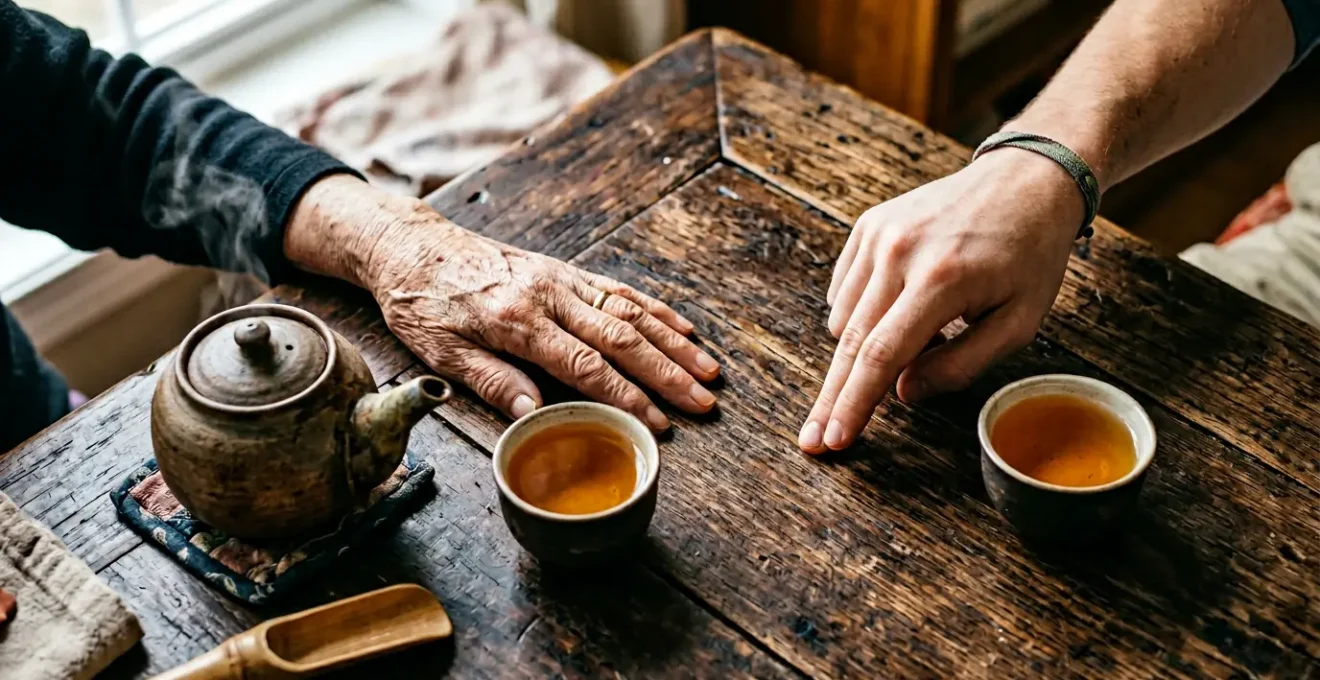
That two-finger tap for tea is more than « thank you »; it’s a secret bow to a disguised emperor, a piece of living history played out on your table.
- The gesture, or « finger kowtow, » originated with the Qianlong Emperor to allow his servants to show respect without revealing his identity.
- Other silent signals, like tilting the teapot lid, are a crucial part of the non-verbal communication in a bustling teahouse.
- Choosing the right tea, like Pu-erh for greasy foods, is about creating harmony and aiding digestion, not just about taste.
Recommendation: Next time you’re at yum cha, use the finger tap not just as a polite gesture, but as a knowing nod to a story that has been passed down for centuries, one sip at a time.
The clatter of ceramic bowls, the rumble of stainless-steel carts, and a symphony of conversations echoing in a grand hall—this is the sensory welcome of a traditional yum cha restaurant. Amidst this vibrant chaos, a silent and sophisticated language is spoken. You may have noticed it: the way an elder leaves the teapot lid slightly ajar, or how, when your cup is refilled, your neighbour gracefully taps their index and middle fingers on the table. These are not random quirks; they are precise gestures in a rich, non-verbal dialogue steeped in centuries of history and tradition.
Many guides will simply tell you « tap two fingers to say thanks. » But to truly appreciate the culture, one must understand the ‘why’ behind the ‘what’. This is not merely about etiquette; it’s about participating in a shared cultural rhythm. The rituals of the tea table are a dance of respect, efficiency, and profound historical meaning, where every action, from the choice of tea to the flick of a wrist, tells a story. Understanding this silent language transforms you from a mere customer into a respectful participant in a time-honoured tradition.
But what if the key wasn’t just to mimic the gestures, but to understand the imperial decree behind a simple tap? This guide will not just give you the rules. As a tea master would, we will peel back the layers of history and philosophy. We will explore the story behind the « finger kowtow, » learn how to communicate with the staff without uttering a word, and discover the art of balancing flavours that makes yum cha a complete culinary experience. By the end, you’ll be able to navigate the teahouse with the quiet confidence of a local.
This article deciphers the unspoken rules of the yum cha table, exploring the history and practical application of its most important rituals. The following sections provide a comprehensive guide to mastering this silent language.
Summary: The Unspoken Etiquette of the Yum Cha Teahouse
- Pu’er or Jasmine: Which Tea Pairs Best with Greasy Dim Sum?
- How to Signal the Waiter for More Hot Water Without Speaking?
- Why Is « Yum Cha » Traditionally a Morning or Lunch Activity?
- Why Is Sunday Yum Cha Crucial for Hong Kong Family Dynamics?
- Is It Rude to Ask for Just Hot Water Instead of Tea?
- How to Use Fortune Sticks Correctly to Ask a Question About Your Future?
- Why Is It Advised to Eat Mooncakes in Small Slices with Tea?
- How to Tell If a Shrimp Dumpling Skin Is Too Thick or Just Right?
Pu’er or Jasmine: Which Tea Pairs Best with Greasy Dim Sum?
At a yum cha table, tea is not a mere beverage; it is a vital balancing agent. The choice between a dark, earthy Pu-erh and a light, floral Jasmine is not a matter of simple preference. It is a strategic decision rooted in the principles of Traditional Chinese Medicine (TCM), which seeks harmony in the body. Greasy, rich dishes like fried turnip cakes (lo bak go) or braised chicken feet (fung zao) introduce heat and oiliness. The goal is to counteract this with a tea that can cleanse the palate and aid digestion.
This is where Pu-erh reigns supreme. Its fermented, warming nature is traditionally believed to « cut through grease » and settle the stomach. This isn’t just folklore; modern science supports the wisdom of this pairing. Studies confirm that Pu-erh tea can effectively reduce the digestion of fat in the small intestine. Conversely, delicate Jasmine tea, with its cooling properties, is the perfect companion for steamed, lighter fare like shrimp dumplings (har gow) or vegetable buns, as it refreshes the palate without overwhelming their subtle flavours.
To navigate this, a tea master often refers to a kind of internal map, matching the tea’s character to the food’s profile. The following table serves as a reliable guide for your next yum cha outing, as detailed in a comprehensive guide to dim sum pairings.
| Tea Type | TCM Property | Best Paired With | Flavor Profile |
|---|---|---|---|
| Pu-erh (Ripe) | Warming, digestive aid | Pork buns, fried dumplings, braised chicken feet, turnip cakes | Rich, fermented, earthy, slightly woody |
| Jasmine Green | Cooling, palate-cleansing | Steamed seafood dumplings (har gow), shrimp rice rolls, vegetable dumplings | Delicate, sweet, aromatic, floral |
| Oolong (Tieguanyin) | Neutral, versatile | Siu mai, sticky rice in lotus leaf, pan-fried dumplings | Smooth, toasty, sometimes fruity or floral |
| Chrysanthemum | Cooling, detoxifying | Fried dim sum, dessert buns, egg tarts | Light, slightly sweet, herbaceous |
Ultimately, the goal is not just to wash down the food, but to create a harmonious experience where the tea elevates the meal and leaves you feeling satisfied and balanced, not heavy and lethargic. Choosing the right tea is the first step in speaking the fluent, silent language of yum cha.
How to Signal the Waiter for More Hot Water Without Speaking?
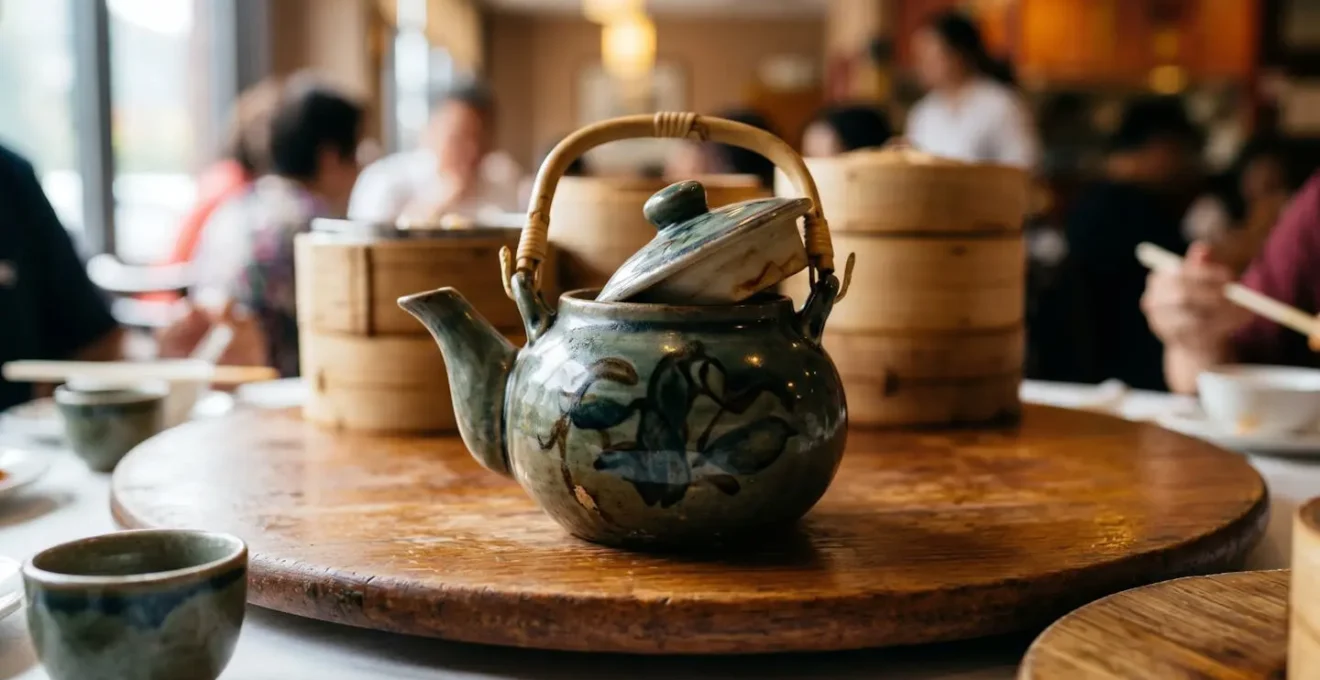
In the bustling symphony of a packed teahouse, catching a server’s attention can be a challenge. Shouting across the room is considered disruptive and impolite. Instead, the culture has evolved a set of elegant, non-verbal signals. The most common and widely understood method to request a hot water refill for your teapot is to simply leave the teapot lid ajar, either tilting it or resting it on the handle. This acts as a clear, silent flag that can be spotted by servers from a distance as they patrol the floor.
Once the server has refilled your pot, another crucial ritual comes into play: the « thank you » tap. This gesture, known colloquially as the « finger kowtow, » has a fascinating origin story that speaks volumes about respect and humility. The legend dates back to the Qianlong Emperor in the 18th century, who enjoyed traveling amongst his subjects in disguise. During a teahouse visit, the Emperor, maintaining his cover, poured tea for a companion. Imperial protocol demanded the companion kneel and bow (kowtow), an act that would have instantly revealed the Emperor’s identity. The quick-thinking official instead bent his index and middle fingers and tapped them on the table, mimicking kneeling legs and a bowing head. This clever act of deference evolved into the universal Chinese tea table custom we see today.
The gesture itself has its own nuanced grammar. When a peer or someone younger pours your tea, you tap two bent fingers (index and middle). However, to show a higher degree of respect, such as when an elder serves you, you should make a loose fist and tap your knuckles on the table. This silent acknowledgement maintains the flow of conversation and shows gratitude without interruption. It’s a small gesture, but one that is rich with history and demonstrates a deep appreciation for the culture.
Why Is « Yum Cha » Traditionally a Morning or Lunch Activity?
The phrase « yum cha » literally translates to « drink tea, » but the custom is deeply intertwined with « dim sum, » the small plates of food that accompany it. Its scheduling as a morning or early afternoon ritual is rooted in a combination of social history, practicality, and traditional wellness beliefs. Historically, teahouses in Southern China were rest stops for rural farmers and travelers. They would visit for a restorative cup of tea and a few small snacks to fuel their journey or workday, making it a daytime affair.
This tradition carried into modern city life, where yum cha became a popular setting for morning business meetings or a leisurely brunch for retired « gong gongs » (grandfathers) and « po pos » (grandmothers) to read their newspapers and socialize. The timing also aligns with principles of digestive health in Chinese culture. Dim sum can be quite rich and filling, and consuming such a meal earlier in the day is believed to give the body ample time to digest before resting in the evening. It’s considered a form of « social sustenance »—a communal break that nourishes both the body and social bonds during active hours.
Furthermore, the logistics of a dim sum restaurant are geared towards a high-volume, fast-turnover daytime service. The intricate process of hand-making dozens of varieties of fresh dumplings, buns, and pastries begins in the pre-dawn hours. By late afternoon, the freshest offerings are gone, and the kitchens traditionally shift focus to preparing for the evening’s la carte dinner service, which features entirely different dishes. Thus, yum cha’s timing is a perfect marriage of cultural habit, physiological wisdom, and the operational rhythm of the restaurant itself.
Why Is Sunday Yum Cha Crucial for Hong Kong Family Dynamics?
If yum cha is a daily ritual for some, then Sunday yum cha is a sacred institution for Hong Kong families. It is far more than just a meal; it is the cornerstone of the week, a vibrant and often boisterous reaffirmation of family ties and filial piety. In a fast-paced, high-pressure city like Hong Kong, where work schedules are demanding, the weekend provides a precious opportunity for multi-generational families to gather. Sunday yum cha is the designated time for this connection.
The event is a powerful expression of filial piety, a core Confucian value emphasizing respect for one’s parents and elders. It is the time for children and grandchildren to treat the older generation. The act of pouring tea for elders before oneself, ensuring their favorite dishes are ordered, and engaging in lively conversation are all part of this performance of respect. The noisy, chaotic atmosphere of a packed restaurant on a Sunday is not a drawback; it is the sound of « yeet hay » (熱鬧), or « hot and noisy, » a desirable ambiance signifying life, prosperity, and communal joy.
For many families, this is the primary forum for catching up on news, celebrating small milestones, and reinforcing a sense of shared identity. Grandparents get to dote on their grandchildren, and parents can relax and connect with their own siblings and parents. It serves as a vital social adhesive, binding the family unit together through a consistent, cherished ritual. To miss Sunday yum cha is to miss a fundamental beat in the rhythm of family life, making it a deeply ingrained and non-negotiable part of the cultural fabric of Hong Kong.
Is It Rude to Ask for Just Hot Water Instead of Tea?
In the context of a traditional yum cha restaurant, asking for a cup of plain hot water instead of tea can be perceived as slightly unusual, though not overtly rude. To understand why, one must consider the business model and cultural significance of the teahouse. The « cha fei, » or tea fee, is a standard cover charge per person, regardless of how much tea you drink. This fee is a fundamental part of the restaurant’s revenue, covering the pot, the leaves, and the continuous service of hot water refills. Asking for hot water only is, in a way, like sidestepping this basic transaction.
From a cultural standpoint, the entire experience is built around the act of « yum cha » (drinking tea). The tea is not just an afterthought; it is the central element that the food is designed to complement. To decline tea is to opt out of the core experience. It’s akin to going to a renowned vineyard and asking for a glass of water instead of wine—perfectly acceptable, but it misses the point of the establishment.
That being said, restaurant staff are professionals and will almost always accommodate the request without fuss, especially if it’s for health or dietary reasons. The most polite way to handle this is to simply state your preference when the server first comes to take your tea order. You may still be charged the standard tea fee, as it functions as a cover charge. A simple « Just hot water for me, thank you » (熱水就可以了, 謝謝 – yit seui jau ho yi liu, m’goi) is perfectly clear and polite. While it may set you apart as a non-traditionalist, it is not a major faux pas in the grand scheme of teahouse etiquette.
How to Use Fortune Sticks Correctly to Ask a Question About Your Future?
Moving from the etiquette of the table to the etiquette of the spirit, we encounter another cherished Chinese tradition: the use of fortune sticks, or « kau cim » (求籤). This practice, often found in Taoist and Buddhist temples, is not a game but a structured form of divination, a respectful dialogue with the divine. Approaching it with the correct mindset and procedure is essential to show respect and receive a meaningful reading. It is another silent language, one of reverence and focused intention.
The process begins not with the shake, but with a moment of quiet contemplation. You must first formulate a single, specific question in your mind. Vague questions yield vague answers. Instead of « Will I be happy? », ask « Should I pursue the new job opportunity I was offered this month? » Kneel before the altar, introduce yourself to the deity, and state your question clearly in your mind or a quiet whisper. This establishes a clear intention for your request.
Only then do you take the bamboo cylinder of numbered sticks. Holding it in both hands, tilt it at a slight downward angle and begin gently shaking it back and forth. The goal is not to vigorously rattle the sticks, but to create a gentle, rhythmic motion that allows a single stick to work its way out and fall to the floor. It is believed that the deity guides the specific stick that corresponds to your answer. Once a stick has fallen, note its number. You may need to verify the answer by dropping two « moon blocks » (jiaobei), curved wooden pieces, to confirm the deity has answered. One flat side up and one curved side up means ‘yes’. You can then take your number to the temple custodian to receive the corresponding printed fortune, which often contains a poetic verse that requires interpretation.
Why Is It Advised to Eat Mooncakes in Small Slices with Tea?
The Mid-Autumn Festival is defined by the mooncake, a dense, rich pastry that is heavy with both calories and symbolism. The round shape of the mooncake represents the full moon and, more importantly, family reunion and completeness. To advise eating it in small slices is not to diminish its importance but to enhance it, following principles of balance, sharing, and mindful appreciation that are central to Chinese food culture.
Firstly, from a practical and health perspective, mooncakes are incredibly rich. A traditional lotus seed paste mooncake with double salted egg yolks can contain over 800 calories. Eating a whole one in a single sitting is overwhelming for both the palate and the digestive system. Slicing it into small wedges allows for moderation and savoring. This practical approach is then elevated by its symbolic meaning. The act of cutting the mooncake and sharing the slices with family members is a physical manifestation of unity. Everyone receives a piece of the whole, reinforcing the theme of togetherness.
Pairing these small slices with tea is non-negotiable. As with greasy dim sum, a strong, palate-cleansing tea like Pu-erh or a robust Oolong is essential. The tea serves to cut through the intense sweetness of the paste and the richness of the yolks, preventing the palate from being overwhelmed. This allows you to better appreciate the complex flavors and textures of the mooncake. This ritual transforms the act of eating from simple consumption into a mindful, multi-sensory experience that honors both the food and the company.
Your Action Plan: Appreciating the Mooncake Ritual
- Wait for the family to gather: Never cut the mooncake alone; its primary purpose is communal.
- Use a dedicated knife: Cut the mooncake into small, equal wedges—typically 4, 6, or 8, depending on the size of the group.
- Serve with strong tea: Brew a pot of Pu-erh or Oolong tea to serve alongside the slices. Avoid sugary drinks.
- Take one slice at a time: Savor the small portion, noting the texture of the crust, the sweetness of the paste, and the savory burst of the yolk.
- Reflect on the symbolism: As you eat, take a moment to appreciate the themes of reunion and completeness with your loved ones.
Key takeaways
- The ‘finger tap’ is a historical gesture of respect, originating from a story involving a disguised emperor.
- Silent signals, like tilting the teapot lid, are an efficient and polite way to communicate in a busy teahouse.
- Tea pairing in yum cha is a deliberate art based on balance, using teas like Pu-erh to counteract rich foods.
- Yum cha’s timing and rituals are deeply connected to social history, family values, and the operational rhythm of the restaurant.
How to Tell If a Shrimp Dumpling Skin Is Too Thick or Just Right?
The shrimp dumpling, or « har gow » (蝦餃), is often considered the benchmark of a dim sum chef’s skill. While the freshness of the shrimp and the quality of the filling are crucial, the true artistry lies in the skin. A perfect har gow wrapper is a testament to mastery, a delicate balance of texture and translucency that elevates the entire dumpling. It is the final piece of the yum cha puzzle, representing the appreciation of craftsmanship that permeates the culture.
A proper har gow skin should be so thin and translucent that you can just make out the pinkish hue of the cooked shrimp within. It should be a delicate veil, not an opaque, starchy barrier. When you pick it up with your chopsticks, it should have enough structural integrity to hold together, yet feel supple and pliant. It should not be sticky or gummy. The texture when you bite into it should be soft with a slight, pleasant chewiness that gives way to the crisp, snappy shrimp inside. It should complement the filling, not dominate it.
Conversely, a skin that is too thick is a common sign of a less-skilled kitchen. It will appear opaque and whitish, hiding the shrimp completely. It will feel heavy and clunky, and its texture will be doughy and pasty in your mouth, detracting from the delicate flavor of the filling. Another red flag is a skin that breaks or falls apart when you try to lift it from the steamer basket. This indicates it was either rolled too thinly without the necessary elasticity, or it has been over-steamed. Judging the skin of a har gow is the final lesson in the silent language of yum cha: the language of appreciating true craftsmanship.
Now, armed with this knowledge, you are ready to step into any teahouse not as a tourist, but as an informed guest. Go forth, drink tea, and speak the silent language of yum cha with confidence and respect.