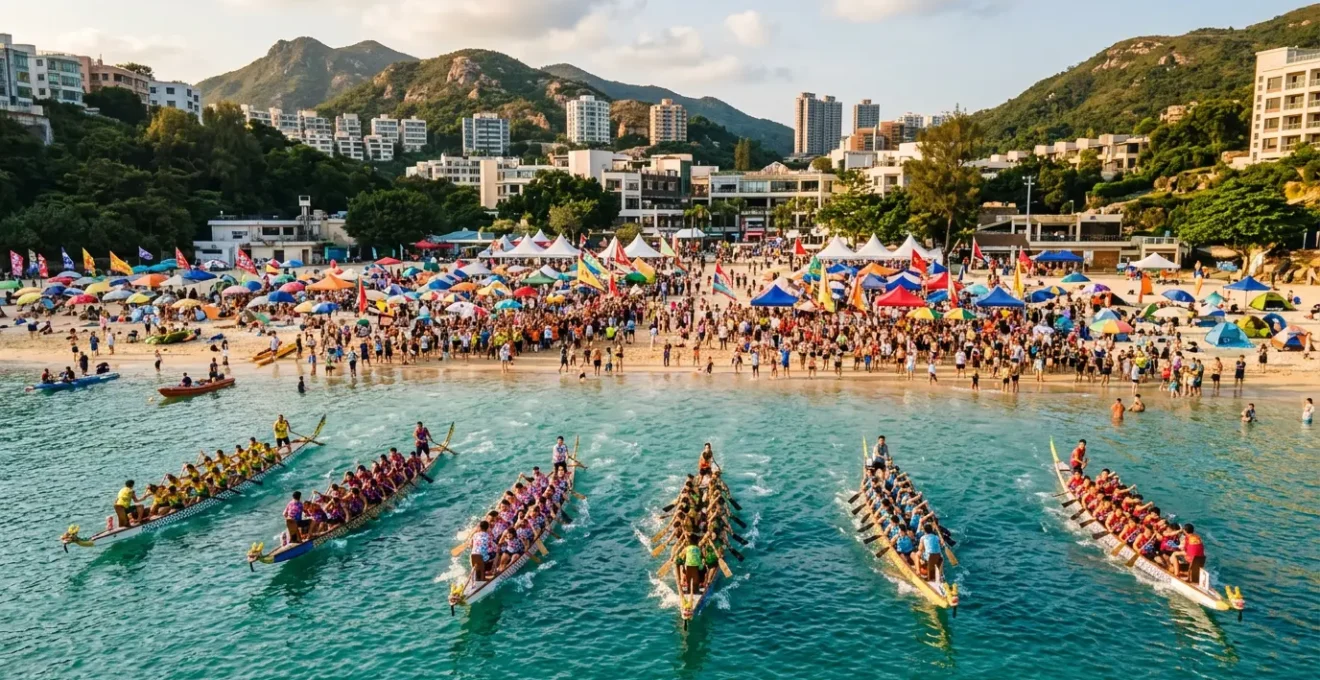
The biggest mistake visitors make at the Stanley Dragon Boat Festival is thinking it’s about boat races.
- It’s a 30,000-person beach carnival where logistics are the real competition, not the paddling.
- Your success is measured in staying cool, finding an escape route, and embracing the chaos.
Recommendation: Treat it like a music festival, not a sporting final, and you’ll have an unforgettable day.
You arrive at Stanley Main Beach on a sweltering June morning, drawn by the promise of the iconic Dragon Boat Festival. You’ve seen the pictures: sleek boats gliding across the water, a testament to ancient tradition and athletic prowess. You’re expecting a day of serious sport, a cultural spectacle with a clear finish line. But what you find is something else entirely: a wall of sound, a sea of humanity, and the distinct, thumping bass of a hundred different Bluetooth speakers. The air smells less of the sea and more of sunscreen, spilled beer, and joyous, chaotic energy.
This is the fundamental truth that glossy travel guides often miss. While the races are the historical anchor of the event, the Stanley festival has evolved into something far more primal and exhilarating: Hong Kong’s ultimate beach carnival. Trying to follow the race heats with a pair of binoculars is a rookie mistake. The real sport for spectators is navigating the glorious pandemonium. Success isn’t about securing a perfect view of the finish line; it’s about mastering the art of the party.
This guide is your tactical briefing. As event organizers, we know that the difference between an amazing day and a miserable one is preparation. We’re here to arm you with the logistical strategies you need to not just survive the Stanley Dragon Boat Festival, but to conquer it. We’ll cover everything from the crucial art of arrival and the science of staying cool to the single most important part of your day: the strategic retreat.
This article breaks down the essential strategies for navigating the festival’s unique blend of sport and party. The following table of contents will guide you through mastering each phase of your day, from securing a spot in the morning chaos to making a clean escape in the evening.
Summary: Is the Stanley Dragon Boat Festival a Sport Event or a Beach Party?
- What Time Must You Arrive at Stanley Beach to Secure a Spot?
- How to Stay Cool on a Crowded Beach in June’s Humidity?
- How Is the Winner Determined in a Dragon Boat Race?
- How to Escape Stanley After the Races Without Waiting 2 Hours for a Bus?
- Do Spectators Wear Costumes to the Dragon Boat Races?
- Why Is the Red Flag Often Hoisted at Shek O Beach During Summer?
- Do You Need a Reservation to Enter the Happy Valley Beer Garden?
- How to Eat a Zongzi Without Making a Sticky Mess?
What Time Must You Arrive at Stanley Beach to Secure a Spot?
You must decide on your strategy before you even leave home, as arrival time dictates your entire day. With over 30,000 spectators and 200 teams creating a human tidal wave, your spot on the beach is earned, not given. There is no single « best » time; there is only the best time for the experience you want. Think of yourself as choosing a character class in a game: are you a Front-Row Warrior or a Vibe Soaker?
The « Front-Row Warriors » execute their plan with military precision, arriving between 7:30 and 8:00 AM to claim prime real estate near the finish line. This is for the dedicated who want to feel the spray and see the paddlers’ exhaustion up close. However, for most, the « Vibe Soaker » approach is more realistic. Arriving around 10:00 AM still allows you to find decent spots in the less-congested family zones. The most important deadline is 9:00 AM; after this « Point of No Return, » taxi and bus access to Stanley becomes severely restricted, and you’ll be dropped far from the action.
There’s also a « Tactical Latecomer » window. Arriving around 1:30 PM means you miss the morning crush but catch the high-stakes afternoon Cup Finals and the transition into the full-blown party atmosphere. This strategy prioritizes energy conservation and party vibes over a full day of sun exposure. Your arrival time is your first and most important tactical decision of the day.
How to Stay Cool on a Crowded Beach in June’s Humidity?
Staying cool isn’t a luxury; it’s a competitive sport in itself. Hong Kong’s June humidity is relentless, and when combined with thousands of bodies, it creates a microclimate that can defeat even the hardiest festival-goer. Your survival depends on a well-curated « Dragon Boat Party Survival Kit, » which goes far beyond a simple bottle of water. This is about active, strategic cooling.
The foundation of your kit should be frozen water bottles. They serve as ice packs in your cooler bag in the morning and melt into life-saving ice-cold hydration in the afternoon. To combat the oppressive heat, a battery-operated fan with a misting function is a game-changer. It’s not just about moving air; it’s about creating your own personal zone of evaporative cooling. Crucially, you must supplement water with electrolyte tablets or sports drinks to replace the salt you’ll lose through sweat and prevent heat exhaustion. Edible cooling comes in the form of frozen grapes or melon chunks, which act as delicious, hydrating ice packs.
One of the most effective tools in your arsenal is the evaporative cooling towel. This is not just any piece of cloth; its specialized microfiber technology provides significant cooling when wet. The visual below shows the science in action, with the fabric designed to hold and slowly release water for a lasting cooling effect.

As you can see, the fabric’s structure is engineered for maximum moisture retention and slow evaporation. This piece of gear, combined with a portable shade structure like a small umbrella, forms your primary defence against the sun. Finally, remember to protect your electronics in zip-lock bags; the biggest threats are not just accidental spills but the sheer amount of sweat and condensation in the air. Mastering your cooling strategy is non-negotiable for enjoying the full day.
How Is the Winner Determined in a Dragon Boat Race?
On the surface, the rule is beautifully simple: the first boat to have its dragon head cross the finish line is declared the winner. The sport itself is a brutal, synchronized sprint. According to international standards, teams of 20 paddlers propel standard boats that are 12.4m long over courses that typically range from 200 to 500 meters. A drummer at the front provides the rhythm, and a steerer at the back guides the vessel. It’s a display of pure power, timing, and teamwork.
But for you, the spectator-turned-party-animal, « winning » has a different meaning. The secret is knowing that not all races are created equal. The Stanley event is structured with multiple categories and heats throughout the day, including Corporate, Open, Women’s, and Mixed divisions.
Spectator Strategy: Targeting the Cup Finals
A casual spectator’s victory lies not in watching every single heat from 8 AM, but in strategically targeting the peak action. The morning and early afternoon are filled with preliminary rounds. The real drama unfolds during the afternoon Cup Finals, typically held between 3:00 PM and 5:00 PM. These races feature the fastest teams that have battled their way through the earlier rounds. The intensity is higher, the finishes are closer, and the crowd energy is at its absolute peak. For those who want maximum excitement without committing to the full eight-hour marathon, this two-hour window is the prime time to focus on the water.
Therefore, while the technical winner is the first boat to cross the line, your win is in timing your attention. You can spend the morning socializing and soaking in the atmosphere, and then shift your focus to the water for the afternoon finals to witness the pinnacle of the day’s competition. It’s about enjoying the party on your own terms and catching the sporting climax when it truly matters.
How to Escape Stanley After the Races Without Waiting 2 Hours for a Bus?
The final and most challenging event of the day is not a boat race; it’s the mass exodus. At 5:00 PM, when the last race finishes, a siren that only you can hear goes off, signaling the start of « The Great Escape. » Thousands of tired, sun-drenched, and tipsy spectators converge on a single bus terminus, creating a queue that can snake for hours. Winning this event requires a pre-planned, multi-pronged strategy. Simply walking to the bus stop is a recipe for disaster.
Your primary tactic is the « Staged Retreat. » Instead of joining the crush at 5:30 PM, you make a strategic move to a waterfront restaurant or bar around 4:30 PM. You trade the two hours you would have spent standing in a bus queue for two hours of relaxed dining and drinks, letting the peak chaos subside before you even attempt to leave. This turns waiting time into enjoyable time. Another key tactic is to bypass the main chokepoints. Veteran attendees know to walk up to the less-known minibus stop on Stanley Gap Road, or even locate the unofficial taxi queue near the Correctional Services Museum.
An advanced maneuver is the « Go Deeper to Get Out » tactic. This involves taking a bus or minibus *further* into the south side of the island, like to Chung Hom Kok, completely bypassing the Stanley traffic jam. From there, you can easily catch a different, less crowded bus route back towards Central. Your exit strategy should be planned with the same seriousness as your arrival.
Your Strategic Exit Plan
- Staged Retreat: Identify a post-race bar or restaurant. Move there at 4:30 PM and wait out the 5:30-7:00 PM peak rush.
- Bypass Chokepoints: On arrival, locate the minibus stop on Stanley Gap Road on your map. This is your primary alternative to the main bus terminus.
- Unofficial Queues: Scout the area near the Correctional Services Museum for the informal taxi line. Assess its length before committing.
- Make the Live-or-Leave Decision: At 4:00 PM, assess your energy. If you’re tired, leave immediately. If you’re staying, commit mentally to staying past 7:00 PM to avoid the worst of the crowds.
- Water Escape: Research ferry routes from nearby piers (like Murray House) to Aberdeen as a potential, albeit slower, scenic escape from the gridlock.
Do Spectators Wear Costumes to the Dragon Boat Races?
Yes, but this question requires a very specific answer, as there’s a clear distinction between paddler costumes and spectator attire. If you show up in a full-body inflatable T-Rex costume, you’ll get some high-fives, but you’ll also be a puddle of sweat in about five minutes. The key is understanding the unwritten dress code: festive and practical.
The paddlers are the ones who truly embrace elaborate costumes. For many teams, especially in the corporate and social leagues, the « Best Dressed » award is as coveted as a race trophy. You’ll see teams in matching superhero outfits, colourful wigs, and intricate face paint. This is a huge part of the carnival atmosphere, and they are the main visual spectacle on and off the water.
The Spectator ‘Costume’: Practical Festivity
Spectator participation is distinctly different. The crowd’s attire is driven by two factors: comfort in the sweltering June heat and the need for mobility across a crowded, sandy beach. Therefore, spectators opt for « Tier 1 » festive accessories rather than full costumes. This includes fun, brightly coloured sun hats, team-coloured tank tops or jerseys, and creative applications of colourful zinc sunscreen on the face. It’s about signalling that you’re part of the party without sacrificing your ability to survive the day. The goal is to be festive, not encumbered.
This approach allows you to join the fun and show your spirit while remaining agile enough to navigate the crowds, make a run for the ice cream van, or find a patch of shade. Think of your outfit as part of your survival kit.
A playful hat and some colourful zinc on your cheeks are the perfect uniform for the savvy spectator, showing you understand the assignment: blend in with the party vibe while staying comfortable and practical for the long, hot day ahead.

This is the look of someone who has mastered the spectator dress code: fun, smart, and ready for anything the day throws at them. It’s about expressing joy without creating a personal heatstroke risk.
Why Is the Red Flag Often Hoisted at Shek O Beach During Summer?
As a Hong Kong event organizer, part of our job is ensuring you understand the local environment, even beyond Stanley. You may notice on other summer beach trips, like to nearby Shek O, a red flag is often flying. This isn’t a political statement; it’s a critical safety warning that you must obey. Hoisting the red flag means swimming is strictly forbidden and unsafe.
There are two primary reasons for this. First, it can indicate dangerous water conditions, such as large waves or strong undercurrents, which are common during typhoon season or periods of unstable weather. The second, and more frequent reason during summer, is water quality. According to Hong Kong Leisure and Cultural Services Department announcements, heavy rainfall can wash pollutants from the land into the sea, causing a transient spike in bacteria levels. When the Beach Water Quality Forecast Index hits « Very Poor, » the red flag goes up to protect public health.
The official message from the Hong Kong Leisure and Cultural Services Department is unambiguous, and it’s a rule that applies to every gazetted beach in the territory:
Swimming at this beach is unsafe. Please do not enter the water.
– Hong Kong Leisure and Cultural Services Department, Official beach warning signal protocol
While Stanley Main Beach on race day is usually a hub of activity and less prone to these closures, it’s vital knowledge for any tourist or expat. Metaphorically, you could say the Stanley festival has its own « red flag » permanently hoisted—not for water quality, but for crowd density and chaos. It’s a signal to be on high alert and manage your day with strategic awareness.
Do You Need a Reservation to Enter the Happy Valley Beer Garden?
No, you don’t need a reservation for the Happy Valley Beer Garden, but this question brings up a fantastic point of comparison. To truly appreciate the unique, anarchic spirit of the Stanley Dragon Boat Festival, it’s incredibly helpful to contrast it with Hong Kong’s other great public spectacle: the Happy Valley horse races.
Happy Valley is an organized, contained, and purpose-built entertainment machine. You’re on concrete, there are tiered seating areas, and the primary activity is a structured loop of betting, drinking, and watching a race on a clear, floodlit track. It’s exhilarating, but it’s organized chaos. Stanley is something else entirely. It’s a sprawling, unstructured, organic party that has erupted on a public beach. The sand, sun, and sea are active variables, not a controlled backdrop.
The following table, based on insights from seasoned attendees and travel guides like those who have compared both experiences, breaks down the fundamental differences in atmosphere and strategy for these two iconic Hong Kong events.
| Aspect | Stanley Dragon Boat Festival | Happy Valley Beer Garden |
|---|---|---|
| Reservation Required | No – first come, first served beach space | No, but arrive before 2nd race for best tables |
| Atmosphere | Chaotic, anarchic, on sand – beach party vibe | Organized, betting-focused, on concrete |
| Optimal Arrival | 7:30 AM for prime spots; 10 AM for decent space | Before Race 2 for trackside; after Race 4 for relaxed vibe |
| Primary Activity | Watching races while partying on beach | Horse racing with beer and betting |
| Crowd Management | Massive unstructured beach crowd (30,000+) | Tiered seating with clear zones |
| Insider Tip | Scout exit routes on arrival; plan staged retreat | Buy beer/food vouchers in bulk on entry to avoid queues |
Understanding this comparison is key. If you approach Stanley with a Happy Valley mindset, you’ll be frustrated. You can’t just buy a beer voucher and find a clean table. You need to bring your own supplies, create your own space, and embrace the wild, untamed nature of a party that cannot be contained.
Key takeaways
- This is a party first, a sporting event second. Your goal is survival and fun, not just observation.
- Logistics are the real competition: plan your arrival, your survival kit, and especially your exit strategy before you go.
- Embrace the chaos with practical festive accessories like fun hats and team colours, not full costumes that will lead to heatstroke.
How to Eat a Zongzi Without Making a Sticky Mess?
You’ve survived the sun, the crowds, and the bus queue. You’ve earned your celebratory snack: the zongzi. This pyramid of glutinous rice, wrapped in bamboo leaves and stuffed with savoury or sweet fillings, is the traditional food of the festival. But eating one can be your final challenge. Its sticky, delicious nature makes it a formidable foe for the unprepared, threatening to cover your hands, face, and clothes in a layer of rice.
Fear not. There is an elegant, time-honoured technique to disarm a zongzi cleanly. First, and most importantly, cut the twine that binds it completely. Do not try to unwrap it while it’s still tied. The next step is the key: use chopsticks to hold the zongzi steady by its base. With your other hand, peel the bamboo leaves downward, away from the pyramid. By unwrapping from top to bottom systematically, you prevent the sticky rice from smearing all over the inside of the leaves.
Keep the unwrapped leaves on your plate to use as a natural, non-stick placemat. This will catch any stray grains of rice that dare to escape. The pros know to pair a savory zongzi with a strong, hot Chinese tea like Pu-erh, which helps cut through the richness and aids digestion.
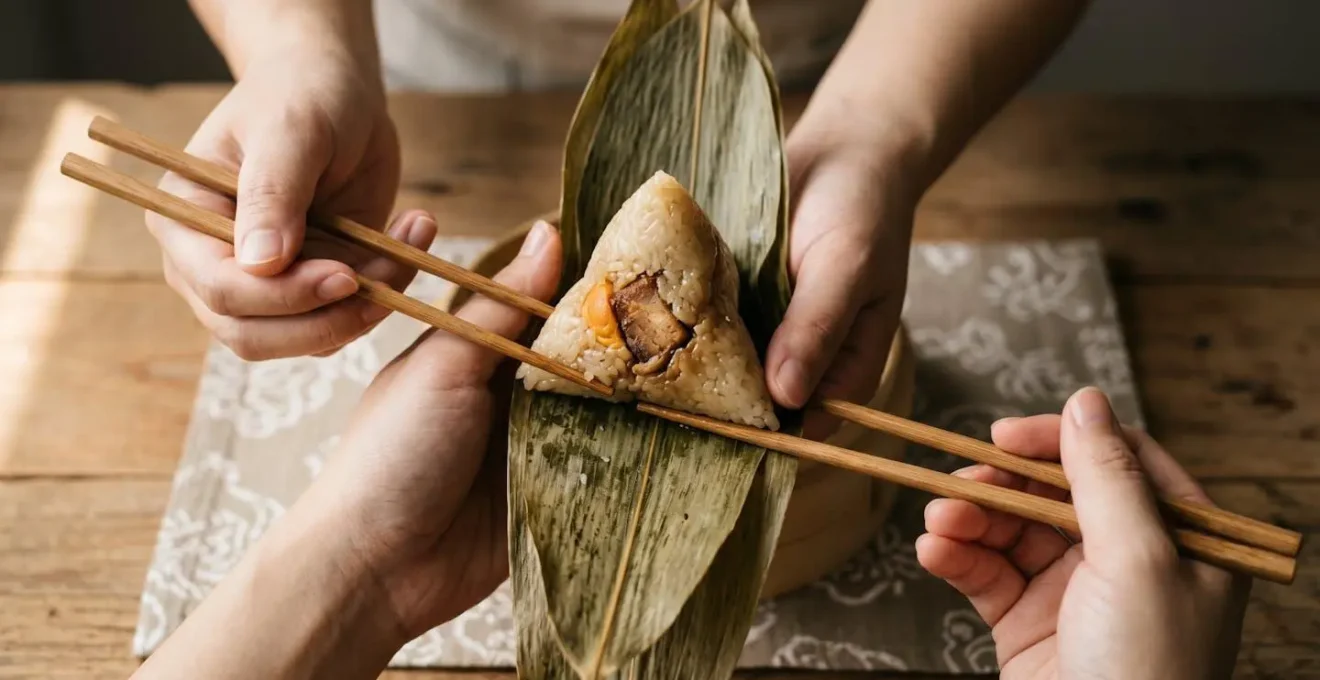
This clean unwrapping technique is a small but satisfying skill. It’s a final demonstration of your mastery over the festival’s challenges, allowing you to enjoy this delicious tradition with poise and without a sticky mess. It’s the perfect, flavourful end to a day of strategic partying.
So, is it a sport event or a beach party? The answer is clear: it’s a glorious, chaotic, and unforgettable beach party that happens to have some boat races. It’s a test of endurance, logistics, and spirit. Now that you have the organizer’s playbook, all that’s left is to dive in, embrace the pandemonium, and have one of the most memorable days Hong Kong has to offer.