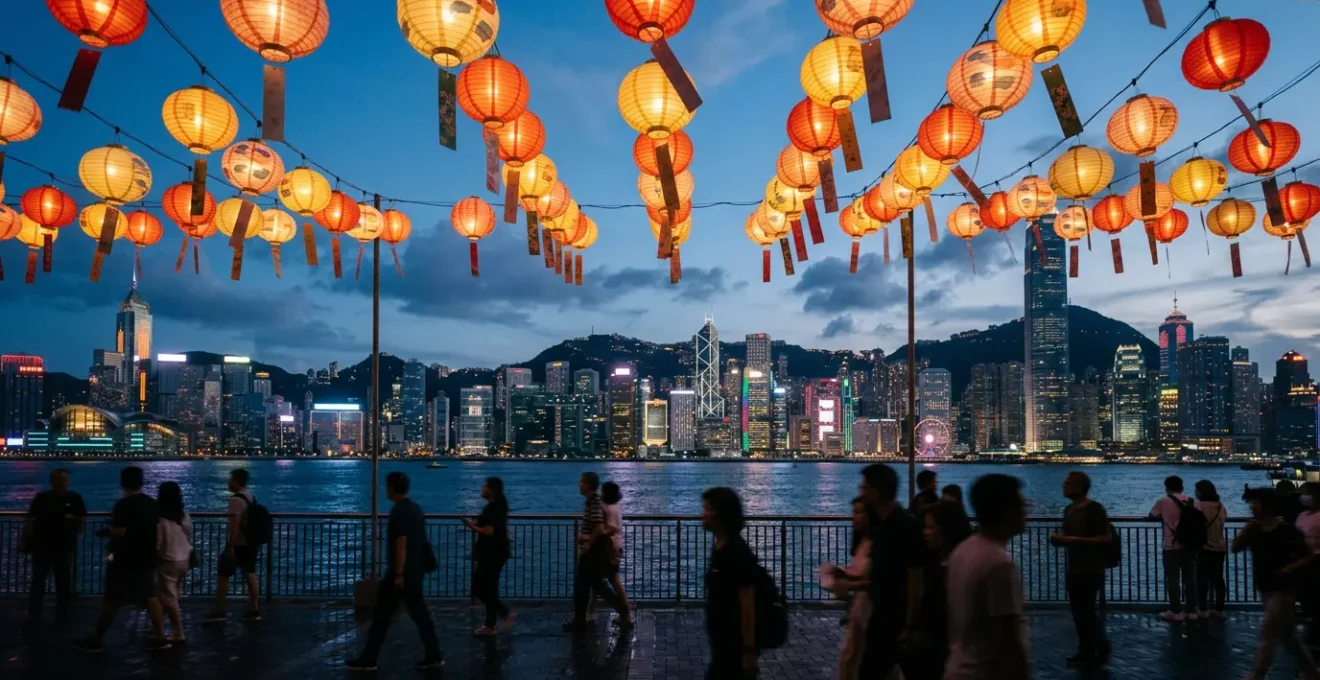
The most captivating Mid-Autumn photos aren’t taken in the biggest crowds, but through strategic light choreography.
- The Tsim Sha Tsui promenade offers superior crowd flow and longer display times compared to the chaotic main carnival at Victoria Park.
- Creating a « photo walk » that connects Soho’s modern street art with Man Mo Temple’s traditional lanterns builds a powerful visual narrative.
Recommendation: Architect your own festival of lights photo tour by understanding the unique scenography of each location before you ever press the shutter button.
The Mid-Autumn Festival arrives, and Hong Kong transforms into a city of light. Your social media feed quickly fills with glowing lanterns, but a familiar image dominates: the dense, chaotic, yet beautiful crush of humanity at Victoria Park. The common advice is to brave the crowds, bring a good camera, and hope for the best. But this approach often leads to frustration and photos that look like everyone else’s.
As an urban lighting scenographer, I see the festival not as a single, overwhelming event, but as a city-wide lighting installation with multiple stages, each with its own character, rhythm, and narrative. The secret to truly stunning, unique photographs isn’t a more expensive lens; it’s a better plan. It’s about shifting your perspective from being a passive spectator to an active choreographer of your own visual experience.
But what if the key to unlocking the festival’s photographic potential wasn’t about enduring the crowds, but about strategically avoiding them? What if understanding the flow of people, the quality of light, and the story behind the displays could yield far more compelling results?
This guide treats Hong Kong as an urban theatre. We will move beyond the obvious and analyze the unique scenography of different locations. We’ll deconstruct the technical settings required to capture ephemeral light, explore sustainable choices that align with a modern creator’s ethos, and design a visual journey that tells a story. Prepare to architect a photo tour that is intentionally, beautifully, and uniquely yours.
This article provides a complete framework for photographers and visual storytellers to navigate the festival. From decoding cultural games to mastering technical settings and discovering unique routes, the following sections will equip you to capture the magic of the Mid-Autumn Festival like a pro.
Summary: An Expert’s Blueprint for Capturing Hong Kong’s Mid-Autumn Lights
- How to Participate in the Lantern Riddle Games if You Don’t Read Chinese?
- Plastic or Paper: Which Lantern Should You Buy for Your Kids?
- What Happens to All the Glow Sticks After the Festival?
- Is the Tsim Sha Tsui Lantern Display Less Crowded Than Victoria Park?
- What ISO Setting Is Best for Handheld Lantern Photos?
- When to Set Up Your Tripod to Catch the Symphony of Lights Perfectly?
- Where to Find the Famous « HK Walls » Murals in Soho?
- Snowy Skin vs Traditional Lotus: Which Mooncake Should You Try?
How to Participate in the Lantern Riddle Games if You Don’t Read Chinese?
The clusters of lanterns adorned with paper strips are more than just decoration; they are a central part of the festival’s interactive scenography. These are the famous lantern riddles (燈謎), a battle of wits that brings families and friends together. For a non-Chinese speaker, this beautiful tradition can feel like an insurmountable language barrier. However, the goal isn’t necessarily to solve the riddle but to participate in the communal experience.
Think of it as a design challenge: how do you engage with an experience when you don’t have the primary tool? You focus on other cues. You observe the patterns of interaction, the joy of a correct guess, and the collaborative spirit. Many riddles also rely on visual puns or characters whose shapes hint at the answer, offering a slim but exciting chance for a non-speaker to decipher the clue. Your camera can become your tool for engagement, capturing the expressions of concentration and delight. Approaching the experience with curiosity rather than a need to « win » transforms it from a frustrating puzzle into a rich cultural observation.
Engaging with this tradition is possible even without language fluency. It requires a shift in perspective, leveraging technology and human connection to bridge the gap. The following plan provides a practical method for immersing yourself in this unique aspect of the festival.
Your Action Plan: Engaging with Lantern Riddles Without Chinese
- Pre-Festival Prep: Download Google Translate or Google Lens on your smartphone. The real-time camera translation can help you grasp keywords and the structure of the riddles.
- Social Approach: Politely approach local families or groups gathered around a riddle. A simple smile and gesture towards your phone can often lead to them helping you translate or explaining the answer.
- Visual Hunting: Actively look for riddles that incorporate obvious visual puns, drawings, or shape-based clues, as these are the most likely to transcend language barriers.
- Seek Official Help: At major carnivals like Victoria Park or Tsim Sha Tsui, find an information booth. Staff may be able to provide English explanations for a few selected, famous riddles.
- Focus on the Atmosphere: Shift your primary goal from solving to observing. Participate by watching, learning the patterns of the game, and celebrating the successes of those around you. This is the heart of the experience.
Plastic or Paper: Which Lantern Should You Buy for Your Kids?
The choice of a lantern for a child is a decision about luminous texture and narrative. A traditional paper lantern, lit from within by a real candle, produces a soft, warm, and living glow. It carries the weight of cultural heritage, connecting your child to generations past. Its fragility teaches a lesson in care and mindfulness. This is the authentic, historical light of the festival. In contrast, a modern plastic LED lantern offers a different story. It emits a sharp, vibrant, and consistent light, often in the shape of a beloved cartoon character. It’s a tale of modernity, safety, and durability.
As a lighting designer, I see beauty in both. The paper lantern offers an organic, flickering light that is challenging and rewarding to photograph. The plastic lantern provides a bold, reliable point of colour that can be used creatively in low-light portraits. The decision isn’t just about aesthetics; it involves practical considerations of safety, environmental impact, and the educational opportunity each type presents. For parents, weighing these factors is key to choosing the right prop for your family’s festival experience.
To make an informed decision, it’s essential to compare the two options directly. The following table breaks down the key criteria, from fire safety to cultural value, providing a clear overview to guide your purchase.
| Criteria | Traditional Paper Lanterns | Modern Plastic LED Lanterns |
|---|---|---|
| Fire Safety | Requires real candles – higher fire risk, requires constant supervision | LED lights – no fire hazard, child-safe |
| Environmental Impact | Biodegradable, natural materials, minimal long-term waste | Non-biodegradable plastic, battery waste requires proper disposal |
| Cultural Heritage Value | Authentic traditional experience, teaches cultural craftsmanship | Modern interpretation, often features popular cartoon characters |
| Durability | Fragile, typically single-use or short lifespan | Reusable for multiple years, weather-resistant |
| Educational Opportunity | Lesson in traditional arts, cultural significance, and responsible fire handling | Introduction to modern technology, LED science, and sustainability discussions |
What Happens to All the Glow Sticks After the Festival?
As a night of celebration concludes, a trail of ephemeral light is left behind. Glow sticks, with their captivating chemical luminescence, are a festival favourite. However, from a design and sustainability perspective, they represent a significant challenge. Their single-use nature creates a massive waste problem. The light they produce is fleeting, but their plastic casing and chemical contents persist in the environment for centuries. An incredible over 1 billion glow sticks are manufactured annually, which translates to millions of litres of hazardous chemicals potentially entering our ecosystems.
This reality forces us, as conscious creators and festival-goers, to think about « responsible scenography. » How can we achieve that magical, personal glow without the environmental cost? The answer lies in shifting towards reusable lighting technologies. Modern alternatives offer the same, if not better, visual impact with a fraction of the waste. Rechargeable LED bracelets, battery-operated mini lanterns, and even photoluminescent materials provide a sustainable way to become part of the festival’s tapestry of light.
Embracing these alternatives isn’t just an environmental choice; it’s a design choice. It’s about opting for a higher quality, more durable, and ultimately more creative lighting tool for your photographic compositions.

The image above showcases the tactile beauty and vibrant glow of a reusable LED light, a superior alternative to disposable options. To make the switch, consider these practical and eco-friendly choices for your next festival outing:
- Rechargeable LED bracelets and necklaces that can be used for multiple events.
- Battery-operated mini lanterns (ensure you use rechargeable batteries and dispose of them correctly).
- Photoluminescent glow sticks that use strontium aluminate crystals and recharge with any light source.
- Small LED flashlights, perhaps with coloured filters, for a controlled and reusable glow effect.
- High-quality reusable LED sticks with long-lasting, replaceable batteries.
Is the Tsim Sha Tsui Lantern Display Less Crowded Than Victoria Park?
For any photographer, crowd control is a key element of composition. The biggest mistake many make during the Mid-Autumn Festival is assuming the largest event, the Victoria Park Lantern Carnival, is the *only* event. While impressive, its enclosed layout and short duration create a bottleneck, resulting in dense crowds that make thoughtful photography nearly impossible. This is where understanding crowd dynamics becomes a strategic advantage.
The lantern display along the Tsim Sha Tsui (TST) Cultural Centre Piazza offers a dramatically different scenography. Its open-promenade layout allows for much better crowd flow, and crucially, the display is typically up for an entire month, not just a single week. This extended duration dilutes the crowds significantly. By visiting on a weekday, or even during peak dinner hours, you can find yourself with ample space and time to interact with the lanterns, experiment with compositions, and set up shots without being jostled.
This is a textbook example of how choosing a secondary location can yield primary results. By trading the « main event » frenzy for the calmer, more accessible TST display, you gain creative control. This strategic decision is often the single biggest factor in elevating your festival photography from simple snapshots to deliberate, well-composed images.
Case Study: A Photographer’s Analysis of Crowd Flow
A multi-year observation by local photographers reveals a clear strategic advantage for the Tsim Sha Tsui display. The month-long installation at the TST Cultural Centre Piazza experiences significantly lower crowds, especially during dinner hours (6:30-7:30 PM) and even during the popular Symphony of Lights show at 8:00 PM. The open promenade allows for better crowd dispersal compared to Victoria Park’s confined soccer pitch setup. This provides photographers with nearly an hour of uninterrupted opportunities for detailed close-ups and wide shots. Furthermore, TST’s accessibility via the Star Ferry and MTR, combined with its flat, open terrain, makes it far easier to navigate with gear, strollers, or for those with mobility challenges.
What ISO Setting Is Best for Handheld Lantern Photos?
Capturing the delicate glow of lanterns without a tripod is a technical dance with light. The goal is to let in enough ambient light to create atmosphere without introducing motion blur from an unsteady hand or excessive noise from a high ISO. This is the heart of the exposure triangle: the interplay between ISO, aperture, and shutter speed. For handheld night photography, your camera’s ISO setting is your most powerful tool for gathering light.
Modern digital cameras handle high ISO settings remarkably well. Don’t be afraid to push it to the ISO 800-3200 range as a starting point. This allows you to use a faster shutter speed (ideally 1/60s or higher) to freeze motion and prevent blur. The second part of the equation is your aperture. Use the widest aperture your lens allows (e.g., f/1.8 or f/2.8) to maximize light intake. This not only helps keep your ISO lower but also creates a beautiful shallow depth of field, isolating your subject and turning background lanterns into soft, dreamy orbs of light known as bokeh.
While technical guidelines are essential, photography is also about feel. As professional photographer Joseph Mak advises on his approach to night festivals:
I tend to set my camera’s shutter speed to 1/40 seconds with a f-stop value of f/2.8 and an ISO of 5000, which has produced great night shots.
– Joseph Mak, Canon Asia Snapshot
This demonstrates a willingness to push the ISO even higher to achieve the desired result. Your ‘best’ setting is a combination of these technical starting points and your own creative adjustments on the scene. To get started, consider this framework:
- ISO: Start in the 800-3200 range. Modern cameras produce clean images here.
- Aperture: Use a wide aperture (f/1.8 to f/2.8) to let in maximum light and create bokeh.
- Shutter Speed: Aim for a minimum of 1/40s to 1/60s to avoid handheld camera shake. If your subject is moving, you’ll need to go faster (1/125s).
- Stabilization: Brace yourself against a wall or railing. Exhale slowly, hold your breath, and gently press the shutter. Use burst mode to take several shots and pick the sharpest one.
When to Set Up Your Tripod to Catch the Symphony of Lights Perfectly?
The « A Symphony of Lights » show is Hong Kong’s nightly spectacle, a piece of city-scale light choreography that transforms the skyline into a dazzling stage. Capturing it effectively isn’t about having the best camera; it’s about preparation and positioning. This is the grand finale of your photographic journey, and securing the best seat in the house requires strategic timing.
The show itself is a predictable constant. According to travel photography guides, the Symphony of Lights runs at 8:00 PM nightly, but the prime, unobstructed spots along the Tsim Sha Tsui promenade are claimed long before. From a scenographer’s perspective, this is about claiming your vantage point. To get a front-row spot for your tripod, free from passing crowds and selfie sticks, you must arrive a full hour early, by 7:00 PM at the latest. This gives you time to set up your tripod, compose your shot, and fine-tune your settings during the « blue hour, » when the fading daylight provides a rich, deep blue backdrop for the city’s emerging lights.
This hour of preparation is not wasted time; it is the most crucial part of the shoot. It allows you to transform a chaotic public space into your private studio, ensuring that when the show begins, you are not scrambling for a position but are ready to capture the performance.
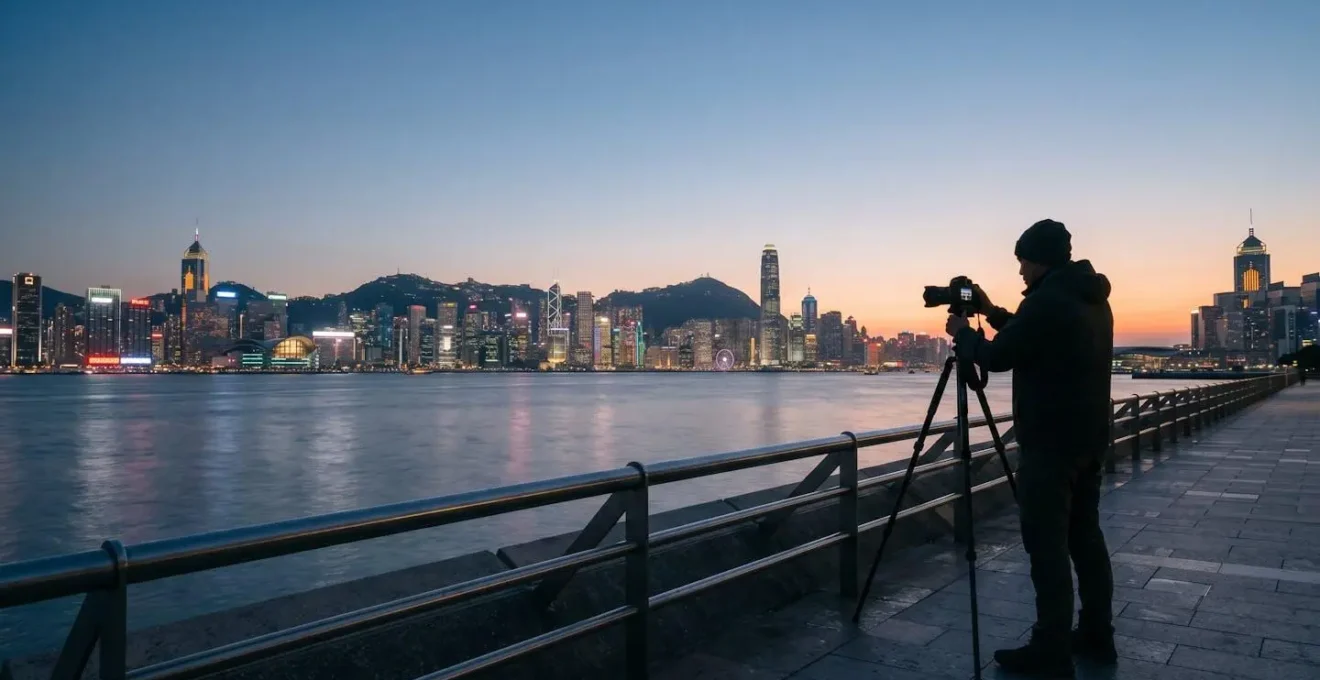
The quiet moments of preparation before the spectacle are as important as the show itself. This dedicated time allows for methodical setup and a calm approach, ensuring you are ready to create a stunning long-exposure photograph that captures the full dynamism and colour of the city’s nightly performance.
Where to Find the Famous « HK Walls » Murals in Soho?
The most compelling photo essays tell a story of contrast and connection. While the Mid-Autumn Festival is steeped in tradition, Hong Kong is a city that thrives on the juxtaposition of old and new. A truly masterful visual narrative of the festival can be created by weaving the modern, vibrant street art of Soho with the timeless glow of traditional lanterns.
This is what I call « light choreography » on a city scale—planning a route that takes you through different types of light and art. The famous murals from the HK Walls street art festival are scattered throughout Central and Sheung Wan, with a high concentration in the Soho district, particularly around Graham Street and Hollywood Road. These dynamic, colourful works provide a stark, contemporary contrast to the delicate, warm light of traditional lanterns.
By designing a photo walk that starts in the late afternoon in Soho, you can capture these murals in the clear, natural light of day. As dusk settles, you then make a short journey to a nearby traditional space, like the historic Man Mo Temple, where the lanterns are beginning to cast their gentle, spiritual glow. This deliberate sequencing creates a powerful story in your photographs: a journey from the raw, expressive energy of the street to the quiet, reverent atmosphere of the temple, all within a few city blocks.
Blueprint for an Art & Lanterns Photo Walk
Create a unique Mid-Autumn photo route by starting at Graham Street in Soho around 4-5 PM to photograph the iconic HK Walls murals in golden hour light. From there, it’s a 10-minute walk to Man Mo Temple on Hollywood Road, where you can capture the traditional lanterns illuminating the historic temple courtyard as twilight begins. The route can then continue to Fuk Wing Street (known as ‘Toy Street’), where the kaleidoscopic displays of lanterns for sale offer a vibrant, commercial counterpoint. This 2-hour circuit masterfully combines contemporary urban art with authentic cultural traditions, offering a diverse and story-rich set of photographic opportunities. Executing this walk a week before the main festival date often means fresher displays and more manageable crowds.
Key takeaways
- Strategic Location: Tsim Sha Tsui offers a less crowded, longer-running alternative to Victoria Park for superior photo opportunities and creative control.
- Technical Mastery: A wide aperture (f/1.8-f/2.8) and an ISO of 800-3200 is the essential starting point for capturing sharp, atmospheric handheld lantern photos.
- Narrative Photography: Combine different visual elements, like Soho’s modern street art and Man Mo Temple’s traditional lanterns, to architect a unique photo story that goes beyond simple festival snapshots.
Snowy Skin vs Traditional Lotus: Which Mooncake Should You Try?
The final layer of the festival’s scenography is taste and texture. The mooncake, a dense pastry symbolizing family reunion and the full moon, is as integral to the festival as the lanterns themselves. The choice of mooncake, much like the choice of lantern, is a decision between tradition and modernity. It’s a sensory experience that completes your cultural immersion and offers yet another photographic subject, often beautifully packaged and intricately designed.
The traditional baked mooncake is a heavyweight of culture and calories. Its golden-brown, chewy pastry crust envelops a rich, dense filling of lotus seed or red bean paste, often hiding a salted egg yolk that represents the moon. It’s best enjoyed in small wedges, paired with a strong Pu-erh tea to cut through its richness. Its visual appeal is in its classic, ornate patterns and deep, warm tones.
In contrast, the snow skin mooncake is a modern Hong Kong innovation. It is a no-bake creation with a soft, chewy, mochi-like skin made from glutinous rice. Served chilled, its fillings are lighter and more varied—from fruit and custard to chocolate and matcha. Visually, they are vibrant and colourful, offering a completely different aesthetic. A single traditional mooncake can contain a startling number of calories; for instance, a lotus paste mooncake can have around 716 calories, while snow skin versions are typically much lighter. This table breaks down the essential differences.
| Aspect | Traditional Lotus Seed Paste Mooncake | Snow Skin Mooncake |
|---|---|---|
| Calories (per piece) | ~716 calories (with salted egg yolk: ~790) | ~350 calories (standard size) |
| Texture & Temperature | Dense, rich, baked pastry crust; served at room temperature | Soft, chewy, mochi-like skin; served chilled or cold |
| Cultural Heritage | Traditional Cantonese style dating back centuries; golden-brown appearance symbolizes harvest moon | Modern Hong Kong innovation (1960s-1980s); white/colorful appearance inspired by snow |
| Common Fillings | Lotus seed paste, red bean paste, mixed nuts, salted egg yolk | Custard, fruit flavors, matcha, chocolate, ice cream variations |
| Preparation Method | Baked at high temperature with golden syrup glaze | No-bake, steamed or microwaved glutinous rice flour skin |
| Recommended Tea Pairing | Bold Pu-erh tea or aged oolong to cut through richness | Delicate green tea or jasmine tea to complement lighter flavors |
With this blueprint, you are no longer just a tourist taking pictures. You are a lighting designer, a storyteller, and a choreographer of your own visual journey. Now, go and architect your personal festival of light.